4,068 posters, 219 videos, 101 topics, 69 sessions, 14,365 authors, 6,128 institutions
ePostersLive by SciGen Technologies S.A. All rights reserved.
Alzheimer's Association International Conference 2026
July 12-15, 2026 | London, United Kingdom, and Online

5613
Longitudinal Analysis Of Gray-white Matter Contrast In Healthy Adults: A Uk Biobank Study
Poster Presenter
Part of Topic
Abstract:
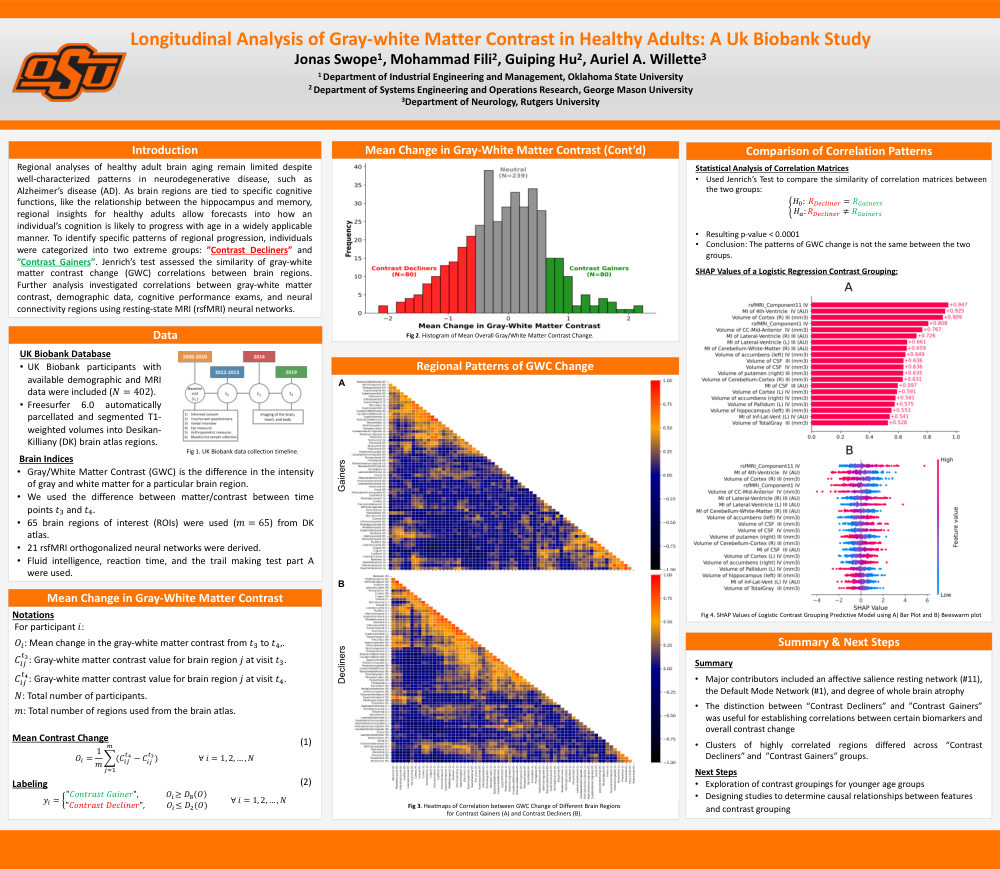
Background: It is important to determine neurological biomarkers that signify whether a participant is prone to age-related cognitive decline or exhibits resilience. Grey-white matter contrast (GWC) is a surface-based MRI measure derived from T1-weighted images. It quantifies a ratio of relative signal intensity between cortical grey matter and white matter. We grouped participants by their GWC trend, and examined patterns of GWC change over time in key brain regions. We then explored factors related to these groups.
Methods: 399 UK Biobank participants (55+ years old at baseline) had longitudinal GWC derived from Desikan-Killany Freesurfer brain regions. Using structural Magnetic Resonance Imaging (sMRI), there were 65 Regions of Interest (ROIs) and 31 left-right hemisphere pairs. We also used 21 resting-state functional Magnetic Resonance Imaging (rsfMRI) components. For downstream analysis, demographic data and longitudinal cognitive performance scores were used. Participants were grouped by mean GWC change, with those in the bottom and top 20% being labeled “Decliners” and “Gainers” respectively. For each group, we computed Pearson correlation matrices of regional GWC change. Jennrich’s test assessed differences in correlation structures. A logistic regression model was trained to predict GWC classes. Shapley Additive exPlanations (SHAP) values estimated feature contributions.
Results: Based on Jennrich’s test, correlation structures significantly differed between Decliners vs. Gainers (p < 0.0001). Heatmaps indicate that regional GWC correlation values tended to be positive and larger for Improvers versus more local weaker clusters for Decliners. The logistic prediction model reasonably differentiated cognitive Improvers from Decliners despite no participants being cognitively impaired (AUC=0.72). For loaded features, the Motor Execution Network had the strongest estimated contribution.
Conclusion: Our results suggest that there is significant difference between correlation patterns of GWC Gainers vs. Decliners. We also highlighted key factors associated with said difference. These findings may help identify biomarkers associated with early diagnosis of cognitive decline.
Comments
Email is required but is not shown publicly.
Loading comments...