4,068 posters, 219 videos, 101 topics, 69 sessions, 14,365 authors, 6,128 institutions
ePostersLive by SciGen Technologies S.A. All rights reserved.
Alzheimer's Association International Conference 2026
July 12-15, 2026 | London, United Kingdom, and Online

2168
Development Of An Interactive Tool To Personalize The Prescription Of 24-hr Time Use For Optimal Cognitive Health
Part of Topic
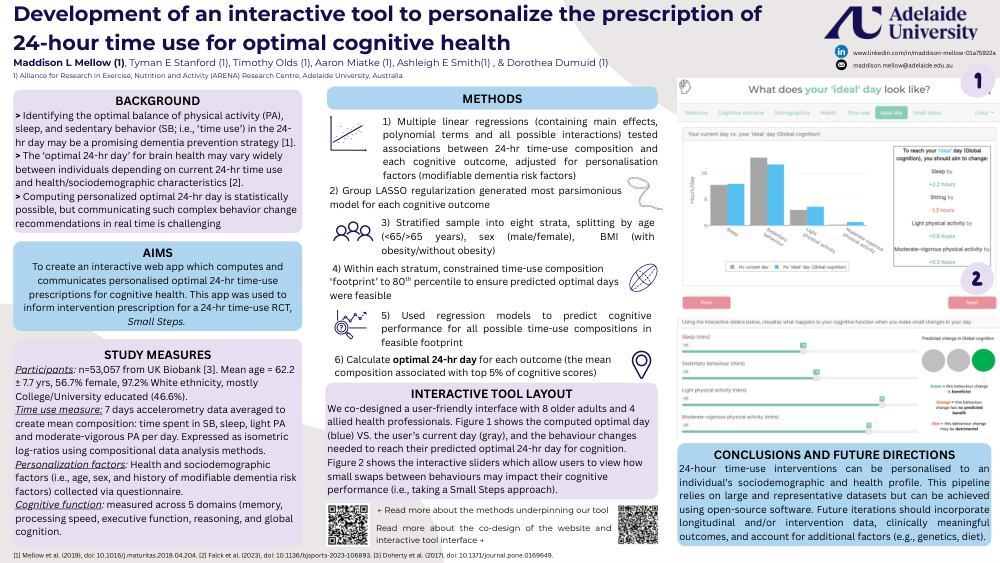
Development of an interactive tool to personalize the prescription of 24-hour time use for optimal cognitive health. BACKGROUND: Identifying the optimal balance of physical activity (PA), sleep, and sedentary behavior (SB; i.e., ‘time use’) in the 24- hr day may be a promising dementia prevention strategy. The ‘optimal 24-hr day’ for brain health may vary widely between individuals depending on current 24-hr time use and health/sociodemographic characteristics. Computing personalized optimal 24-hr day is statistically possible, but communicating such complex behavior change recommendations in real time is challenging. AIMS: To create an interactive web app which computes and communicates personalised optimal 24-hr time-use prescriptions for cognitive health. This app was used to inform intervention prescription for a 24-hr time-use RCT, Small Steps. STUDY MEASURES: Participants: n=53,057 from UK Biobank [3]. Mean age = 62.2 ± 7.7 yrs, 56.7% female, 97.2% White ethnicity, mostly College/University educated (46.6%). Time use measure: 7 days accelerometry data averaged to create mean composition: time spent in SB, sleep, light PA and moderate-vigorous PA per day. Expressed as isometric log-ratios using compositional data analysis methods. Personalization factors: Health and sociodemographic factors (i.e., age, sex, and history of modifiable dementia risk factors) collected via questionnaire. Cognitive function: measured across 5 domains (memory, processing speed, executive function, reasoning, and global cognition. METHODS: 1) Multiple linear regressions (containing main effects, polynomial terms and all possible interactions) tested associations between 24-hr time-use composition and each cognitive outcome, adjusted for personalisation factors (modifiable dementia risk factors). 2) Group LASSO regularization generated most parsimonious model for each cognitive outcome. 3) Stratified sample into eight strata, splitting by age (<65/>65 years), sex (male/female), BMI (with obesity/without obesity). 4) Within each stratum, constrained time-use composition ‘footprint’ to 80 percentile to ensure predicted optimal days were feasible. 5) Used regression models to predict cognitive performance for all possible time-use compositions in feasible footprint. 6) Calculate optimal 24-hr day for each outcome (the mean composition associated with top 5% of cognitive scores). INTERACTIVE TOOL LAYOUT: We co-designed a user-friendly interface with 8 older adults and 4 allied health professionals. Figure 1 shows the computed optimal day (blue) VS. the user’s current day (gray), and the behaviour changes needed to reach their predicted optimal 24-hr day for cognition. Figure 2 shows the interactive sliders which allow users to view how small swaps between behaviours may impact their cognitive performance (i.e., taking a Small Steps approach). CONCLUSIONS: 24-hour time-use interventions can be personalised to an individual’s sociodemographic and health profile. This pipeline relies on large and representative datasets but can be achieved using open-source software. Future iterations should incorporate longitudinal and/or intervention data, clinically meaningful outcomes, and account for additional factors (e.g., genetics, diet).
Comments
Email is required but is not shown publicly.
Loading comments...