4,068 posters, 219 videos, 101 topics, 69 sessions, 14,365 authors, 6,128 institutions
ePostersLive by SciGen Technologies S.A. All rights reserved.
Alzheimer's Association International Conference 2026
July 12-15, 2026 | London, United Kingdom, and Online

4441
Population-based Mapping Decodes Dynamic Spatiotemporal EEG Microstates Across The Alzheimer’S Disease Continuum In Older Adults
Part of Topic
Population-based Mapping Decodes Dynamic Spatiotemporal EEG Microstates Across The Alzheimer’S Disease Continuum In Older Adults
Background: Resting-state electroencephalogram (EEG) microstates capture millisecond-scale brain network dynamics, offering a potentially promising tool for early detection of Alzheimer's disease (AD). However, the evolutionary patterns of microstates in cognitive phenotypes across the AD continuum have yet to be characterized in the general older population.
Methods: This population-based study included 2059 participants in the MIND-China EEG Substudy that were examined in 2023-2024,. We recorded awake closed-eye 3 minutes EEG (19-channel) and selected the last minute for microstate analysis. We used K-means topology clustering to identify six microstate types (A-F) and quantified their temporal dynamics parameters (i.e., duration, occurrence, contribution, and transitions). We defined distinct cognitive states—mild cognitive impairment (MCI) and AD, evaluated function of multidimensional cognitive domains, and measured AD-related plasma biomarkers. Multivariable linear and logistic regression models were used to examine the associations of EEG microstate parameters with cognitive outcomes. We used receiver operating characteristic curves to assess the capacity of microstate measures in differentiating between cognitive states.
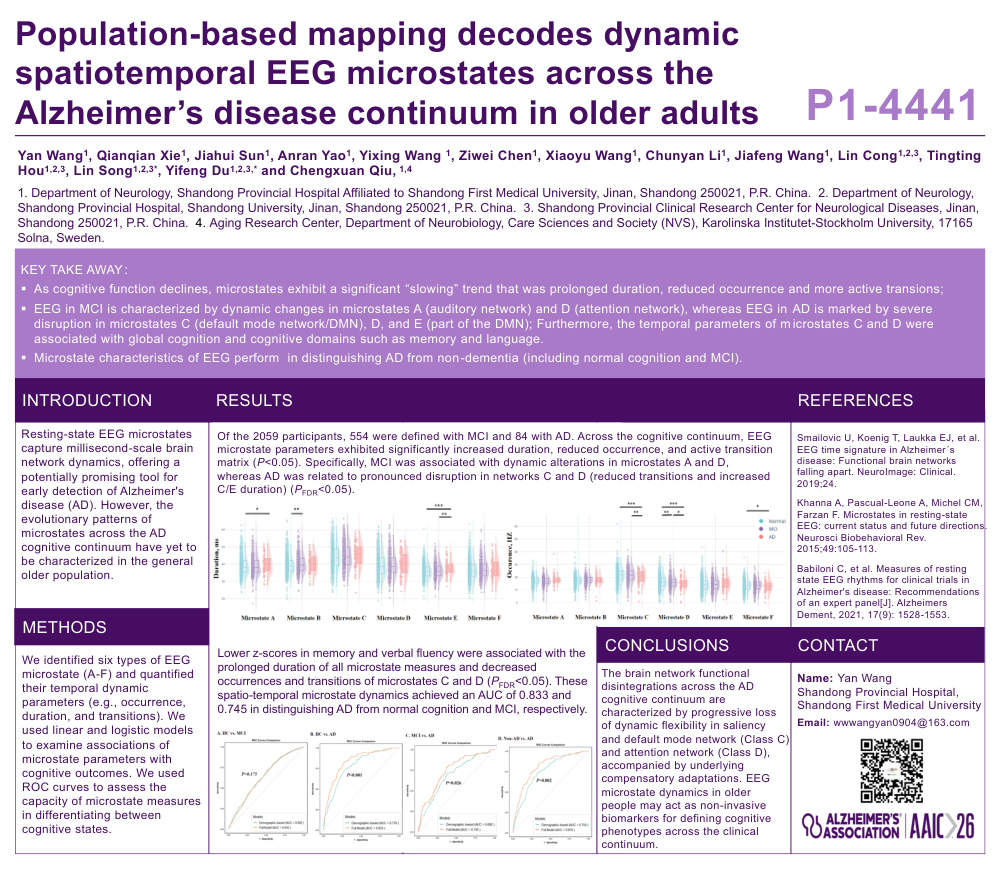
Results: Of the 2059 participants, 554 were defined with MCI and 84 with AD. Across the cognitive continuum, EEG microstate parameters exhibited significantly increased duration, reduced occurrence, enhanced contribution, and active transition matrix (P<0.05). Specifically, MCI was associated with dynamic alterations in microstates A and D, whereas AD was related to pronounced disruption in networks C and D (reduced transitions and increased C/E duration) (PFDR<0.05). Furthermore, lower z-scores in cognitive domains such as memory and verbal fluency were associated with the prolonged duration of all microstate measures and decreased occurrences and transitions of microstates C and D (PFDR<0.05). These spatio-temporal microstate dynamics achieved an area under the curve of 0.833 and 0.745 in distinguishing AD from normal cognition and MCI, respectively. Moreover, microstate F-class dynamics were significantly correlated with increased plasma p-tau217 (PFDR<0.05).
Conclusions: The brain network functional disintegrations across the AD continuum are characterized by progressive loss of dynamic flexibility in the saliency and default mode network (Microstate C) and attention network (Microstate D), accompanied by underlying compensatory adaptations. EEG microstate dynamics in older people may act as non-invasive biomarkers for defining cognitive phenotypes across the clinical continuum.
Contact Information:
Yan Wang
Department of Neurology, Shandong Provincial Hospital, Shandong First Medical University
Email: wwwangyan0904@163.com
Suggested Keywords:resting-state electroencephalogram, microstates, cognition, saliency and default mode network, attention network, population-based study
Comments
Email is required but is not shown publicly.
Loading comments...