4,068 posters, 219 videos, 101 topics, 69 sessions, 14,365 authors, 6,128 institutions
ePostersLive by SciGen Technologies S.A. All rights reserved.
Alzheimer's Association International Conference 2026
July 12-15, 2026 | London, United Kingdom, and Online

6294
Resting-state EEG Connectivity Reveals Differential Network Disruption In Alzheimer’S And Frontotemporal Dementia
Poster Presenter
Authors
Part of Topic
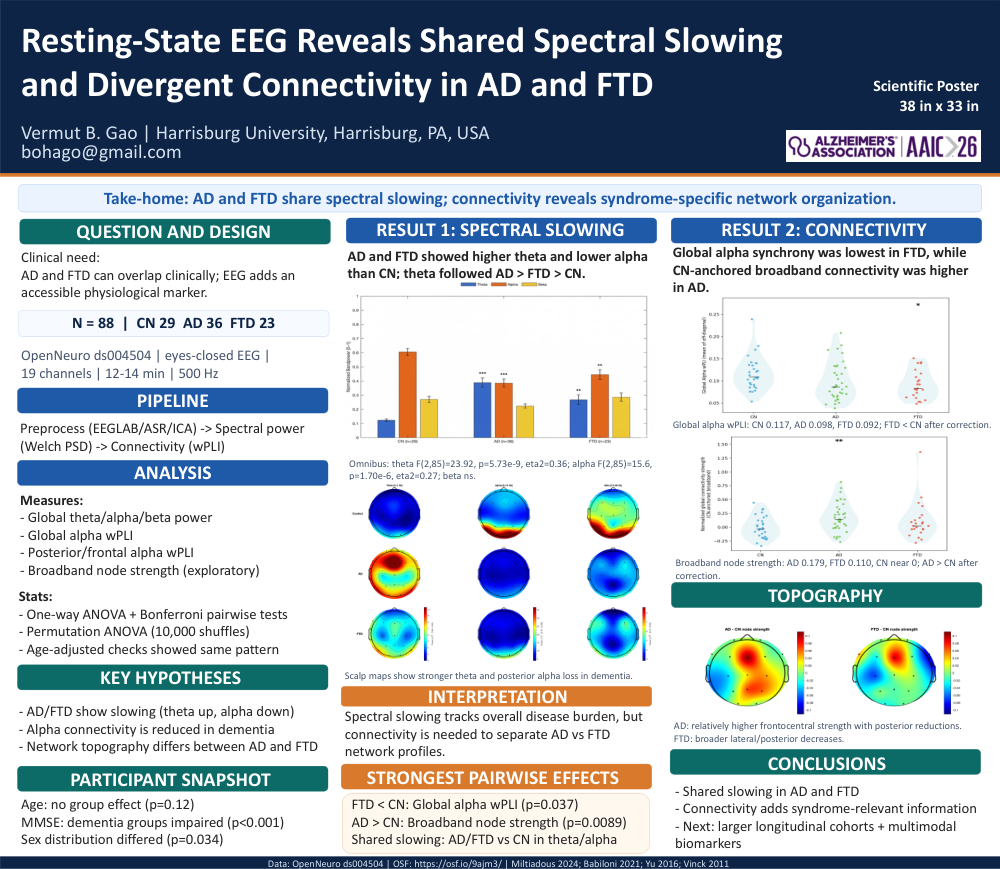
Background: Resting-state EEG spectral slowing is a well-established marker of neurodegeneration, but it may provide limited specificity for distinguishing dementia subtypes. Alzheimer’s disease (AD) and frontotemporal dementia (FTD) are associated with different patterns of network-level brain dysfunction, suggesting that connectivity-based EEG measures may capture subtype-relevant alterations beyond spectral power alone.
Methods: Resting-state eyes-closed EEG data from the public OpenNeuro ds004504 dataset were analyzed in 88 participants (CN = 29, AD = 36, FTD = 23) using 19-channel EEG recordings. After preprocessing, spectral power was estimated using Welch power spectral density measures, and functional connectivity was computed using weighted phase-lag index (wPLI). Analyses focused on global theta, alpha, and beta power; global alpha wPLI; posterior and frontal alpha wPLI; and exploratory broadband node strength. Group effects were tested using one-way ANOVA with Bonferroni-corrected pairwise tests and permutation ANOVA.
Results: AD and FTD showed shared EEG slowing relative to cognitively normal controls, with increased theta power and reduced alpha power. Theta power followed the pattern AD > FTD > CN, while beta power did not show a significant group effect. Connectivity measures showed additional syndrome-relevant patterns. Global alpha wPLI was lowest in FTD, with FTD showing lower global alpha connectivity than CN. Broadband node strength was higher in AD compared with CN. Topographic results suggested relatively higher frontocentral strength with posterior reductions in AD and broader lateral/posterior decreases in FTD.
Conclusion: Spectral slowing robustly characterizes dementia-related EEG changes, but connectivity measures provide complementary information about subtype-relevant network organization. AD and FTD share broad slowing, while alpha synchrony and broadband connectivity highlight divergent network profiles. These findings support EEG connectivity as a scalable framework for physiological characterization of dementia subtypes, while emphasizing that no single EEG feature is diagnostic.
Keywords: resting-state EEG; Alzheimer’s disease; frontotemporal dementia; spectral slowing; alpha power; theta power; wPLI; functional connectivity; dementia biomarkers.
Comments
Email is required but is not shown publicly.
Loading comments...