4,068 posters, 219 videos, 101 topics, 69 sessions, 14,365 authors, 6,128 institutions
ePostersLive by SciGen Technologies S.A. All rights reserved.
Alzheimer's Association International Conference 2026
July 12-15, 2026 | London, United Kingdom, and Online

8663
Higher Variability In Daily Rest-activity Rhythm Amplitude Is Linked To Lower Alzheimer’S Dementia Risk
Poster Presenter
Authors
Part of Topic
Higher Variability In Daily Rest-Activity Rhythm Amplitude
Is Linked To Lower Alzheimer’s Dementia Risk
Sebastian Moguilner1, Hui-Wen Yang2, Shahab Haghayegh1, Frank AJL Scheer3,4, Susan Redline3,4, Kun Hu1,4,5 and Peng Li1,4,5
¹Medical Biodynamics Center, Massachusetts General Hospital, Harvard Medical School, Boston, MA
2Department of Biomedical Sciences and Engineering, Tzu Chi University, Hualien, Taiwan
3Division of Sleep and Circadian Disorders, Brigham and Women's Hospital, Boston, MA
4Division of Sleep Medicine, Harvard Medical School, Boston, MA
5Broad Institute, Cambridge, MA
BACKGROUND
RESULTS DISCUSSION
• Circadian rhythms drive optimal biological function
• Circadian disruption is linked to age-related diseases
• Rest-activity rhythms (RAR) are disrupted with aging and in
dementia
• Disrupted RAR are early markers of dementia risk
• Actigraphy provides a non-invasive, real-world circadian
assessment in naturalistic settings
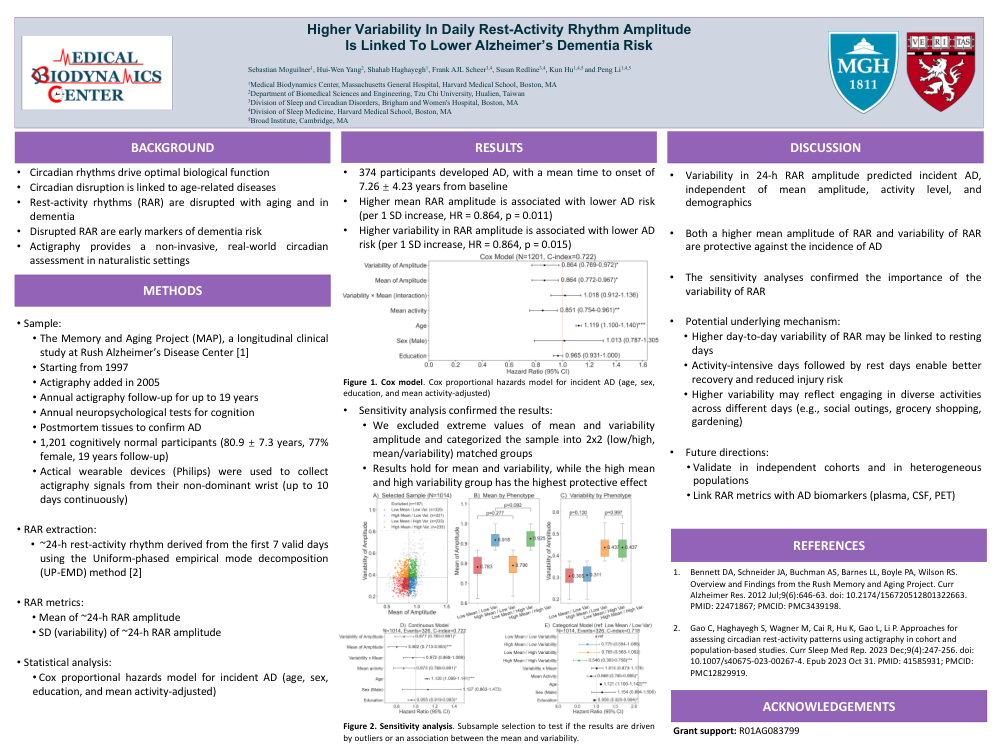
• 374 participants developed AD, with a mean time to onset of
7.26 ± 4.23 years from baseline
• Higher mean RAR amplitude is associated with lower AD risk
(per 1 SD increase, HR = 0.864, p = 0.011)
• Higher variability in RAR amplitude is associated with lower AD
risk (per 1 SD increase, HR = 0.864, p = 0.015)
METHODS
• Sample:
• The Memory and Aging Project (MAP), a longitudinal clinical
study at Rush Alzheimer’s Disease Center [1]
• Starting from 1997
• Actigraphy added in 2005
• Annual actigraphy follow-up for up to 19 years
• Annual neuropsychological tests for cognition
• Postmortem tissues to confirm AD
• 1,201 cognitively normal participants (80.9 ± 7.3 years, 77%
female, 19 years follow-up)
• Actical wearable devices (Philips) were used to collect
actigraphy signals from their non-dominant wrist (up to 10
days continuously)
• RAR extraction:
• ~24-h rest-activity rhythm derived from the first 7 valid days
using the Uniform-phased empirical mode decomposition
(UP-EMD) method [2]
• RAR metrics:
• Mean of ~24-h RAR amplitude
• SD (variability) of ~24-h RAR amplitude
• Statistical analysis:
• Cox proportional hazards model for incident AD (age, sex,
education, and mean activity-adjusted)
Figure 1. Cox model. Cox proportional hazards model for incident AD (age, sex,
education, and mean activity-adjusted)
• Sensitivity analysis confirmed the results:
• We excluded extreme values of mean and variability
amplitude and categorized the sample into 2x2 (low/high,
mean/variability) matched groups
• Results hold for mean and variability, while the high mean
and high variability group has the highest protective effect
• Variability in 24-h RAR amplitude predicted incident AD,
independent of mean amplitude, activity level, and
demographics
• Both a higher mean amplitude of RAR and variability of RAR
are protective against the incidence of AD
• The sensitivity analyses confirmed the importance of the
variability of RAR
• Potential underlying mechanism:
• Higher day-to-day variability of RAR may be linked to resting
days
• Activity-intensive days followed by rest days enable better
recovery and reduced injury risk
• Higher variability may reflect engaging in diverse activities
across different days (e.g., social outings, grocery shopping,
gardening)
• Future directions:
• Validate in independent cohorts and in heterogeneous
populations
• Link RAR metrics with AD biomarkers (plasma, CSF, PET)
REFERENCES
1. 2. Bennett DA, Schneider JA, Buchman AS, Barnes LL, Boyle PA, Wilson RS.
Overview and Findings from the Rush Memory and Aging Project. Curr
Alzheimer Res. 2012 Jul;9(6):646-63. doi: 10.2174/156720512801322663.
PMID: 22471867; PMCID: PMC3439198.
Gao C, Haghayegh S, Wagner M, Cai R, Hu K, Gao L, Li P. Approaches for
assessing circadian rest-activity patterns using actigraphy in cohort and
population-based studies. Curr Sleep Med Rep. 2023 Dec;9(4):247-256. doi:
10.1007/s40675-023-00267-4. Epub 2023 Oct 31. PMID: 41585931; PMCID:
PMC12829919.
ACKNOWLEDGEMENTS
Figure 2. Sensitivity analysis. Subsample selection to test if the results are driven
by outliers or an association between the mean and variability.
Grant support: R01AG083799
Comments
Email is required but is not shown publicly.
Loading comments...