4,068 posters, 219 videos, 101 topics, 69 sessions, 14,365 authors, 6,128 institutions
ePostersLive by SciGen Technologies S.A. All rights reserved.
Alzheimer's Association International Conference 2026
July 12-15, 2026 | London, United Kingdom, and Online

10814
A Unified Framework For Estimating Brain Age And Aging Velocity From MRI Data
Poster Presenter
Authors
Affiliations
Part of Topic
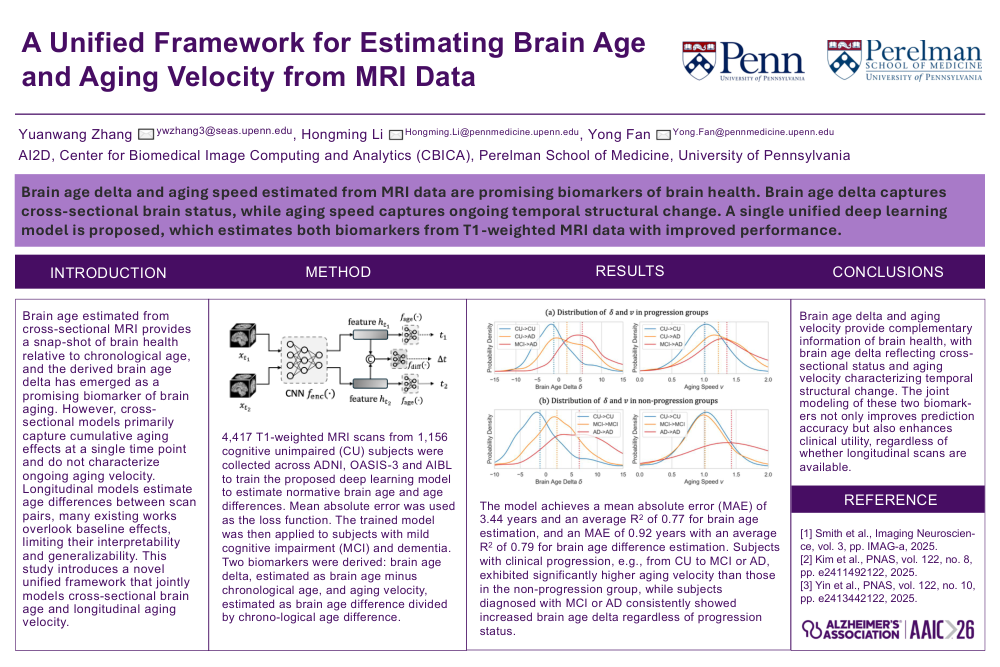
Background: Accurate characterization of brain aging is essential for understanding neurodegenerative risk and variability in cognitive decline. Brain age estimated from cross-sectional MRI provides a snapshot of brain health relative to chronological age, and the derived brain age delta has emerged as a promising biomarker of brain aging. However, cross-sectional models primarily capture cumulative aging effects at a single time point and do not characterize ongoing aging velocity. While longitudinal models estimate age differences between scan pairs, many existing works overlook baseline effects, limiting their interpretability and generalizability. This study introduces a novel unified framework that jointly models cross-sectional brain age and longitudinal aging velocity.
Methods: 4,417 T1-weighted MRI scans from 1,156 cognitive unimpaired (CU) subjects were collected across ADNI, OASIS-3 and AIBL to train the proposed model (Figure 1) to estimate normative brain age and age differences. The trained model was then applied to subjects with mild cognitive impairment (MCI) and dementia. Two biomarkers were derived: brain age delta, estimated brain age minus chronological age, and aging velocity, estimated brain age difference divided by chronological age difference.
Results: The model achieves a mean absolute error (MAE) of 3.44 years and an average R2 of 0.77 for brain age estimation, and an MAE of 0.92 years with an average R2 of 0.79 for brain age difference estimation. Subjects with clinical progression, e.g., from CU to MCI or AD, exhibited significantly higher aging velocity than those in the non-progression group, while subjects diagnosed with MCI or AD consistently showed increased brain age delta regardless of progression status (Figure 2 A). Both biomarkers demonstrated significant Spearman correlations with multiple cognitive measures (Figure 2. B).
Conclusion: Brain age delta and aging velocity provide complementary information of brain health, with brain age delta reflecting cross-sectional status and aging velocity characterizing temporal structural change. The joint modeling of these two biomarkers not only improves prediction accuracy but also enhances clinical utility, regardless of whether longitudinal scans are available.
Comments
Email is required but is not shown publicly.
Loading comments...