4,068 posters, 219 videos, 101 topics, 69 sessions, 14,365 authors, 6,128 institutions
ePostersLive by SciGen Technologies S.A. All rights reserved.
Alzheimer's Association International Conference 2026
July 12-15, 2026 | London, United Kingdom, and Online

973
Frequency Domain Analysis Of Hippocampal MRI Using Distance Correlation For Early Alzheimer's Disease Detection
Poster Presenter
Authors
Part of Topic
Background: Early detection of Alzheimer’s disease (AD) remains challenging, particularly when
distinguishing early mild cognitive impairment (EMCI) from cognitively normal (CN) individuals. Because
hippocampal alterations emerge early in the disease course, hippocampal MRI may provide sensitive
neuroimaging biomarkers. We evaluated whether frequency-domain hippocampal features and robust
dependence measures improve separation among CN, EMCI, AD.
Methods: T1-weighted 3T MP-RAGE MRI scans were obtained from ADNI for CN, EMCI, and AD
(n=50/group; age 50-70). Images were denoised and intensity-normalized, registered to the MNI152 atlas
(12 DOF), and the hippocampus was segmented and extracted. Hippocampal regions were analyzed in
spatial and frequency domains using 3D FFT. Similarity to the atlas was quantified using Pearson,
Spearman, Kendall, and distance correlation (capturing linear and nonlinear dependencies). Group
differences were assessed with ANOVA, and separability/classification was evaluated using nonoverlapping confidence-interval decision ranges and standard performance metrics
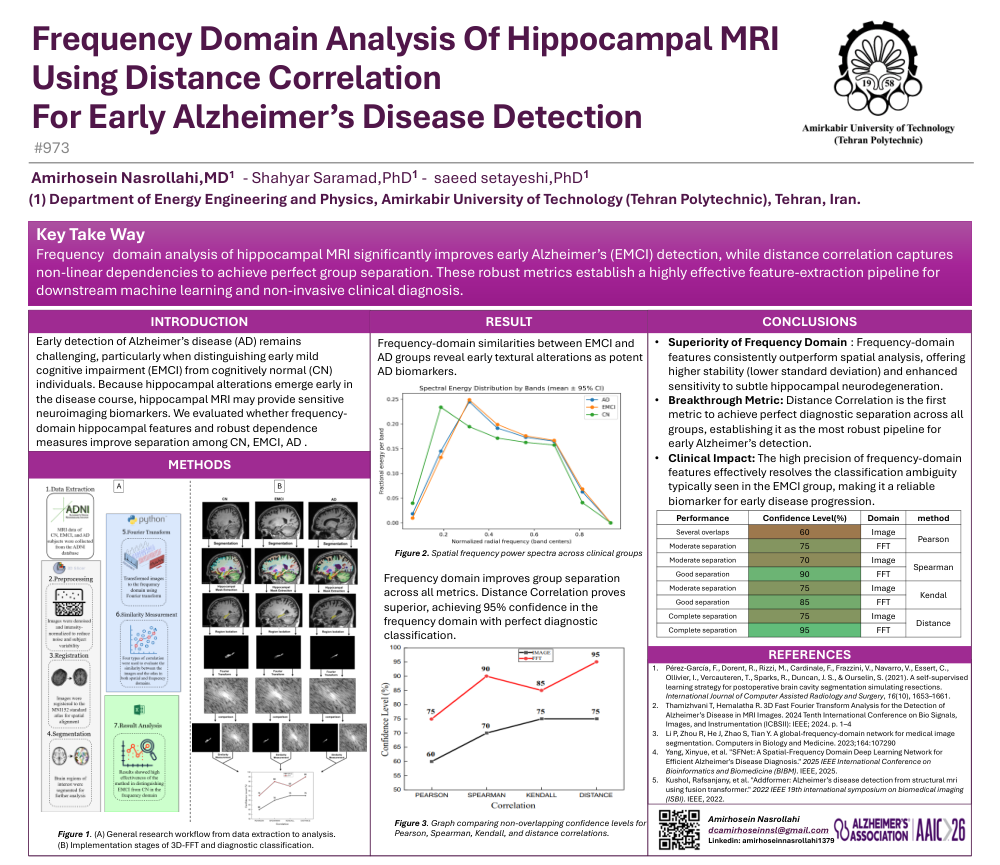
Results: Spatial-domain measures separated AD from CN but showed limited sensitivity for EMCI.
Frequency-domain features improved EMCI versus CN differentiation, increasing sensitivity and F1-score
relative to the spatial domain. Across both domains, distance correlation provided the strongest group
separation, yielding statistically significant between-group differences (p<1%) and the largest nonoverlapping confidence intervals, reaching 95% confidence in the frequency domain.
Conclusion: Frequency-domain hippocampal MRI analysis enhances detection of subtle early-stage
changes and improves EMCI discrimination compared with spatial-domain analysis. Distance correlation,
by capturing nonlinear dependencies, offers a robust similarity measure for neuroimaging-based early AD
detection and may provide strong features for downstream machine-learning and deep-learning.
Comments
Email is required but is not shown publicly.
Loading comments...