4,068 posters, 219 videos, 101 topics, 69 sessions, 14,365 authors, 6,128 institutions
ePostersLive by SciGen Technologies S.A. All rights reserved.
Alzheimer's Association International Conference 2026
July 12-15, 2026 | London, United Kingdom, and Online

4142
Imaging-guided Transcriptomic Vulnerability Distinguishes Alzheimer’S, Vascular, And Lewy Body Dementia
Poster Presenter
Authors
Affiliations
Part of Topic
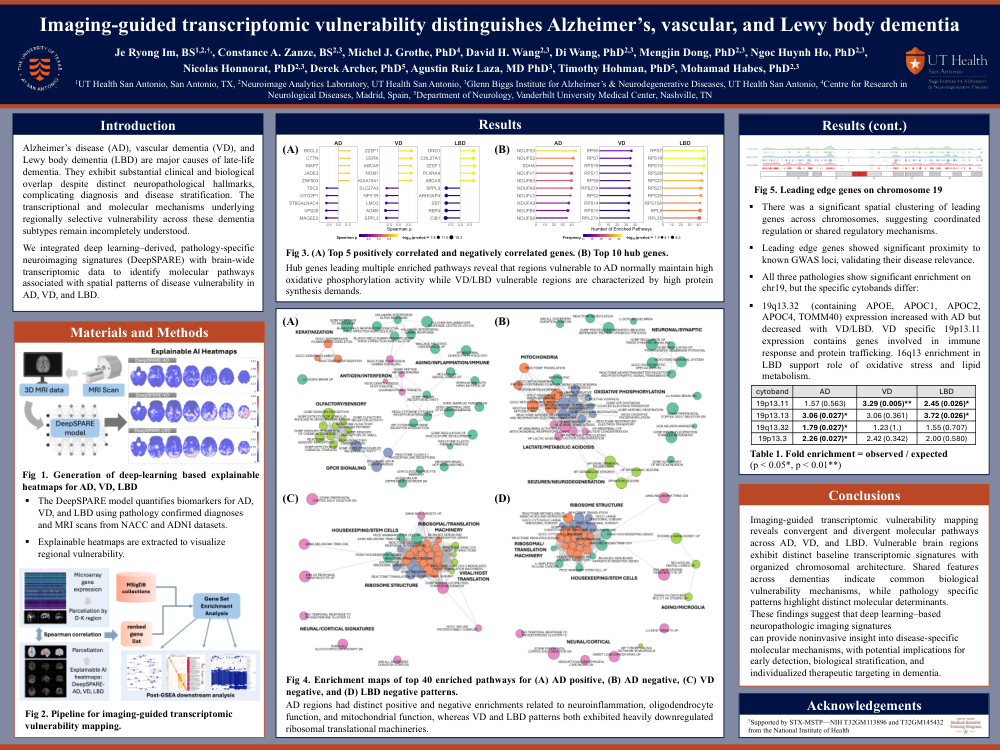
Alzheimer’s disease (AD), vascular dementia (VD), and Lewy body dementia (LBD) are major causes of late-life dementia. They exhibit substantial clinical and biological overlap despite distinct neuropathological hallmarks, complicating diagnosis and disease stratification. The transcriptional and molecular mechanisms underlying regionally selective vulnerability across these dementia subtypes remain incompletely understood. We integrated deep learning–derived, pathology-specific neuroimaging signatures (DeepSPARE) with brain-wide transcriptomic data to identify molecular pathways associated with spatial patterns of disease vulnerability in AD, VD, and LBD.
The DeepSPARE model quantifies biomarkers for AD, VD, and LBD using pathology confirmed diagnoses and MRI scans from NACC and ADNI datasets. Explainable heatmaps are extracted to visualize regional vulnerability.
Hub genes leading multiple enriched pathways reveal that regions vulnerable to AD normally maintain high oxidative phosphorylation activity while VD/LBD vulnerable regions are characterized by high protein synthesis demands. AD regions had distinct positive and negative enrichments related to neuroinflammation, oligodendrocyte function, and mitochondrial function, whereas VD and LBD patterns both exhibited heavily downregulated ribosomal translational machineries. There was a significant spatial clustering of leading genes across chromosomes, suggesting coordinated regulation or shared regulatory mechanisms. Leading edge genes showed significant proximity to known GWAS loci, validating their disease relevance. All three pathologies show significant enrichment on chr19, but the specific cytobands differ: 19q13.32 (containing APOE, APOC1, APOC2, APOC4, TOMM40) expression increased with AD but decreased with VD/LBD; VD specific 19p13.11 expression contains genes involved in immune response and protein trafficking; 16q13 enrichment in LBD support role of oxidative stress and lipid metabolism.
Imaging-guided transcriptomic vulnerability mapping reveals convergent and divergent molecular pathways across AD, VD, and LBD. Vulnerable brain regions exhibit distinct baseline transcriptomic signatures with organized chromosomal architecture. Shared features across dementias indicate common biological vulnerability mechanisms, while pathology specific patterns highlight distinct molecular determinants. These findings suggest that deep learning–based neuropathologic imaging signatures canprovidenoninvasive insight into disease-specific molecular mechanisms, with potential implications for early detection, biological stratification, and individualized therapeutic targeting in dementia.
Comments
Email is required but is not shown publicly.
Loading comments...