4,068 posters, 219 videos, 101 topics, 69 sessions, 14,365 authors, 6,128 institutions
ePostersLive by SciGen Technologies S.A. All rights reserved.
Alzheimer's Association International Conference 2026
July 12-15, 2026 | London, United Kingdom, and Online

6645
Age-dependent Longitudinal Microstructural Vulnerability And Network Reorganization Within The Frontoparietal Network
Poster Presenter
Part of Topic
Background
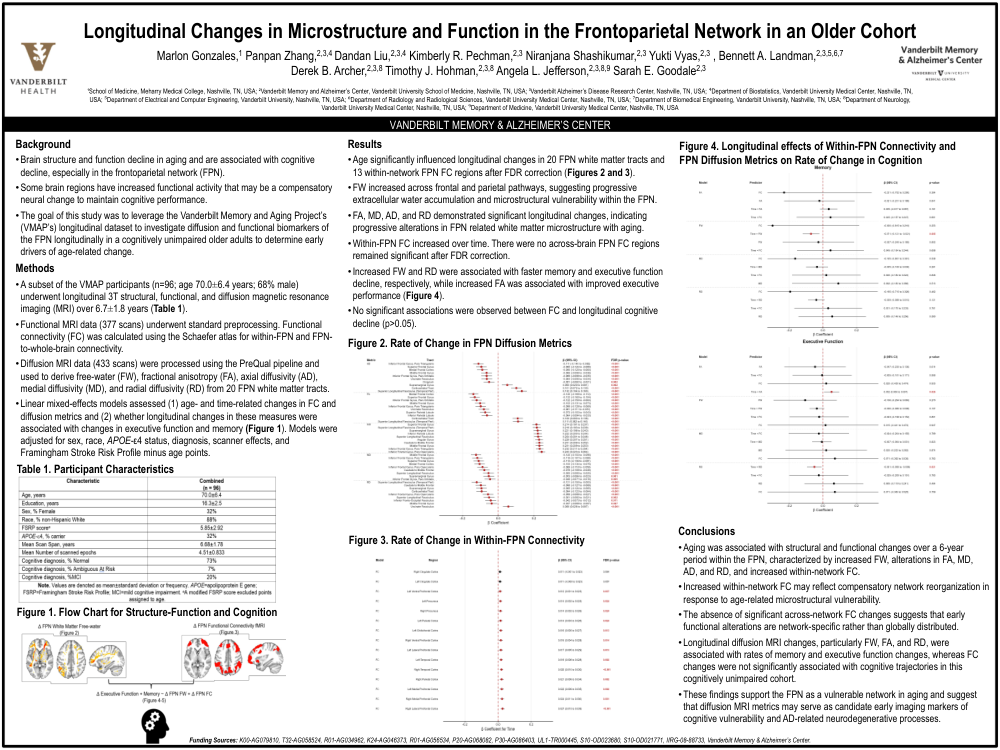
•Brain structure and function decline in aging and are associated with cognitive decline, especially in the frontoparietal network (FPN).
•Some brain regions have increased functional activity that may be a compensatory neural change to maintain cognitive performance.
•The goal of this study was to leverage the Vanderbilt Memory and Aging Project’s (VMAP’s) longitudinal dataset to investigate diffusion and functional biomarkers of the FPN longitudinally in a cognitively unimpaired older adults to determine early drivers of age-related change.
Methods
•A subset of the VMAP participants (n=96; age 70.0±6.4 years; 68% male) underwent longitudinal 3T structural, functional, and diffusion magnetic resonance imaging (MRI) over 6.7±1.8 years (Table 1).
•Functional MRI data (377 scans) underwent standard preprocessing. Functional connectivity (FC) was calculated using the Schaefer atlas for within-FPN and FPN-to-whole-brain connectivity.
•Diffusion MRI data (433 scans) were processed using the PreQual pipeline and used to derive free-water (FW), fractional anisotropy (FA), axial diffusivity (AD), medial diffusivity (MD), and radial diffusivity (RD) from 20 FPN white matter tracts.
•Linear mixed-effects models assessed (1) age- and time-related changes in FC and diffusion metrics and (2) whether longitudinal changes in these measures were associated with changes in executive function and memory (Figure 1). Models were adjusted for sex, race, APOE-ε4 status, diagnosis, scanner effects, and Framingham Stroke Risk Profile minus age points.
Results
•Age significantly influenced longitudinal changes in 20 FPN white matter tracts and 13 within-network FPN FC regions after FDR correction (Figures 2 and 3).
•FW increased across frontal and parietal pathways, suggesting progressive extracellular water accumulation and microstructural vulnerability within the FPN.
•FA, MD, AD, and RD demonstrated significant longitudinal changes, indicating progressive alterations in FPN related white matter microstructure with aging.
•Within-FPN FC increased over time. There were no across-brain FPN FC regions remained significant after FDR correction.
•Increased FW and RD were associated with faster memory and executive function decline, respectively, while increased FA was associated with improved executive performance (Figure 4).
•No significant associations were observed between FC and longitudinal cognitive decline (p>0.05).
Conclusions
•Aging was associated with structural and functional changes over a 6-year period within the FPN, characterized by increased FW, alterations in FA, MD, AD, and RD, and increased within-network FC.
•Increased within-network FC may reflect compensatory network reorganization in response to age-related microstructural vulnerability.
•The absence of significant across-network FC changes suggests that early functional alterations are network-specific rather than globally distributed.
•Longitudinal diffusion MRI changes, particularly FW, FA, and RD, were associated with rates of memory and executive function changes, whereas FC changes were not significantly associated with cognitive trajectories in this cognitively unimpaired cohort.
•These findings support the FPN as a vulnerable network in aging and suggest that diffusion MRI metrics may serve as candidate early imaging markers of cognitive vulnerability and AD-related neurodegenerative processes.
Comments
Email is required but is not shown publicly.
Loading comments...