Loading...

4,068 posters, 219 videos, 101 topics, 69 sessions, 14,365 authors, 6,128 institutions

ePostersLive by SciGen Technologies S.A. All rights reserved.

Alzheimer's Association International Conference 2026

July 12-15, 2026 | London, United Kingdom, and Online

Alzheimer's Association International Conference 2026 banner

4409

Flexible Amyloid-tau Coupling Improves Tau Pathology Prediction In Alzheimer’s Disease
Part of Topic

Flexible Amyloid-tau Coupling Improves Tau Pathology Prediction In Alzheimer’s Disease

1 - Background

•Network spreading models simulate pathology propagation through brain connectomes to probe disease mechanisms in Alzheimer’s disease.
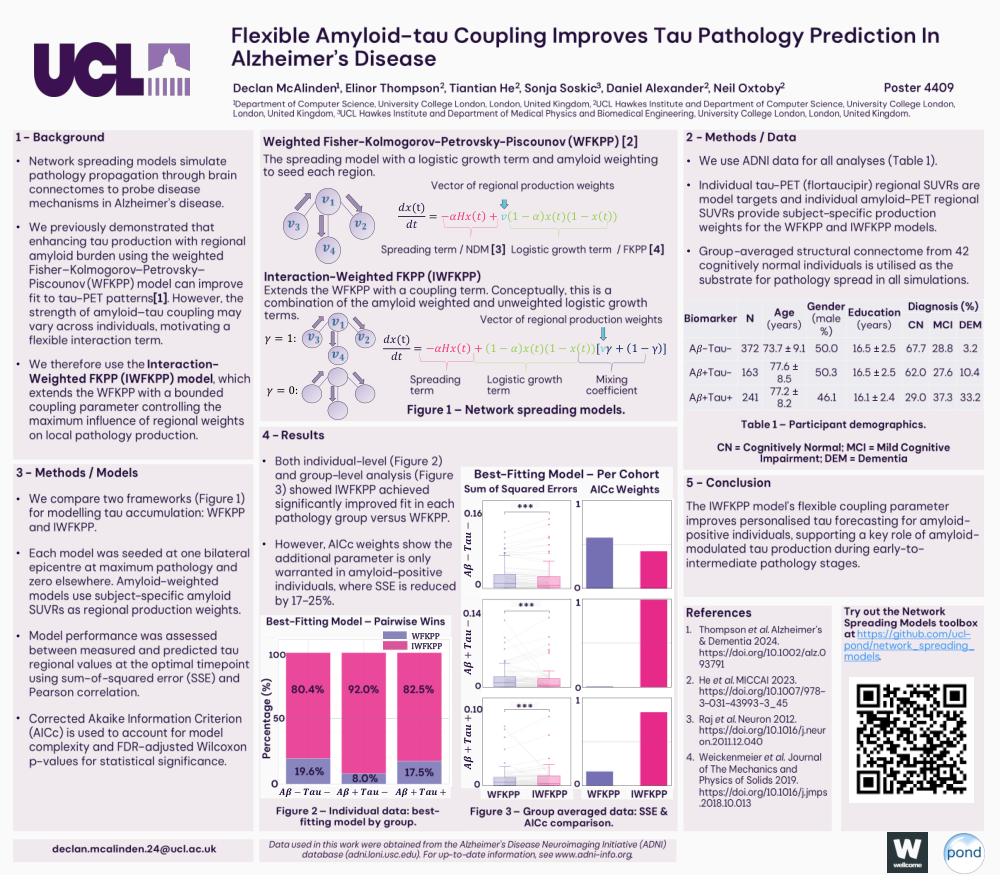
•We previously demonstrated that enhancing tau production with regional amyloid burden using the weighted Fisher–Kolmogorov–Petrovsky–Piscounov (WFKPP) model can improve fit to tau-PET patterns[1]. However, the strength of amyloid–tau coupling may vary across individuals, motivating a flexible interaction term.
•We therefore use the Interaction-Weighted FKPP (IWFKPP) model, which extends the WFKPP with a bounded coupling parameter controlling the maximum influence of regional weights on local pathology production.
•Conceptually, this is a combination of the amyloid weighted and unweighted logistic growth terms.
 

2 - Methods / Data

•We use ADNI data for all analyses (Table 1).
•Individual tau-PET (flortaucipir) regional SUVRs are model targets and individual amyloid-PET regional SUVRs provide subject-specific production weights for the WFKPP and IWFKPP models.
•Group-averaged structural connectome from 42 cognitively normal individuals is utilised as the substrate for pathology spread in all simulations.
 

3 - Methods / Models

•We compare two frameworks (Figure 1) for modelling tau accumulation: WFKPP and IWFKPP.
•Each model was seeded at one bilateral epicentre at maximum pathology and zero elsewhere. Amyloid-weighted models use subject-specific amyloid SUVRs as regional production weights.
•Model performance was assessed between measured and predicted tau regional values at the optimal timepoint using sum-of-squared error (SSE) and Pearson correlation.
•Corrected Akaike Information Criterion (AICc) is used to account for model complexity and FDR-adjusted Wilcoxon p-values for statistical significance. 
 

4 - Results

•Both individual-level (Figure 2) and group-level analysis (Figure 3) showed IWFKPP achieved significantly improved fit in each pathology group versus WFKPP.
•However, AICc weights show the additional parameter is only warranted in amyloid-positive individuals, where SSE is reduced by 17-25%.
 

5 - Conclusion

The IWFKPP model’s flexible coupling parameter improves personalised tau forecasting for amyloid-positive individuals, supporting a key role of amyloid-modulated tau production during early-to-intermediate pathology stages.

Comments

Email is required but is not shown publicly.

Loading comments...

aaic2026 banner
Copyright © 2015-2026, ePostersLive® SciGen is a registered trademark of SciGen Technologies S.A. Patent pending.

This website and third-party tools we use rely on cookies for the best user experience. By selecting "I agree", you agree to cookie usage as described in our Privacy Policy.