4,068 posters, 219 videos, 101 topics, 69 sessions, 14,365 authors, 6,128 institutions
ePostersLive by SciGen Technologies S.A. All rights reserved.
Alzheimer's Association International Conference 2026
July 12-15, 2026 | London, United Kingdom, and Online

9204
Temporalis Muscle Thickness As A Biomarker For Sarcopenia In Older Adults With Mild Cognitive Impairment Or Subjective Memory Concerns
Poster Presenter
Authors
Andrew Huynh, Kate Sturzaker, Pierrick Bourgeat, James Andrews, Christopher Rowe, Kathryn Ellis, Chris Steward, Colin Masters, Patricia Desmond, Nicola Lautenschlager, Louise Burrell, Paul Yates
Affiliations
Department of Geriatric Medicine, Austin Health, Heidelberg, Melbourne, Victoria, Australia; Department of Medicine, Austin Health, The University of Melbourne, Heidelberg, Victoria, Australia, Department of Medicine, Austin Health, The University of Melbourne, Heidelberg, Victoria, Australia, CSIRO Health and Biosecurity, Brisbane, Queensland, Australia, Department of Clinical Immunology and Rheumatology, Department of Medicine, University of Alabama, Birmingham, Alabama, United States of America ; Birmingham Atlanta VA GRECC, Birmingham VA Health Care System, Birmingham, Alabama, United States of America, Department of Molecular Imaging & Therapy, Austin Health, Heidelberg, Melbourne, Victoria, Australia, Department of Psychiatry, The University of Melbourne, Parkville, Victoria, Australia, Department of Radiology, Royal Melbourne Hospital, Parkville, Victoria, Australia, Alzheimer’s Research Australia, Parkville, Melbourne, Victoria, Australia
Part of Topic
Introduction
Sarcopenia is:
Current guideline-recommended tools to diagnose sarcopenia1, such as handgrip strength, sit-to-stand (STS) test, and to assess sarcopenia severity such as timed-up-and-go (TUG) test, are not commonly done in a diagnostic cognitive workup in memory clinics.
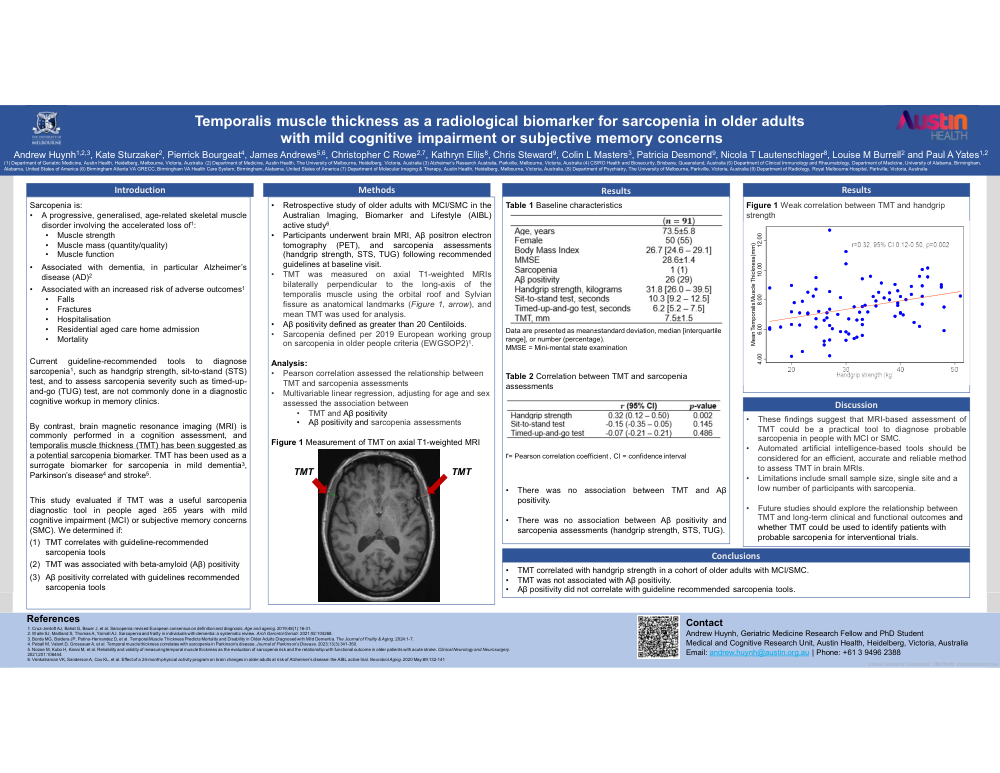
By contrast, brain magnetic resonance imaging (MRI) is commonly performed in a cognition assessment, and temporalis muscle thickness (TMT) has been suggested as a potential sarcopenia biomarker. TMT has been used as a surrogate biomarker for sarcopenia in mild dementia3, Parkinson’s disease4 and stroke5.
This study evaluated if TMT was a useful sarcopenia diagnostic tool in people aged ≥65 years with mild cognitive impairment (MCI) or subjective memory concerns (SMC). We determined if:
Analysis:
Comments
Email is required but is not shown publicly.
Loading comments...