4,068 posters, 219 videos, 101 topics, 69 sessions, 14,365 authors, 6,128 institutions
ePostersLive by SciGen Technologies S.A. All rights reserved.
Alzheimer's Association International Conference 2026
July 12-15, 2026 | London, United Kingdom, and Online

2736
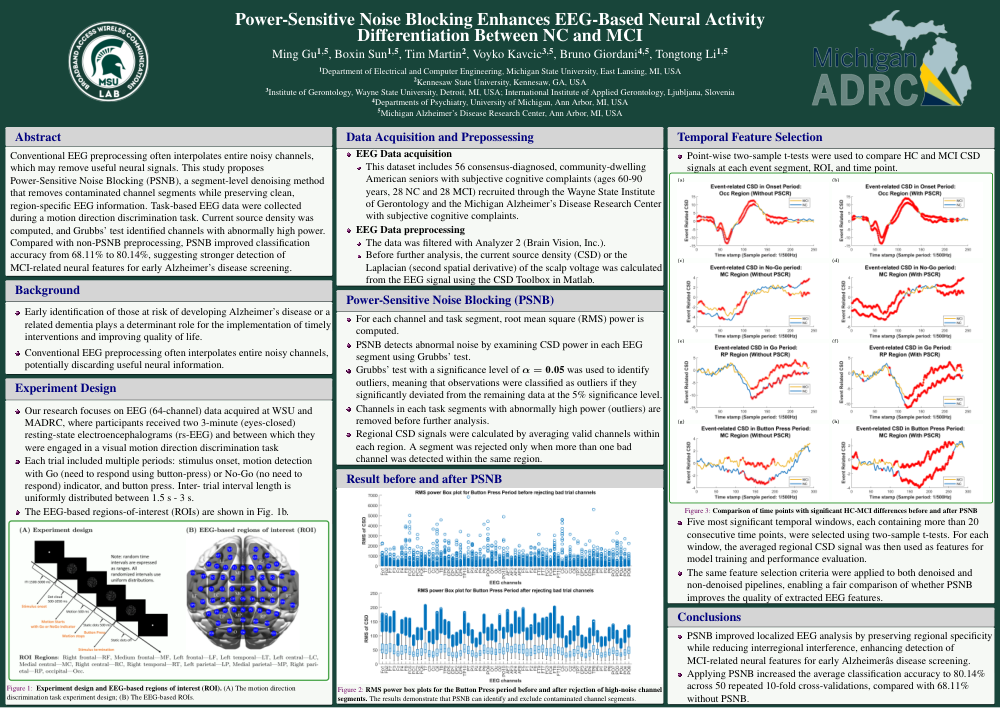
Power-sensitive Noise Blocking Enhances EEG-based Neural Activity Differentiation Between NC And MCI
Part of Topic
Background: Traditional EEG preprocessing methods often address noisy channels by interpolating the entire signal using neighboring channels. However, individual channels may contain substantial portions of high-quality data, and full-length interpolation can unnecessarily replace valid signals, leading to a significant loss of informative content. In this study, we propose removing only contaminated segments while preserving clean, region-specific data.
Method: Task-based EEG data were collected using a 64-channel system at Wayne State University (WSU) while participants performed a motion direction discrimination task. The study included 56 community-dwelling older adults aged 60–90, comprising 28 cognitively normal (NC) individuals and 28 individuals with mild cognitive impairment (MCI). All participants were consensus-diagnosed. EEG data from correct trials were segmented into four task periods: stimulus onset, Go-indication to motion stop, NoGo-indication to motion stop, and button-press. Current source density (CSD) was computed for each segment. For each task period to remove residual noise, we propose the Power-Sensitive Noise Blocking (PSNB) method, where a 90% confidence threshold is set based on statistical analysis, and channels with CSD power level exceeding the threshold are excluded for region-of-interest signal computation.
Results: Compared with conventional EEG preprocessing, the PSNB method preserves uncontaminated signals, reducing interregional interference and enabling more accurate detection of neural differences between NC and MCI. Our results revealed distinct activation patterns between NC and MCI across task periods. During stimulus onset, MCI showed prolonged elevated CSD activity and a slower return to baseline, while NC reached higher peak activation at comparable time points. In the NoGo condition, NC demonstrated sustained activation in frontal and central regions associated with executive control. In contrast, MCI exhibited higher activity in parietal and occipital regions, particularly during later time periods of NoGo, suggesting altered task-related processing and resource allocation.
Conclusion: The PSNB method preserves high-quality EEG segments while selectively removing contaminated data, maintaining regional specificity and reducing inter-regional interference. Using PSNB, we identified distinct neural activation patterns in MCI versus cognitively normal participants. These results support its use for localized brain activity analysis in Alzheimer’s and other EEG studies.
Funding: NSF-2032709/Li; NIH-1R21AG046637-01A1/Kavcic and NIH-1R01AG054484-01A1/Kavcic; NIH-P30AG072931/Paulson; NIH-P30AG024824/Yung.
Learning Objectives:
- Attendees will learn about potential mechanisms underlying cognitive impairment and see how the proposed method differentiates NC and MCI.
- Attendees will learn about how to generate event-related regional-level CSD with the proposed method.
Comments
Email is required but is not shown publicly.
Loading comments...