4,068 posters, 219 videos, 101 topics, 69 sessions, 14,365 authors, 6,128 institutions
ePostersLive by SciGen Technologies S.A. All rights reserved.
Alzheimer's Association International Conference 2026
July 12-15, 2026 | London, United Kingdom, and Online

10750
Heterogeneous Patterns Informative For Prognosis Of Neurodegenerative Diseases
Poster Presenter
Authors
Affiliations
Part of Topic
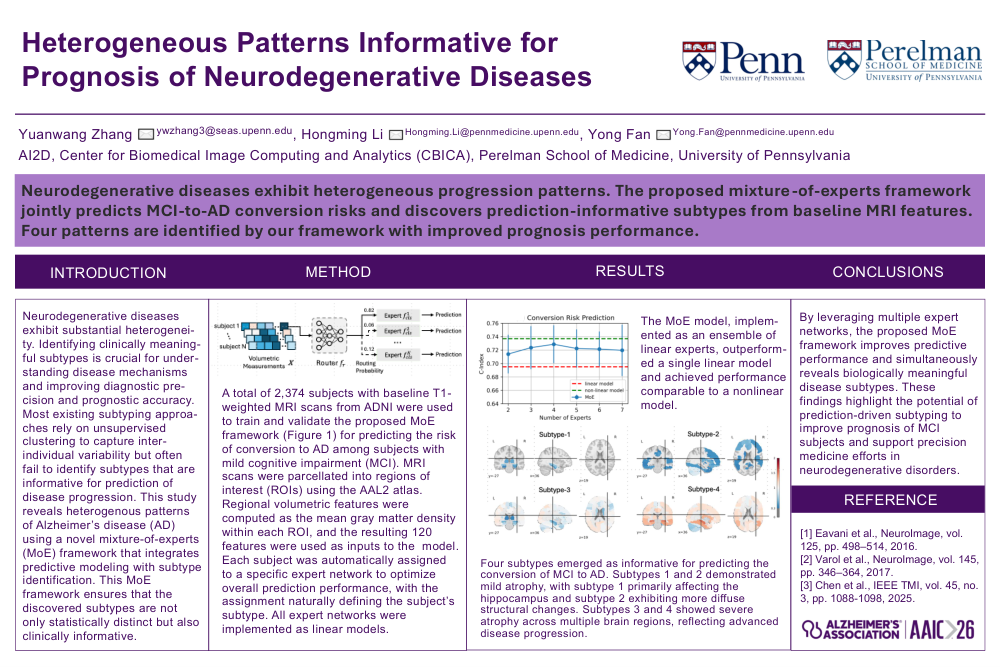
Background: Neurodegenerative diseases exhibit substantial heterogeneity. Identifying clinically meaningful subtypes is crucial for understanding disease mechanisms and improving diagnostic precision and prognostic accuracy. Most existing subtyping approaches rely on unsupervised clustering to capture inter-individual variability but often fail to identify subtypes that are informative for prediction of disease progression. This study reveals heterogenous patterns of Alzheimer’s disease (AD) using a novel mixture-of-experts (MoE) framework that integrates predictive modeling with subtype identification.
Methods: A total of 2,374 subjects with baseline T1-weighted MRI scans from ADNI were used to train and validate the proposed MoE framework (Figure 1) for predicting the risk of conversion to AD among subjects with mild cognitive impairment (MCI). MRI scans were parcellated into regions of interest (ROIs) using the AAL2 atlas. Regional volumetric features were computed as the mean gray matter density within each ROI, and the resulting 120 features were used as inputs to the model. Each subject was automatically assigned to a specific expert network to optimize overall prediction performance, with the assignment naturally defining the subject’s subtype. All expert networks were implemented as linear models.
Results: The MoE model, implemented as an ensemble of linear experts, outperformed a single linear model and achieved performance comparable to a nonlinear model on prognosis task (Figure 2). Four subtypes emerged as informative for predicting the conversion of MCI to AD (Figure 3). Subtypes 1 and 2 demonstrated mild atrophy, with subtype 1 primarily affecting the hippocampus and subtype 2 exhibiting more diffuse structural changes. Subtypes 3 and 4 showed severe atrophy across multiple brain regions, reflecting advanced disease progression.
Conclusion: By leveraging multiple expert networks, the proposed MoE framework improves predictive performance and simultaneously reveals biologically meaningful disease subtypes. These findings highlight the potential of prediction-driven subtyping to improve prognosis of MCI subjects and support precision medicine efforts in neurodegenerative disorders.
Comments
Email is required but is not shown publicly.
Loading comments...