4,068 posters, 219 videos, 101 topics, 69 sessions, 14,365 authors, 6,128 institutions
ePostersLive by SciGen Technologies S.A. All rights reserved.
Alzheimer's Association International Conference 2026
July 12-15, 2026 | London, United Kingdom, and Online

1529
Morphometric Network Alterations In Alzheimer’s And Lewy Body Dementia: A Jensen-Shannon Divergence Based Similarity Network Approach
Poster Presenter
Authors
Minheng Chen, Tong Chen, Xinyan Jian, Tianming Liu, Andrew Blamire, John O'Brien, Li Su, Dajiang Zhu
Affiliations
Department of Psychiatry, University of Cambridge, Cambridge, UK, Sheffield Institute for Translational Neuroscience, University of Sheffield, Sheffield, UK, Department of Computer Science and Engineering, University of Texas at Arlington, Arlington, TX, USA, Department of Biomedical Engineering, Case Western Reserve University, Cleveland, OH, USA, School of Computing, University of Georgia, Athens, GA, USA, Translational and Clinical Research Institute, Newcastle University, Newcastle upon Tyne, UK
Part of Topic
Background
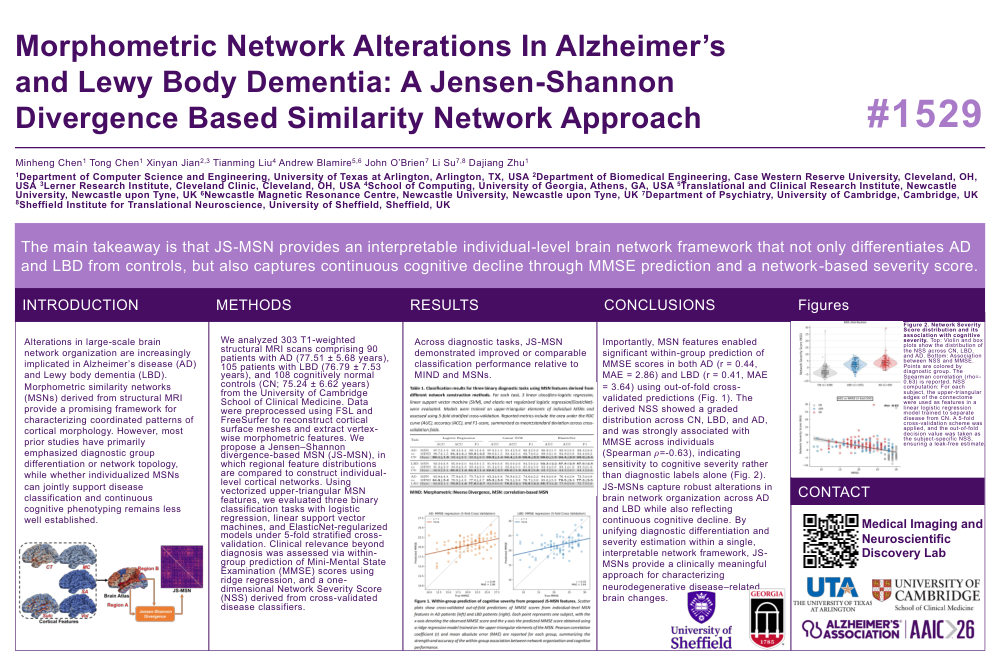
Alterations in large-scale brain network organization are increasingly implicated in Alzheimer’s disease (AD) and Lewy body dementia (LBD). Morphometric similarity networks (MSNs) derived from structural MRI provide a promising framework for characterizing coordinated patterns of cortical morphology. However, most prior studies have primarily emphasized diagnostic group differentiation or network topology, while whether individualized MSNs can jointly support disease classification and continuous cognitive phenotyping remains less well established.
Method
We analyzed 303 T1-weighted structural MRI scans comprising 90 patients with AD (77.51 ± 5.68 years), 105 patients with LBD (76.79 ± 7.53 years), and 108 cognitively normal controls (CN; 75.24 ± 6.62 years) from the University of Cambridge School of Clinical Medicine. Data were preprocessed using FSL and FreeSurfer to reconstruct cortical surface meshes and extract vertex-wise morphometric features. We propose a Jensen–Shannon divergence-based MSN (JS-MSN), in which regional feature distributions are compared to construct individual-level cortical networks. Using vectorized upper-triangular MSN features, we evaluated three binary classification tasks with logistic regression, linear support vector machines, and ElasticNet-regularized models under 5-fold stratified cross-validation. Clinical relevance beyond diagnosis was assessed via within-group prediction of Mini-Mental State Examination (MMSE) scores using ridge regression, and a one-dimensional Network Severity Score (NSS) derived from cross-validated disease classifiers.
Results
Across diagnostic tasks, JS-MSN demonstrated improved or comparable classification performance relative to MIND and correlation-based MSNs, with the most pronounced gains for AD versus CN discrimination (Table 1). Importantly, MSN features enabled significant within-group prediction of MMSE scores in both AD (r = 0.44, MAE = 2.86) and LBD (r = 0.41, MAE = 3.64) using out-of-fold cross-validated predictions (Fig. 1). The derived NSS showed a graded distribution across CN, LBD, and AD, and was strongly associated with MMSE across individuals (Spearman =-0.63), indicating sensitivity to cognitive severity rather than diagnostic labels alone (Fig. 2).
Conclusion
JS-MSNs capture robust alterations in brain network organization across AD and LBD while also reflecting continuous cognitive decline. By unifying diagnostic differentiation and severity estimation within a single, interpretable network framework, JS-MSNs provide a clinically meaningful approach for characterizing neurodegenerative disease–related brain changes.
Comments
Email is required but is not shown publicly.
Loading comments...