4,068 posters, 219 videos, 101 topics, 69 sessions, 14,365 authors, 6,128 institutions
ePostersLive by SciGen Technologies S.A. All rights reserved.
Alzheimer's Association International Conference 2026
July 12-15, 2026 | London, United Kingdom, and Online

6562
Comparing Different Machine Learning Approaches In The Longitudinal Prediction Of Clinical Dementia Rating From Multimodal MRI
Poster Presenter
Authors
Affiliations
Part of Topic
Video
================================================================================
COMPARING MACHINE LEARNING APPROACHES FOR LONGITUDINAL PREDICTION OF CLINICAL DEMENTIA RATING FROM MULTIMODAL MRI
================================================================================
Ali Eslamian¹·³, Qiang Cheng¹·², Colleen Pappas³, Christopher E. Bauer³,
Neetu Nair³, Subeksha Khanal³ & Brian T. Gold³·⁴
¹ Computer Science
² Institute for Biomedical Informatics
³ Neuroscience
⁴ Sanders-Brown Center on Aging
University of Kentucky, Lexington, KY
AAIC® 2026 · Virtual Poster
Contact: Ali Eslamian · ali.eslamian@uky.edu
University of Kentucky, Departments of Computer Science & Neuroscience
--------------------------------------------------------------------------------
INTRODUCTION
--------------------------------------------------------------------------------
Early identification of individuals at risk for dementia may be improved by
modeling longitudinal trajectories of brain structure and cognitive performance.
To this end, we leverage two large repositories (SCAN and ADNI) to test how
accurately combined neuroimaging and neuropsychological data predict conversion
from normal cognition to dementia.
--------------------------------------------------------------------------------
AIM
--------------------------------------------------------------------------------
Compare three mixed-effects machine learning models for predicting Clinical
Dementia Rating (CDR-Global) from structural MRI, white matter measures, and
demographics across repeated visits.
--------------------------------------------------------------------------------
METHODS
--------------------------------------------------------------------------------
STUDY COHORT
· 604 participants
· Mean age: 71.6 years
· 260 Male / 344 Female
· ≥ 3 visits each
· Source: SCAN + ADNI participants with baseline MRI and at least two
follow-up visits
IMAGING PREDICTORS
· Hippocampal volume
· Entorhinal cortical thickness
· White matter hyperintensities (WMH)
· Other regional volumes & cortical thicknesses
· All features adjusted for age, sex, and education as covariates
PROCESSING
· FreeSurfer regional volumes and cortical thickness (Desikan–Killiany atlas)
· WMH from standard segmentation
· Site effects removed with ComBat harmonization
· Features residualized for age, sex, education, and head size
(Total Intracranial Volume)
· All preprocessing fit on the training set only to prevent data leakage
ANALYSIS
· Outcome: CDR-Global (0–2) modeled with time-by-predictor interactions
and subject-specific random effects
· Data split 80/20 by subject; test predictions use fixed effects only
· Model comparison metric: multiclass accuracy
--------------------------------------------------------------------------------
MODELS COMPARED
--------------------------------------------------------------------------------
1. GPBoost — Gradient boosting with grouped random effects
2. MERF — Mixed-Effects Random Forest
3. LME — One-vs-rest logistic linear mixed-effects (BinomialBayesMixedGLM)
--------------------------------------------------------------------------------
KEY RESULTS
--------------------------------------------------------------------------------
Test-set accuracy (multiclass, subject-wise; range: 0.68 – 0.76):
★ Gaussian Process Boosting (GPBoost) 0.740 ← Best
Linear Mixed Effects (LME) 0.727
Mixed-Effects Random Forest (MERF) 0.715
FINDINGS
· GPBoost achieved the highest accuracy (0.740), outperforming both
LME (0.727) and MERF (0.715).
· Among MRI features, hippocampal volume and WMH burden were the
leading predictors.
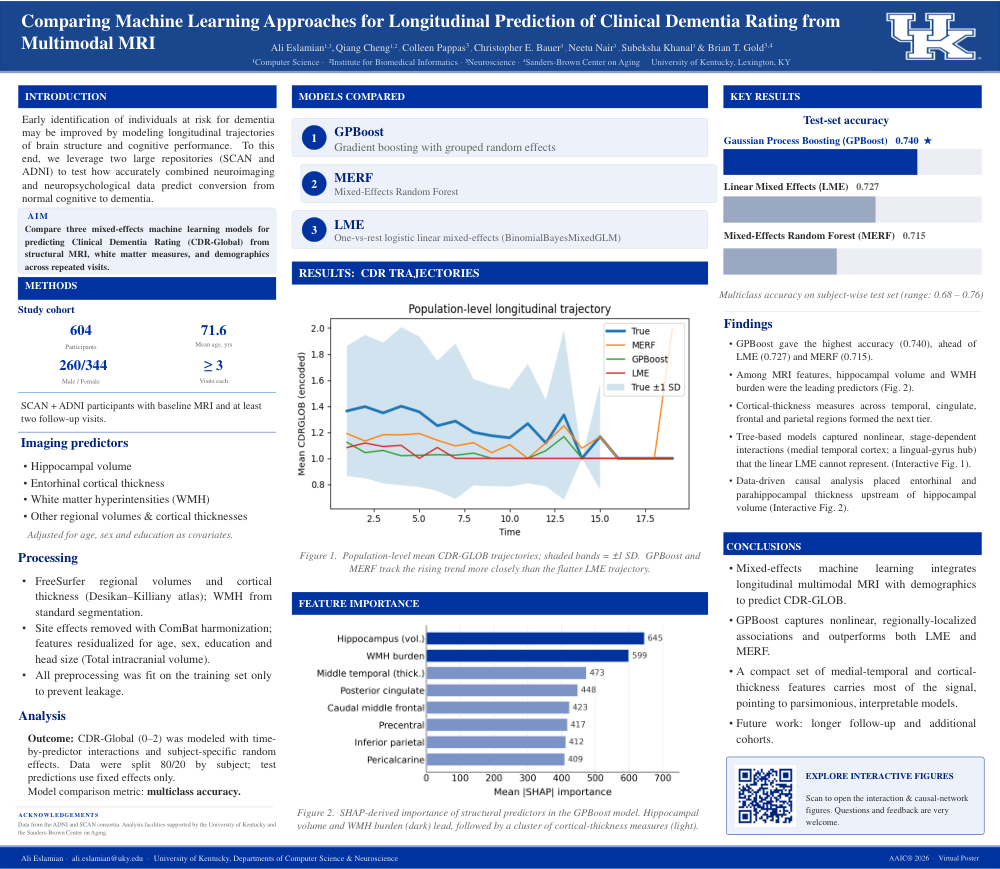
· Top SHAP-derived feature importances (GPBoost model):
1. Hippocampal volume 645
2. WMH burden 599
3. Middle temporal thickness 473
4. Posterior cingulate 448
5. Caudal middle frontal 423
6. Precentral 417
7. Inferior parietal 412
8. Pericalcarine 409
· Cortical-thickness measures across temporal, cingulate, frontal, and
parietal regions formed the next tier of predictive importance.
· Tree-based models captured nonlinear, stage-dependent interactions
(medial temporal cortex; a lingual-gyrus hub) that the linear LME
cannot represent.
· Data-driven causal analysis placed entorhinal and parahippocampal
thickness upstream of hippocampal volume.
· Population-level CDR-GLOB trajectories: GPBoost and MERF tracked
the rising trend more closely than the flatter LME trajectory.
--------------------------------------------------------------------------------
CONCLUSIONS
--------------------------------------------------------------------------------
· Mixed-effects machine learning integrates longitudinal multimodal MRI
with demographics to predict CDR-GLOB.
· GPBoost captures nonlinear, regionally-localized associations and
outperforms both LME and MERF.
· A compact set of medial-temporal and cortical-thickness features carries
most of the predictive signal, pointing to parsimonious, interpretable
models.
· Future work: longer follow-up and additional cohorts.
--------------------------------------------------------------------------------
ACKNOWLEDGEMENTS
--------------------------------------------------------------------------------
Data from the ADNI and SCAN consortia. Analysis facilities supported by the
University of Kentucky and the Sanders-Brown Center on Aging.
================================================================================
Comments
Email is required but is not shown publicly.
Loading comments...