4,068 posters, 219 videos, 101 topics, 69 sessions, 14,365 authors, 6,128 institutions
ePostersLive by SciGen Technologies S.A. All rights reserved.
Alzheimer's Association International Conference 2026
July 12-15, 2026 | London, United Kingdom, and Online

5008
Spectral Characteristics Of Quantitative EEG: Associated Factors And Differentiation Of Cognitive States Across The Clinical Continuum
Part of Topic
Spectral Characteristics Of Quantitative EEG: Associated Factors And Differentiation Of Cognitive States Across The Clinical Continuum
Background: Resting-state electroencephalogram (EEG) power spectral density (PSD) serves as a crucial non-invasive biomarker that reflects cortical neural oscillatory activity. Characterizing demographic, cardiometabolic, and cognitive profiles of PSD in a general older population may facilitate the understanding of the electrophysiological patterns that underly cognitive disorders in older adults.
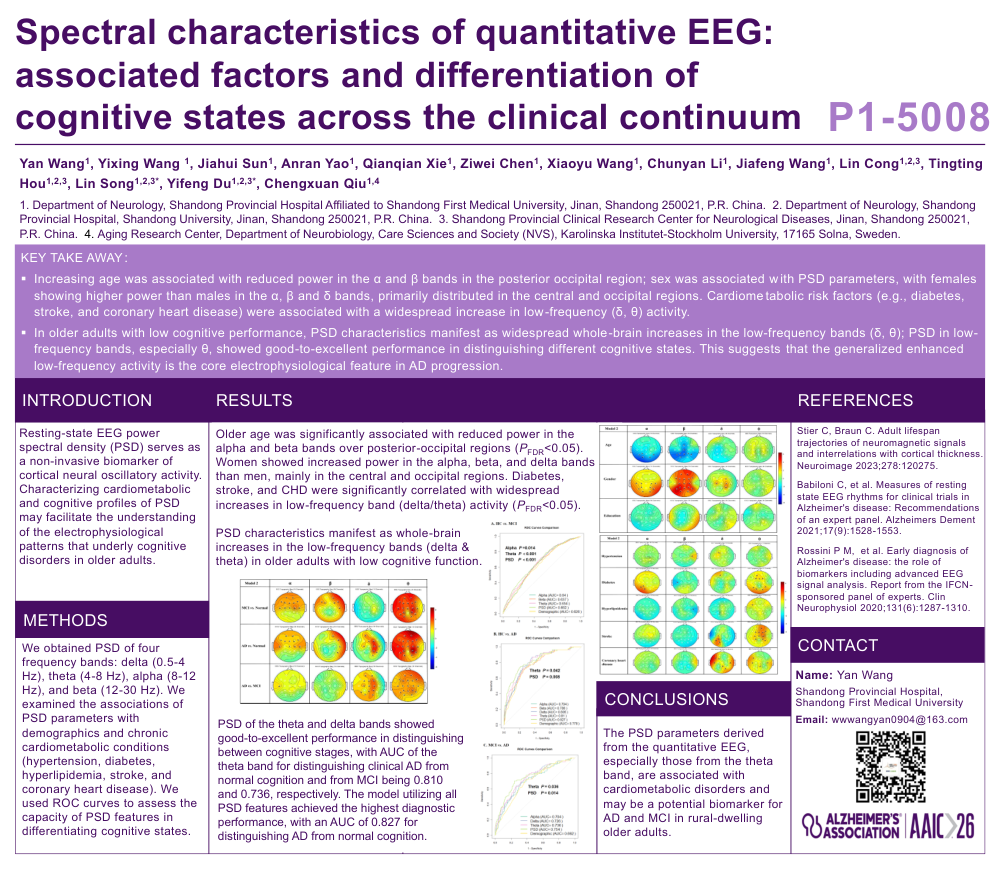
Methods: This population-based cross-sectional study included 2127 older adults (age ≥60 years; 57.26% women) from the MIND-China project who underwent awake closed-eye 19-channel 3 minutes EEG examination in 2023-2024. Clinical Alzheimer's disease (AD) and mild cognitive impairment (MCI) were diagnosed following international criteria. We used the Brainstorm toolboxes in MATLAB software to analyze the last-minute EEG signals and obtain the PSD of four typical frequency bands: Delta (0.5–4 Hz), Theta (4–8 Hz), Alpha (8–12 Hz), and Beta (12–30 Hz). We examined the associations of PSD parameters with demographics (age, sex, and education) and chronic cardiometabolic conditions (hypertension, diabetes, hyperlipidemia, stroke, and coronary heart disease). We used the receiver operating characteristic (ROC) curves to assess the capacity of PSD features in differentiating between cognitive states across the cognitive continuum.
Results: Older age was significantly associated with reduced power in the alpha and beta bands over posterior-occipital regions (PFDR<0.05). Women showed increased power in the alpha, beta, and delta bands than men, mainly distributed over the central and occipital regions. Diabetes, clinical stroke, and coronary heart disease were significantly correlated with widespread increases in low-frequency band (delta/theta) activity (PFDR<0.05). After adjusting for potential confounders, the PSD of the theta and delta bands showed good-to-excellent performance in distinguishing between cognitive stages, with AUC of the theta band for distinguishing clinical AD from normal cognition and from MCI being 0.810 and 0.736, respectively. The comprehensive model utilizing all PSD features achieved the highest diagnostic performance, with an AUC of 0.827 for distinguishing AD from normal cognition.
Conclusions: The PSD parameters derived from the quantitative EEG, especially those from the theta band, are associated with cardiometabolic disorders and may emerge as a potential biomarker for AD and MCI in rural-dwelling older adults.
Contact Information:
Yan Wang
Department of Neurology, Shandong Provincial Hospital, Shandong First Medical University
Email: wwwangyan0904@163.com
Suggested Keywordsd: rest-state electroencephalography; power spectral density; cognitive impairment; Alzheimer's disease; theta; population-based study
Comments
Email is required but is not shown publicly.
Loading comments...