4,068 posters, 219 videos, 101 topics, 69 sessions, 14,365 authors, 6,128 institutions
ePostersLive by SciGen Technologies S.A. All rights reserved.
Alzheimer's Association International Conference 2026
July 12-15, 2026 | London, United Kingdom, and Online

9753
Evolution Of Alzheimer’S Diagnosis: Merging Molecular And Fluid Biomarkers Intoclinical Frameworks For Early And Preclinical Detection
Poster Presenter
Authors
Part of Topic
Evolution of Alzheimer’s Diagnosis: Merging Molecular and Fluid Biomarkers into Clinical Frameworks for Early and Preclinical Detection
Abstract
Background
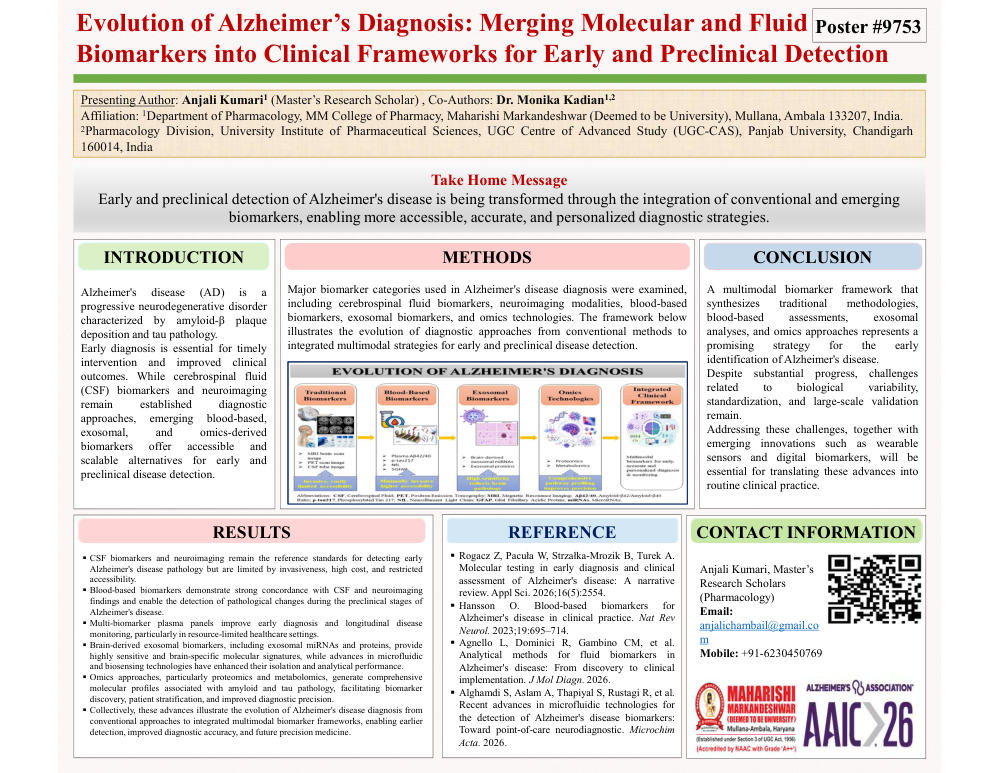
The prompt recognition of Alzheimer’s disease (AD) is vital for timely intervention and optimized disease management. Diagnostic techniques have transitioned from invasive and imaging-based frameworks to more accessible and non-invasive biomarker platforms. Established cerebrospinal fluid (CSF) and neuroimaging parameters continue to be fundamental, while emerging innovations highlight the merits of blood-based, exosomal, and omics-derived biomarkers in enhancing diagnostic accuracy and feasibility.
Methods
This abstract amalgamates conventional and innovative biomarker strategies for the identification of AD, incorporating CSF analysis (amyloid-β42, total tau, phosphorylated tau), sophisticated neuroimaging modalities (positron emission tomography [PET] and magnetic resonance imaging [MRI]), blood-derived biomarkers (plasma Aβ42/40 ratios, phosphorylated tau, neurofilament light chain, glial fibrillary acidic protein [GFAP]), along with cutting-edge exosomal and omics methodologies. A comprehensive summary of evidence from recent studies highlighting diagnostic accuracy, clinical utility, and methodological nuances is meticulously presented.
Results
CSF biomarkers and neuroimaging proficiently identify early AD-related pathology; however, they are constrained by factors such as invasiveness, cost, and accessibility. Blood-based biomarkers exhibit robust correlations with CSF and imaging findings, demonstrating the capacity to detect pathological alterations years prior to the onset of clinical symptoms. Multi-pathway plasma biomarker panels reveal a characteristic progression of modifications, thereby facilitating early diagnosis and disease monitoring, particularly in resource-limited environments. Exosomal biomarkers, particularly brain-derived exosomal miRNAs, demonstrate remarkable sensitivity and specificity. Concurrent advancements in microfluidics and biosensor technologies have significantly enhanced the isolation and detection capabilities. Omics methodologies, encompassing metabolomics and proteomics, yield comprehensive biomarker profiles intricately associated with amyloid and tau pathology, thereby augmenting diagnostic precision.
Conclusion
A multimodal biomarker framework that synthesizes traditional methodologies, blood-based assessments, exosomal analyses, and omics approaches embodies a promising direction for the early identification of AD. Despite substantial progress, obstacles related to biological variability, standardization, and large-scale validation endure. Confronting these challenges, coupled with prospective innovations such as wearable sensors, is crucial for effectively translating these advancements into standard clinical practice.
Comments
Email is required but is not shown publicly.
Loading comments...