4,068 posters, 219 videos, 101 topics, 69 sessions, 14,365 authors, 6,128 institutions
ePostersLive by SciGen Technologies S.A. All rights reserved.
Alzheimer's Association International Conference 2026
July 12-15, 2026 | London, United Kingdom, and Online

1587
Long-term Exposure To Multiple Environmental Factors And Late-life Cognitive Decline
Poster Presenter
Authors
Part of Topic
Background:
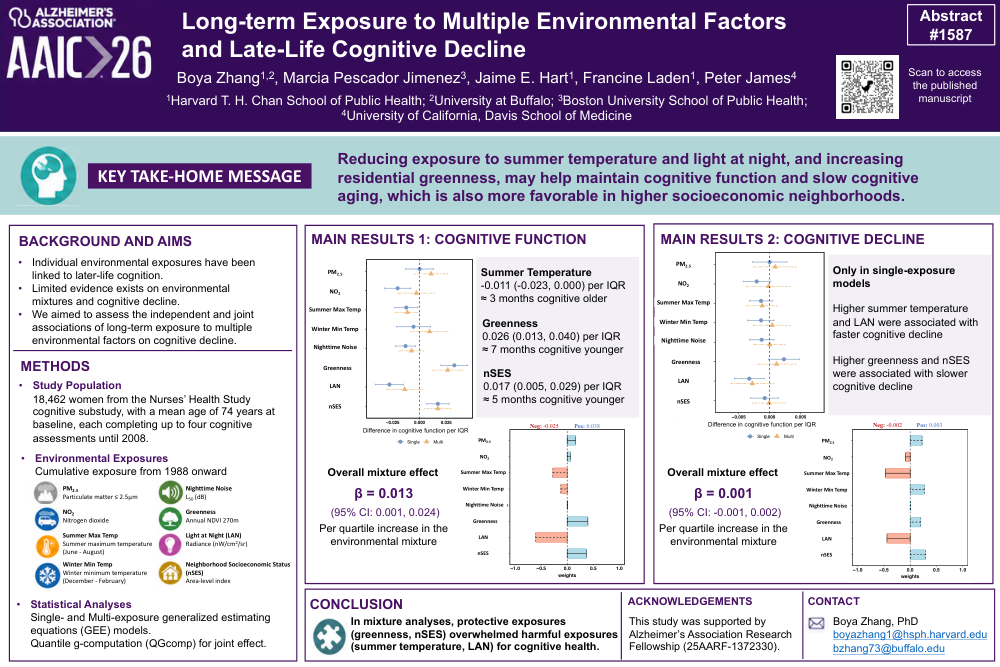
While individual environmental exposures have been linked to cognitive function later in life, their combined effects, particularly on the rate of cognitive decline, remain poorly understood.
Methods:
We evaluated independent and joint associations of long-term exposure to multiple environmental factors with cognitive function and decline among 18,462 participants from the Nurses’ Health Study cognitive substudy, enrolled between 1995 and 2001, and followed up biannually. Cumulative average exposures to air pollution, seasonal temperature, noise, greenness, light at night, and neighborhood socioeconomic status since 1988 were assigned based on updated residential addresses. We used generalized estimating equations to evaluate individual exposures and quantile g-computation models to assess the joint effects on global cognitive score.
Results:
We observed that each interquartile range (IQR) increase in greenness and nSES was associated with better cognitive function across all models, with a 0.026 (95% CI: 0.013, 0.040) and 0.017 (0.005, 0.029) standard units increase in the multi-exposure model. Higher summer temperatures were associated with lower cognitive function (-0.011; -0.023, 0.000). For the joint association, each quartile increase across all exposures was associated with a 0.013 (0.001, 0.024) standard unit higher cognitive function. Higher exposures to summer maximum temperatures (-0.001; -0.003, 0.000) and light at night (LAN) (-0.003; -0.006, -0.001) were linked to faster cognitive decline only in single-exposure models, while attenuated in multi-exposure models. No significant joint association was observed with cognitive decline, though negative weights were primarily attributable to summer temperature (47%) and LAN (44%).
Conclusion:
This study suggests that reducing exposure to extreme summer temperatures and LAN, and increasing residential greenness, may help maintain cognitive function and slow cognitive aging, which is also more favorable in higher socioeconomic neighborhoods.
Comments
Email is required but is not shown publicly.
Loading comments...