4,068 posters, 219 videos, 101 topics, 69 sessions, 14,365 authors, 6,128 institutions
ePostersLive by SciGen Technologies S.A. All rights reserved.
Alzheimer's Association International Conference 2026
July 12-15, 2026 | London, United Kingdom, and Online

9054
Freewater Diffusion And Quantitative T1 Mapping In FTLD - A Pilot Study
Poster Presenter
Authors
Vishaal Sumra, Sriranga Kashyap, Kamil Uludag, Nico Paulo Dimal, Alonso Morales Rivero, Abeer Khoka, Maria Carmela Tartaglia
Affiliations
University of Toronto, Institute of Medical Science, Toronto, ON, Canada, Krembil Brain Institute, University Health Network, Toronto, ON, Canada, Division of Neurology, Toronto Western Hospital, University Health Network, Toronto, ON, Canada
Part of Topic
Background:
- Neuroinflammation has been proposed as a common feature of neurodegenerative diseases (NDs)1
- Differences in inflammatory profiles have been observed between NDs suggesting disease specific inflammatory profiles2
- In frontotemporal lobar degeneration (FTLD), neuroinflammation and proteinopathy are expected in frontal and temporal regions, depending on subtype
- Free-water diffusion (FWD) and T1 maps are non-specific biomarkers of neuroinflammation, where increased tissue water caused by cytokine release is expected to increase both FWD and T1 values3.4,5
- AIM: investigate T1 mapping and FWD as candidate biomarkers for neuroinflammation in FTLD syndromes
-
Subjects: qT1 and FWD maps were generated in an ongoing project of 10 gene-negative healthy controls with a family history of FTLD (4M, 6F, mean age 46±13) and 19 FTLD patients (8 corticobasal syndrome (CBS, 4M 4F, mean age 68±5), 2 semantic variant primary progressive aphasia (svPPA, 2F, mean age 83±9), 2 nonfluent variant primary progressive aphasia (nfvPPA, 1M1F, mean age 741±3), 4 progressive supranuclear palsy (PSP, 3F, 1M mean age 80±4), and 3 behavioural variant frontotemporal dementia (bvFTD) (3M, mean age 68±8).
-
MRI:T1-weighted MPRAGE, diffusion-weighted EPI (two shells) for free-water mapping, and MP2RAGE for qT1 mapping were acquired on a Siemens MAGNETOM Prisma 3T scanner, using a 20ch head coil. Scanning parameters are in Table 1.
- Image Processing:Skull stripping and binary mask creation were done using ICVmapp3r on T1-weighted MPRAGE scans. MP2RAGE T1 maps were corrected for B1+ using a separately acquired B1+ map. Diffusion data preprocessing included 1) Synb0 to generate a undistorted b0 image, 2) FSL's topup for phase-encoding distortion correction and 3) FSL's eddy for eddy current, motion and susceptibility distortion correction. Free-water maps were calculated according to the model proposed by Pasternak et al., (2009) using the eddy processed diffusion data in MATLAB. FWD and T1 maps were co-registered using FSL flirt.
- Statistical Analysis:A w-score approach was used to assess significant differences in qT1 and FWD between FTLD subgroups and healthy controls in disease-relevant ROIs. Pearson's correlations were conducted to assess the relationship between qT1 and FWD-derived w-scores and GFAP, NfL and MoCA as markers of neuroinflammation, neurodegeneration and cognition respectively.
-
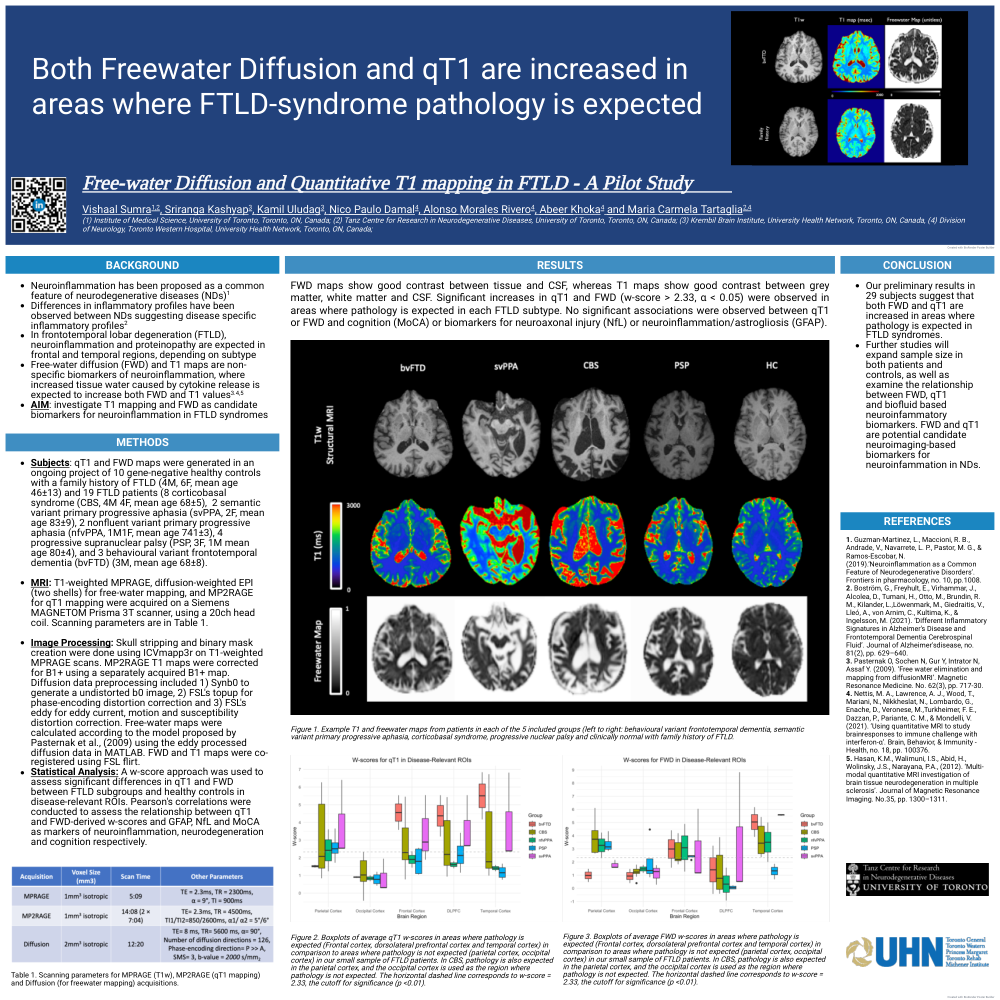
FWD maps show good contrast between tissue and CSF, whereas T1 maps show good contrast between grey matter, white matter and CSF. Significant increases in qT1 and FWD (w-score > 2.33, α < 0.05) were observed in areas where pathology is expected in each FTLD subtype. No significant associations were observed between qT1 or FWD and cognition (MoCA) or biomarkers for neuroaxonal injury (NfL) or neuroinflammation/astrogliosis (GFAP).
Conclusion:
- Our preliminary results in 29 subjects suggest that both FWD and qT1 are increased in areas where pathology is expected in FTLD syndromes.
- Further studies will expand sample size in both patients and controls, as well as examine the relationship between FWD, qT1 andbiofluidbased neuroinfammatory biomarkers. FWD and qT1 are potential candidate neuroimaging-based biomarkers for neuroinfammation in NDs.
Comments
Email is required but is not shown publicly.
Loading comments...