4,068 posters, 219 videos, 101 topics, 69 sessions, 14,365 authors, 6,128 institutions
ePostersLive by SciGen Technologies S.A. All rights reserved.
Alzheimer's Association International Conference 2026
July 12-15, 2026 | London, United Kingdom, and Online

6865
Spatiotemporal Atrophy Subtyping And Staging In AD: Neurodegeneration-vascular Interplay And Prognostic Superiority
Poster Presenter
Authors
Yuyue Qiu, Chenhui Mao, Bo Li, Yuhan Jiang, Jialu Bao, Yunfan You, Tianyi Wang, Yuanheng Li, Wenjun Wang, Shanshan Chu, Wei Jin, Peilin Fan, Bo Hou, Xinying Huang, Meiqi Wu, Yifei Wang, Dan Lei, Longze Sha, Qi Xu, Ling Qiu, Li Huo, Feng Feng, Liling Dong, Jing Gao
Affiliations
Part of Topic
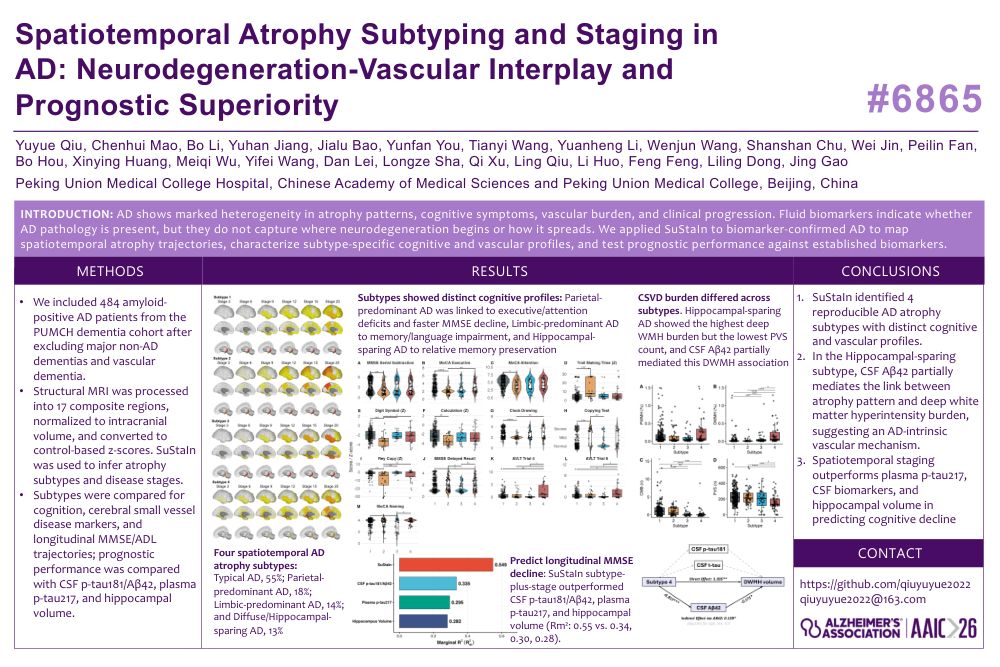
Spatiotemporal Atrophy Subtyping and Staging in AD: Neurodegeneration-Vascular Interplay and Prognostic Superiority
Background: To characterize spatiotemporal atrophy subtypes in "pure" Alzheimer disease (AD) and investigate their associations with specific cognitive profiles, cerebrovascular lesions, and prognostic utility compared to fluid biomarkers.
Methods: We applied the Subtype and Stage Inference (SuStaIn) algorithm to structural MRI data from 484 biomarker-confirmed AD patients from the PUMCH dementia cohort (ClinicalTrials.gov: NCT05023564). We analyzed subtype-specific cognitive domains and small vessel disease burdens, including white matter hyperintensities, cerebral microbleeds and perivascular spaces. Mediation analysis assessed the link between amyloid pathology and white matter injury. Finally, we compared the SuStaIn against plasma p-tau 217, CSF biomarker, and hippocampal volume in predicting longitudinal cognitive decline.
Results: We identified four subtypes: Typical (55%), Parietal-predominant (18%; characterized by early onset, executive dysfunction, and rapid decline), Limbic-predominant (14%; prominent memory and language deficits), and Hippocampal-sparing (13%). The Hippocampal-sparing subtype exhibited relative memory preservation and the highest deep white matter hyperintensity burden despite having the lowest perivascular space count. Mediation analysis confirmed that CSF amyloid-beta 42 partially mediated this white matter injury. Longitudinally, the spatiotemporal model demonstrated superior predictive performance for cognitive decline (Rm2 = 0.55) compared to models based on cerebrospinal fluid biomarkers (Rm2 = 0.34), plasma phosphorylated tau 217 (Rm2 = 0.30), or simple hippocampal volume (Rm2 = 0.28).
Conclusion: AD manifests as distinct spatiotemporal phenotypes with unique cognitive and vascular profiles. The intrinsic link between amyloid and white matter injury in specific subtypes challenges the strict separation of vascular and neurodegenerative pathologies. Furthermore, spatiotemporal staging offers a superior prognostic roadmap compared to emerging fluid biomarkers.
Comments
Email is required but is not shown publicly.
Loading comments...