4,068 posters, 219 videos, 101 topics, 69 sessions, 14,365 authors, 6,128 institutions
ePostersLive by SciGen Technologies S.A. All rights reserved.
Alzheimer's Association International Conference 2026
July 12-15, 2026 | London, United Kingdom, and Online

1863
Apoe Genotype Modifies Associations Between Estradiol Exposure And Plasma Alzheimer Disease Biomarkers In Postmenopausal Females
Poster Presenter
Authors
Part of Topic
Greater estradiol exposure is associated with greater Alzheimer disease plasma biomarkers in postmenopausal APOE ε4 carriers.
APOE genotype modifies associations between estradiol exposure and plasma Alzheimer disease biomarkers in postmenopausal females
Jasper FE Crockford, Dylan X Guan, Maryam Ghahremani, Cindy K Barha, Eric E Smith, Zahinoor Ismail
What we know:
What we don’t know:
Whether the associations of E2 exposure with AD pathology differ by APOE ε4 status.
Participants: 301 postmenopausal females across the neurocognitive continuum from COMPASS-ND.
Measures:
Analysis:
Result:
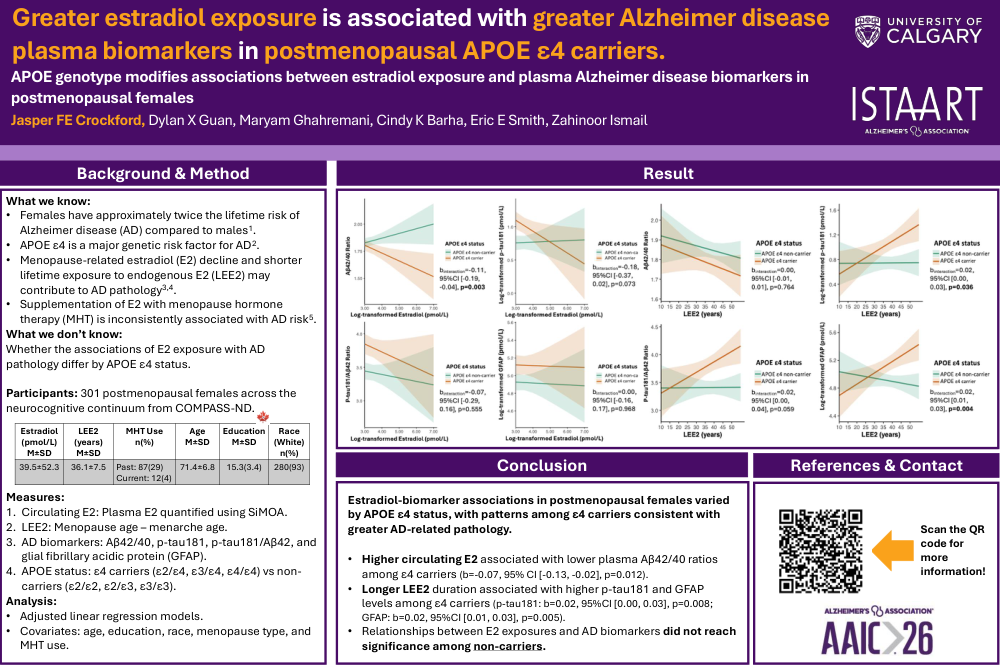
Relationship between Aβ42/40 and circulating estradiol levels significantly moderated by APOE ε4 status: binteraction=-0.11, 95%CI [-0.19, -0.04], p=0.003
Relationship between p-tau181 and circulating estradiol levels not moderated by APOE ε4 status: binteraction=-0.18, 95%CI [-0.37, 0.02], p=0.073
Relationship between p-tau181/Aβ42 and circulating estradiol levels not moderated by APOE ε4 status: binteraction=-0.07, 95%CI [-0.29, 0.16], p=0.555
Relationship between glial fibrillary acidic protein and circulating estradiol levels not moderated by APOE ε4 status: binteraction=0.00, 95%CI [-0.16, 0.17], p=0.968
Relationship between Aβ42/40 and LEE2 not moderated by APOE ε4 status: binteraction=0.00, 95%CI [-0.01, 0.01], p=0.764
Relationship between p-tau181 and LEE2 significantly moderated by APOE ε4 status: binteraction=0.02, 95%CI [0.00, 0.03], p=0.036
Relationship between p-tau181/Aβ42 and LEE2 not moderated by APOE ε4 status: binteraction=0.02, 95%CI [0.00, 0.04], p=0.059
Relationship between glial fibrillary acidic protein and LEE2 not moderated by APOE ε4 status: binteraction=0.02, 95%CI [0.01, 0.03], p=0.004
Conclusion:
Estradiol-biomarker associations in postmenopausal females varied by APOE ε4 status, with patterns among ε4 carriers consistent with greater AD-related pathology.
•Higher circulating E2 associated with lower plasma Aβ42/40 ratios among ε4 carriers (b=-0.07, 95% CI [-0.13, -0.02], p=0.012).
•Longer LEE2 duration associated with higher p-tau181 and GFAP levels among ε4 carriers (p-tau181: b=0.02, 95%CI [0.00, 0.03], p=0.008; GFAP: b=0.02, 95%CI [0.01, 0.03], p=0.005).
•Relationships between E2 exposures and AD biomarkers did not reach significance among non-carriers.
References and Contact:
Scan the QR code for more information.
Alternatively, click for the references and contact information here: https://docs.google.com/document/d/1lcaE2W6l54QznYc9H4hj_cJbi_9uxaagSghnkRhAoXc/edit?usp=sharing
Comments
Email is required but is not shown publicly.
Loading comments...