4,068 posters, 219 videos, 101 topics, 69 sessions, 14,365 authors, 6,128 institutions
ePostersLive by SciGen Technologies S.A. All rights reserved.
Alzheimer's Association International Conference 2026
July 12-15, 2026 | London, United Kingdom, and Online

10458
Distinct Network-based Signatures Of Atrophy And Hypometabolism In Alzheimer's Disease
Poster Presenter
Authors
Annie Dang, Prem Patel, Crystal Franklin, Anne Wells, Peter Fox
Affiliations
Part of Topic
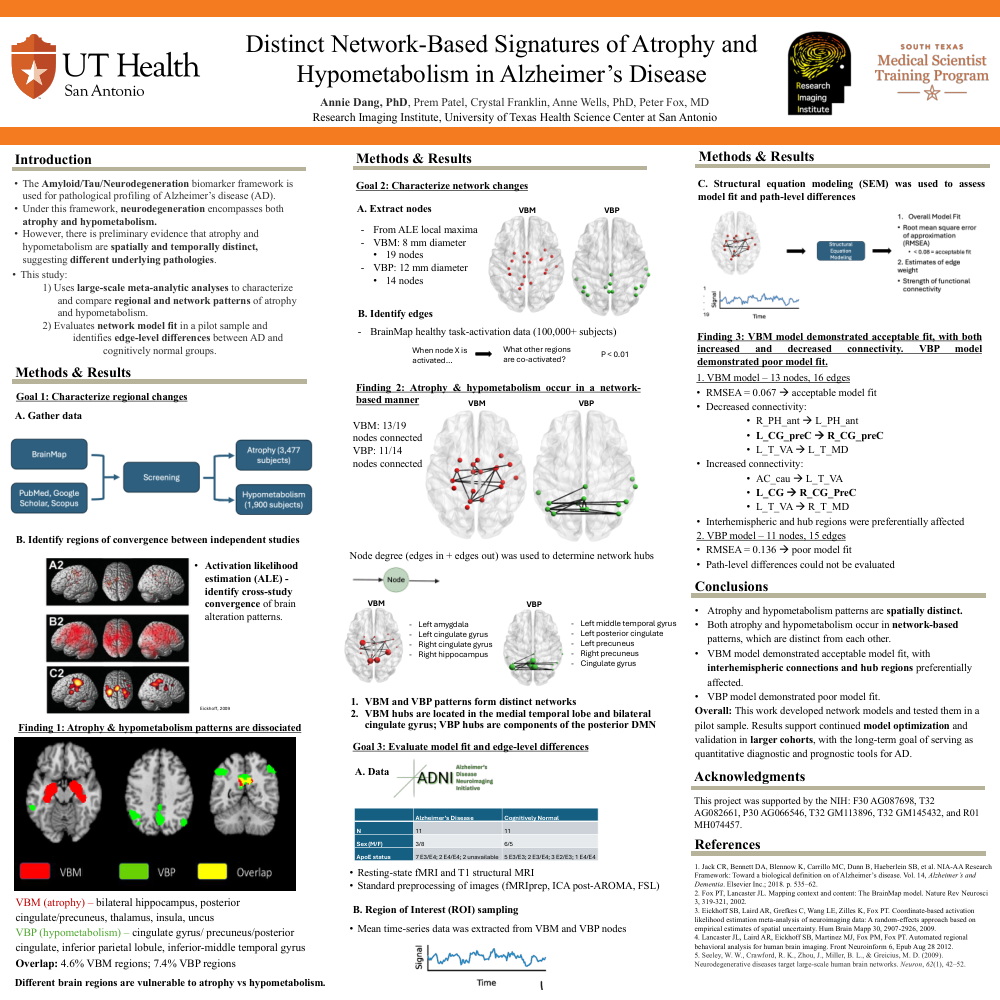
Introduction: Voxel-based morphometry (VBM) and voxel-based physiology (VBP) measure structural atrophy and functional hypometabolism, respectively. In Alzheimer’s disease (AD), VBM and VBP changes have signature, but distinct, patterns, with VBM changes predominantly occurring in the bilateral hippocampus and temporal gyrus and VBP changes occurring in the posterior cingulate and bilateral parietal lobes. However, whether these alterations occur in a network-based pattern remains unclear. The Network Degeneration Hypothesis states that patterns of neurodegeneration are not random and instead follow healthy functional networks. Here, we hypothesize that both VBM and VBP alteration patterns in AD occur in a network-based manner.
Methods: VBM and VBP studies of AD were identified through the BrainMap databasesand PubMed. Inclusion/exclusion criteria were applied. Activation likelihood estimation (ALE) was performed separately for VBM and VBP contrasts (AD < controls) to identify regions of consistent alteration across studies. Local maxima were used to define regions of interest (ROIs). Meta-analytic connectivity modeling (MACM) was used to identify functional connections between ROIs (nodes). Specifically, each ROI was seeded into the BrainMap Task-Activation database (>100,000 healthy subjects) to determine regions of co-activation. ALE analysis and thresholding were applied to determine significant connections between nodes.
Results: A total of 95 VBM and 68 VBP AD < controls contrasts were included. VBM analysis identified 5 clusters comprising 19 local maxima. VBP analysis identified 5 clusters with 14 maxima. MACM of VBM-derived nodes identified 24 edges at a stringent threshold (p < 0.01), with an additional 33 edges at p < 0.05. All VBM nodes were connected to at least one other node at p < 0.05. MACM of VBP-derived nodes identified 19 edges at p < 0.01 and 21 additional edges at p < 0.05. Three nodes were disconnected, while all other nodes demonstrated robust connectivity.
Conclusion: Both structural atrophy and functional hypometabolism in AD exhibit network-based organization. These findings suggest strong potential of VBM and VBP alterations as complementary, network-based biomarkers for AD diagnosis and staging.
Comments
Email is required but is not shown publicly.
Loading comments...