4,068 posters, 219 videos, 101 topics, 69 sessions, 14,365 authors, 6,128 institutions
ePostersLive by SciGen Technologies S.A. All rights reserved.
Alzheimer's Association International Conference 2026
July 12-15, 2026 | London, United Kingdom, and Online

4716
Enhancing Early Mild Cognitive Impairment Detection: Structural MRI Combined With Multidimensional Gait Features
Poster Presenter
Authors
Affiliations
Part of Topic
Enhancing Early Mild Cognitive Impairment Detection: Structural MRI Combined With Multi-Dimensional Gait Features
Silin Tao1,3, Xiang Fan1, Yining Liao2, Keyan Yu1, Lele Chen1, Zhuonan Wei1, Lin Hu1, Hui Chen1, Gaigai Lu1, Tong Wu1, Chen Yunchen1,3, Guanxun Cheng1*.
(1)Peking University Shenzhen Hospital, Shenzhen, China (2)The Chinese University of Hong Kong, Shenzhen, Shenzhen, China (3)Shenzhen University, Shenzhen, China
Integrating multidimensional gait features with hippocampal volume significantly improves early MCI detection over hippocampal volume alone. This non-invasive, low-cost approach enhances diagnostic accuracy, supporting gait as a practical digital biomarker for identifying prodromal Alzheimer’s disease.
INTRODUCTION
Mild cognitive impairment (MCI), a clinically critical prodromal stage of Alzheimer’s disease and related dementias, requires early detection to enable timely therapeutic intervention. Although hippocampal volume (HV) derived from structural MRI is a well-established biomarker, its sensitivity in early-stage MCI remains suboptimal. Gait, a non-invasive functional marker of neural integrity, is frequently impaired in the context of cognitive decline. This study evaluated whether integrating multidimensional gait features with HV enhances MCI diagnostic performance over using HV alone.
METHODS
We enrolled 150 participants (65 with MCI and 85 cognitively unimpaired (CU) controls) who underwent neuropsychological testing, video-based gait recording, and 3D T1-weighted MRI. HV was automatically segmented. Multidimensional gait features were extracted using a validated deep-learning pose estimation system. Group differences in demographic, clinical, and gait parameters were analyzed using independent t-tests or chi-square tests, as appropriate. Spearman correlations evaluated relationships among HV, cognitive scores (MMSE/MoCA), and gait parameters. Binary logistic regression models were constructed: one with HV alone, and another integrating HV with selected gait features. Only variables with variance inflation factor (VIF) < 2 were included to avoid multicollinearity. Model performance was assessed using ROC analysis.
RESULTS
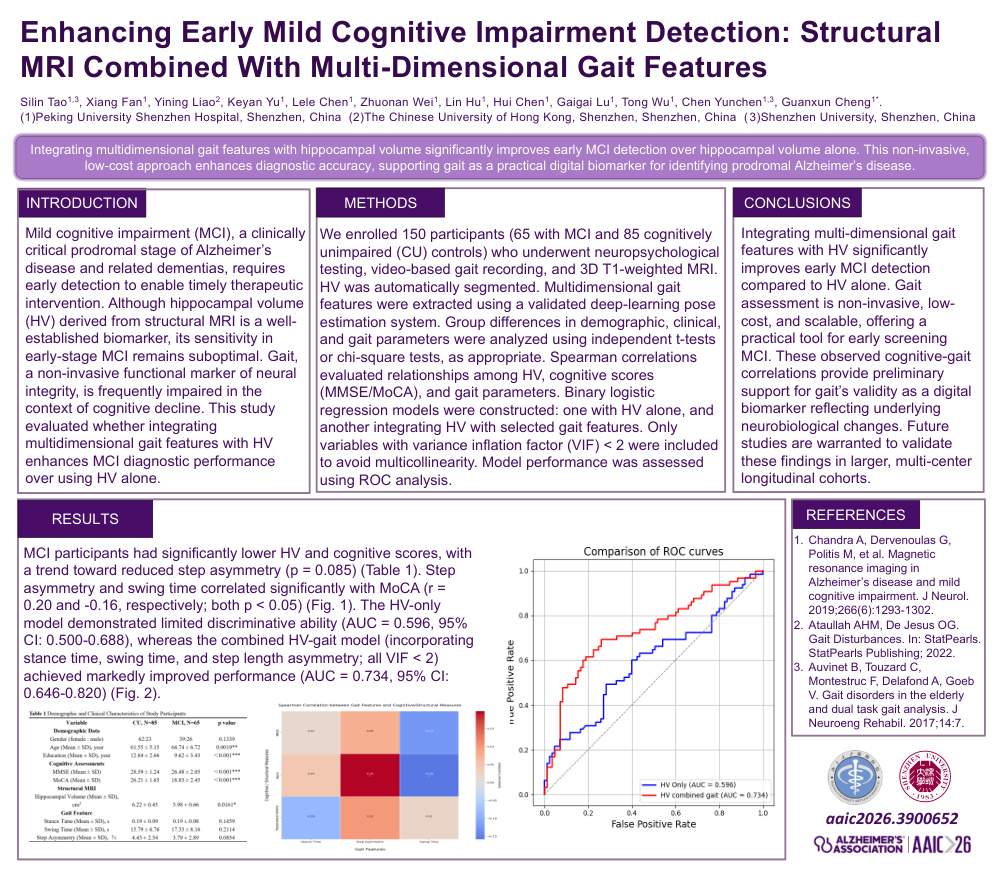
MCI participants had significantly lower HV and cognitive scores, with a trend toward reduced step asymmetry (p = 0.085) (Table 1). Step asymmetry and swing time correlated significantly with MoCA (r = 0.20 and -0.16, respectively; both p < 0.05) (Fig. 1). The HV-only model demonstrated limited discriminative ability (AUC = 0.596, 95% CI: 0.500-0.688), whereas the combined HV-gait model (incorporating stance time, swing time, and step length asymmetry; all VIF < 2) achieved markedly improved performance (AUC = 0.734, 95% CI: 0.646-0.820) (Fig. 2).
CONCLUSIONS
Integrating multi-dimensional gait features with HV significantly improves early MCI detection compared to HV alone. Gait assessment is non-invasive, low-cost, and scalable, offering a practical tool for early screening MCI. These observed cognitive-gait correlations provide preliminary support for gait’s validity as a digital biomarker reflecting underlying neurobiological changes. Future studies are warranted to validate these findings in larger, multi-center longitudinal cohorts.
REFERENCES
Comments
Email is required but is not shown publicly.
Loading comments...