4,068 posters, 219 videos, 101 topics, 69 sessions, 14,365 authors, 6,128 institutions
ePostersLive by SciGen Technologies S.A. All rights reserved.
Alzheimer's Association International Conference 2026
July 12-15, 2026 | London, United Kingdom, and Online

10762
Association of Selective Serotonin Reuptake Inhibitor Use With Tau Pathology in Older Adults Without Dementia
Poster Presenter
Authors
Maryam Abdolmaleki, Cara Lwin, Dandan Liu, Timothy Hohman, Henrik Zetterberg, Angela Jefferson, Corey Bolton
Affiliations
Vanderbilt Memory & Alzheimer’s Center, Vanderbilt University Medical Center, Nashville, TN, USA, Institute of Neuroscience and Physiology, The Sahlgrenska Academy at University of Gothenburg, Sweden;
Part of Topic
Background: Selective serotonin reuptake inhibitors (SSRIs) are among the most commonly prescribed medications in older adults and are frequently used in Alzheimer's disease (AD) given the high prevalence of depressive symptoms. A recent study reported that SSRI use was associated with lower plasma p-tau181 levels in patients with Alzheimer's disease dementia; however, associations in cognitively unimpaired and mild cognitive impairment populations remain unclear. This study examined the association between SSRI use and fluid tau biomarkers in older adults without dementia.
Methods: This cross-sectional study included 335 participants from the Vanderbilt Memory and Aging Project who were free of clinical dementia or stroke (mean age = 72.9 ± 7.3 years; 39.4% MCI). SSRI use was determined from baseline medication records. Plasma p-tau231 was measured using the Quanterix Simoa platform, and CSF total tau and p-tau181 were measured using the Fujirebio Lumipulse® G platform. Linear regression models examined associations between SSRI use and plasma and CSF biomarkers after adjustment for age, sex, education, race/ethnicity, cognitive status, and APOE-ε4 carrier status. Follow-up models assessed interactions by sex, cognitive status, amyloid status, and APOE genotype. Sensitivity analyses excluding outliers and false discovery rate correction were also performed.
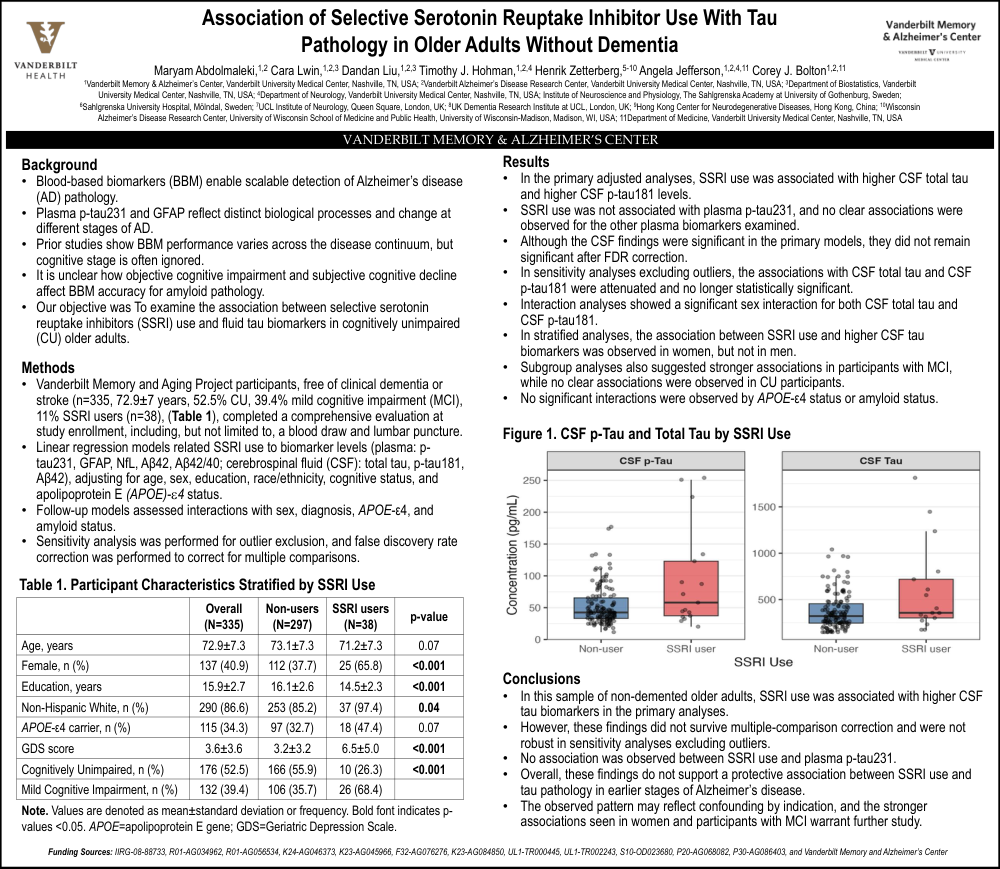
Results: Thirty-eight participants (11%) were taking SSRIs at baseline. In the primary adjusted analyses, SSRI use was associated with higher CSF total tau (β = 140.2, p = 0.03) and p-tau181 (β = 24.64, p = 0.02) but was not associated with plasma p-tau231 (p = 0.62). No associations were observed with the other plasma biomarkers. Significant interactions with sex were observed for both CSF biomarkers, with associations present in women but not men. No significant interactions were observed for cognitive status, amyloid status, or APOE genotype. Associations with CSF biomarkers did not remain significant after false discovery rate correction and were attenuated in sensitivity analyses excluding outliers.
Conclusions: In this cohort of older adults without dementia, SSRI use was associated with higher CSF tau biomarkers in the primary analyses but not with plasma p-tau231. However, these associations were not robust after multiple-comparison correction and sensitivity analyses. Overall, these findings do not support a protective association between SSRI use and tau pathology in the pre-dementia stages of AD. The stronger associations observed in women warrant further investigation and may reflect confounding by indication, whereby individuals with greater underlying AD pathology are more likely to experience neuropsychiatric symptoms and receive SSRI.
Keywords: Alzheimer's disease, SSRI, antidepressants, tau, cerebrospinal fluid, plasma biomarkers, p-tau181, p-tau231, mild cognitive impairment, aging.
Comments
Email is required but is not shown publicly.
Loading comments...