4,068 posters, 219 videos, 101 topics, 69 sessions, 14,365 authors, 6,128 institutions
ePostersLive by SciGen Technologies S.A. All rights reserved.
Alzheimer's Association International Conference 2026
July 12-15, 2026 | London, United Kingdom, and Online

7354
Immune, Blood-brain Barrier, And Metabolic Biomarkers Mediate Gut-brain Axis Crosstalk In Alzheimer's Disease
Poster Presenter
Authors
Jincheng Li, Ziyu Yuan, Jialin Li, Zhenqiu Liu, Yingzhe Wang, Mei Cui, Chen Suo, Li Jin, Ding Ding, Xingdong Chen, Yanfeng Jiang
Affiliations
State Key Laboratory of Genetics and Development of Complex Phenotypes, Human Phenome Institute, Research and Innovation Center, Shanghai Pudong Hospital, Zhangjiang Fudan International Innovation Center, and National Clinical Research Center for Aging and Medicine, Fudan University, Shanghai 200433, China., Fudan University Taizhou Institute of Health Sciences, Taizhou 225300, Jiangsu, China., State Key Laboratory of Genetics and Development of Complex Phenotypes, Human Phenome Institute, Research and Innovation Center, Shanghai Pudong Hospital, Zhangjiang Fudan International Innovation Center, and National Clinical, Department of Neurology, Huashan Hospital, Fudan University, Shanghai 200040, China., Ministry of Education Key Laboratory of Public Health Safety, Department of Epidemiology, School of Public Health, Fudan University, Shanghai 200032, China., Institute of Neurology, National Clinical Research Center for Aging and Medicine, National Center for Neurological Disorders, Huashan Hospital, Fudan University, Shanghai 200040, China.
Part of Topic
Abstract
Background: Gut microbiota may influence Alzheimer's disease (AD) pathogenesis by modulating host homeostasis. However, population-based causal evidence linking gut dysbiosis to Alzheimer’s disease pathogenesis, especially via immune, vascular, and metabolic pathways, remains insufficient.
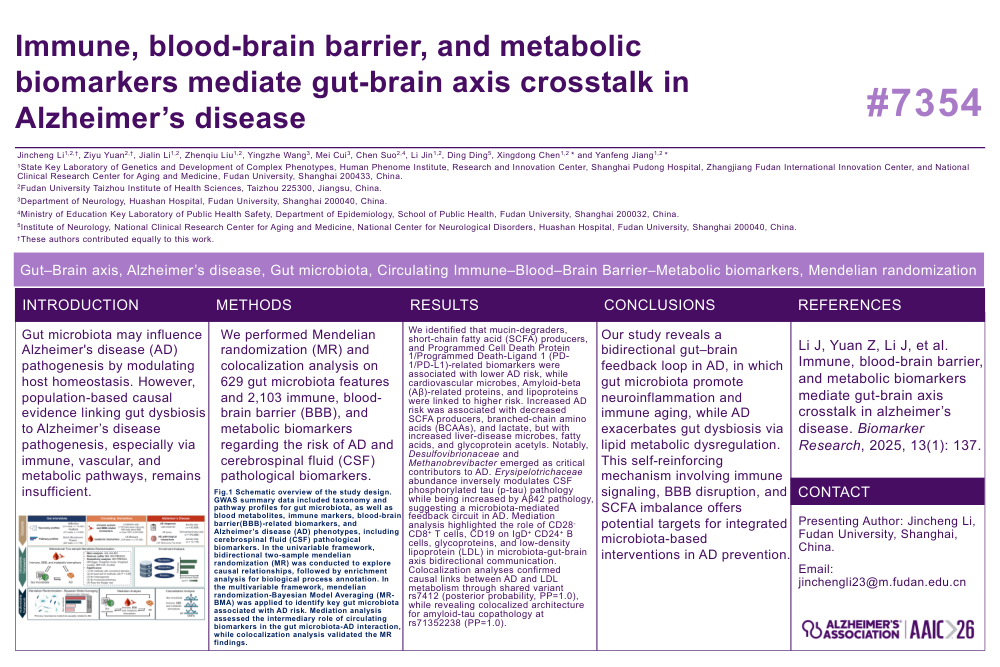
Methods: We performed Mendelian randomization (MR) and colocalization analysis on 629 gut microbiota features and 2,103 immune, blood-brain barrier (BBB), and metabolic biomarkers regarding the risk of AD and cerebrospinal fluid (CSF) pathological biomarkers.
Results: We identified that mucin-degraders, short-chain fatty acid (SCFA) producers, and Programmed Cell Death Protein 1/Programmed Death-Ligand 1 (PD-1/PD-L1)-related biomarkers were associated with lower AD risk, while cardiovascular microbes, Amyloid-beta (Aβ)-related proteins, and lipoproteins were linked to higher risk. Increased AD risk was associated with decreased SCFA producers, branched-chain amino acids (BCAAs), and lactate, but with increased liver-disease microbes, fatty acids, and glycoprotein acetyls. Notably, Desulfovibrionaceae and Methanobrevibacter emerged as critical contributors to AD. Erysipelotrichaceae abundance inversely modulates CSF phosphorylated tau (p-tau) pathology while being increased by Aβ42 pathology, suggesting a microbiota-mediated feedback circuit in AD. Mediation analysis highlighted the role of CD28-CD8+ T cells, CD19 on IgD+ CD24+ B cells, glycoproteins, and low-density lipoprotein (LDL) in microbiota-gut-brain axis bidirectional communication. Colocalization analyses confirmed causal links between AD and LDL metabolism through shared variant rs7412 (posterior probability, PP=1.0), while revealing colocalized architecture for amyloid-tau copathology at rs71352238 (PP=1.0).
Conclusions: Our study reveals a bidirectional gut–brain feedback loop in AD, in which gut microbiota promote neuroinflammation and immune aging, while AD exacerbates gut dysbiosis via lipid metabolic dysregulation. This self-reinforcing mechanism involving immune signaling, BBB disruption, and SCFA imbalance offers potential targets for integrated microbiota-based interventions in AD prevention.
Keywords
Gut–Brain Axis, Alzheimer’s Disease, Gut Microbiota, Circulating Immune–Blood–Brain Barrier–Metabolic Biomarkers, Mendelian randomization
Comments
Email is required but is not shown publicly.
Loading comments...