4,068 posters, 219 videos, 101 topics, 69 sessions, 14,365 authors, 6,128 institutions
ePostersLive by SciGen Technologies S.A. All rights reserved.
Alzheimer's Association International Conference 2026
July 12-15, 2026 | London, United Kingdom, and Online

5037
Longitudinal Trajectories Of AD Plasma Biomarkers And Related Factors In Cognitively Normal Adults: A Cohort Study
Part of Topic
Longitudinal Trajectories Of AD Plasma Biomarkers And Related Factors In Cognitively Normal Adults: A Cohort Study
Simeng Cui, Pejie Liu, Ningwei Hu, Qqi Qiang, Liangjun Dang, Suhang Shang, Qiumin Qu
Department of Neurology, The First Affiliated Hospital of Xi 'an Jiaotong University, Xi 'an, Shaanxi Province, China
Abstract
Background
Alzheimer's disease (AD) is characterized by dynamic changes in multiple biological pathways over time. Longitudinal evaluation of AD-related biomarkers is essential for understanding disease progression and identifying early pathophysiological changes. However, population-based studies integrating multiple biomarkers with extended follow-up periods among cognitively normal adults remain limited.
Methods
This longitudinal analysis was based on a population-based cohort in rural China, including 127 cognitively normal participants with plasma biomarker assessments conducted at three time points between 2016 and 2023. Plasma biomarkers included phosphorylated tau 217 (p-tau217), phosphorylated tau 181 (p-tau181), amyloid-β40 (Aβ40), amyloid-β42 (Aβ42), glial fibrillary acidic protein (GFAP), and neurofilament light chain (NfL). Generalized linear mixed-effects models were applied to evaluate longitudinal biomarker trajectories. All models were adjusted for baseline age, sex, years of education, apolipoprotein E (APOE) e4 carrier status and cognitive performance assessed by the Mini-Mental State Examination (MMSE).
Results
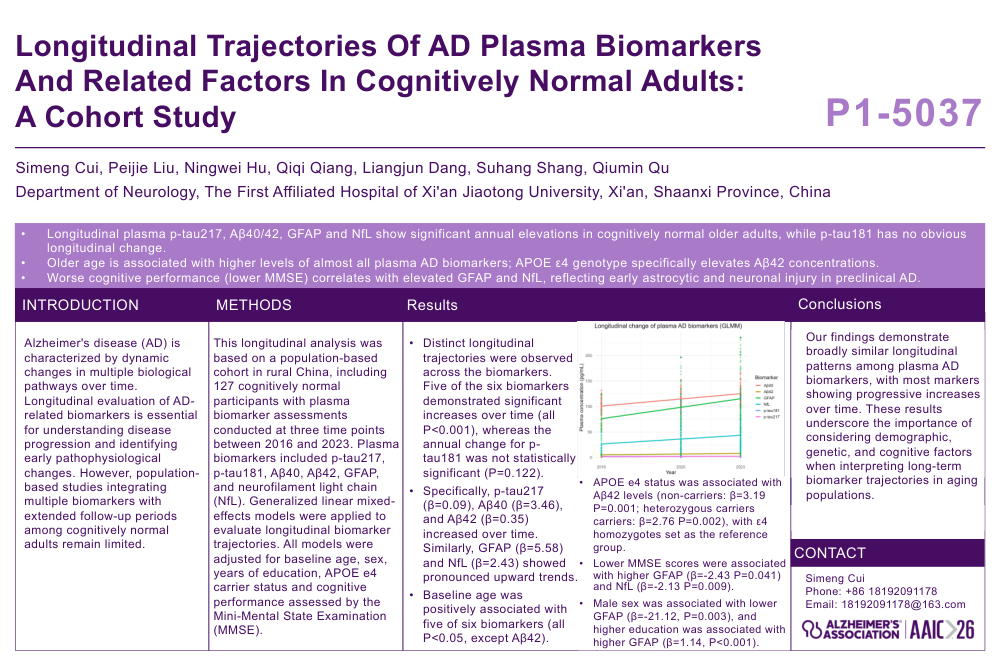
Distinct longitudinal trajectories were observed across the biomarkers. Five of the six biomarkers demonstrated significant increases over time (all P<0.001), whereas the annual change for p-tau181 was not statistically significant (P=0.122). Specifically, p-tau217 (β=0.09), Aβ40 (β=3.46), and Aβ42 (β=0.35) increased over time. Similarly, GFAP (β=5.58) and NfL (β=2.43) showed pronounced upward trends. All estimates were obtained from models adjusting for baseline age, sex, education, APOE e4 status, and MMSE score.
Baseline age was positively associated with five of six biomarkers (all P<0.05, except Aβ42). APOE e4 status was associated with Aβ42 levels (non-carriers: β = 3.19 P=0.001; carriers: β=2.76 P=0.002). Lower MMSE scores were associated with higher GFAP (β=-2.43 P=0.041) and NfL(β=-2.13 P=0.009). Male sex was associated with lower GFAP (β= -21.12, P=0.003), and higher education was associated with higher GFAP (β=1.14, P<0.001).
Conclusion
Our findings demonstrate broadly similar longitudinal patterns among plasma AD biomarkers, with most markers showing progressive increases over time. These results underscore the importance of considering demographic, genetic, and cognitive factors when interpreting long-term biomarker trajectories in aging populations.
Comments
Email is required but is not shown publicly.
Loading comments...