4,068 posters, 219 videos, 101 topics, 69 sessions, 14,365 authors, 6,128 institutions
ePostersLive by SciGen Technologies S.A. All rights reserved.
Alzheimer's Association International Conference 2026
July 12-15, 2026 | London, United Kingdom, and Online

5860
Modeling Sporadic Alzheimer’s Disease Across Aging: Behavioral Effects Of ICV Streptozotocin In Female Rats
Poster Presenter
Authors
Facundo Peralta, Ana Abril Vidal Escobedo, Julia Emilia Alejandra Diaz Baliero, Juan Ignacio Posada, Paula Cecilia Reggiani
Affiliations
Instituto de Investigaciones Bioquímicas de La Plata `Prof. Dr. Rodolfo R. Brenner´(CONICET-UNLP), Cátedra de Citología, Histología y Embriología, Facultad de Ciencias Médicas, UNLP
Part of Topic
Modeling Sporadic Alzheimer’s Disease Across Age: Behavioral Effects of ICV Streptozotocin in Female Rats
Peralta F.*1, Vidal Escobedo AA.*1, Díaz Baliero JEA.2, Posada JI.2, Reggiani PC.1,2.
1- Instituto de Investigaciones Bioquímicas de La Plata `Prof. Dr. Rodolfo R. Brenner´ (CONICET-UNLP)
2- Cátedra de Citología, Histología y Embriología, Facultad de Ciencias Médicas, UNLP
*FP&AAVE have equal contribution.
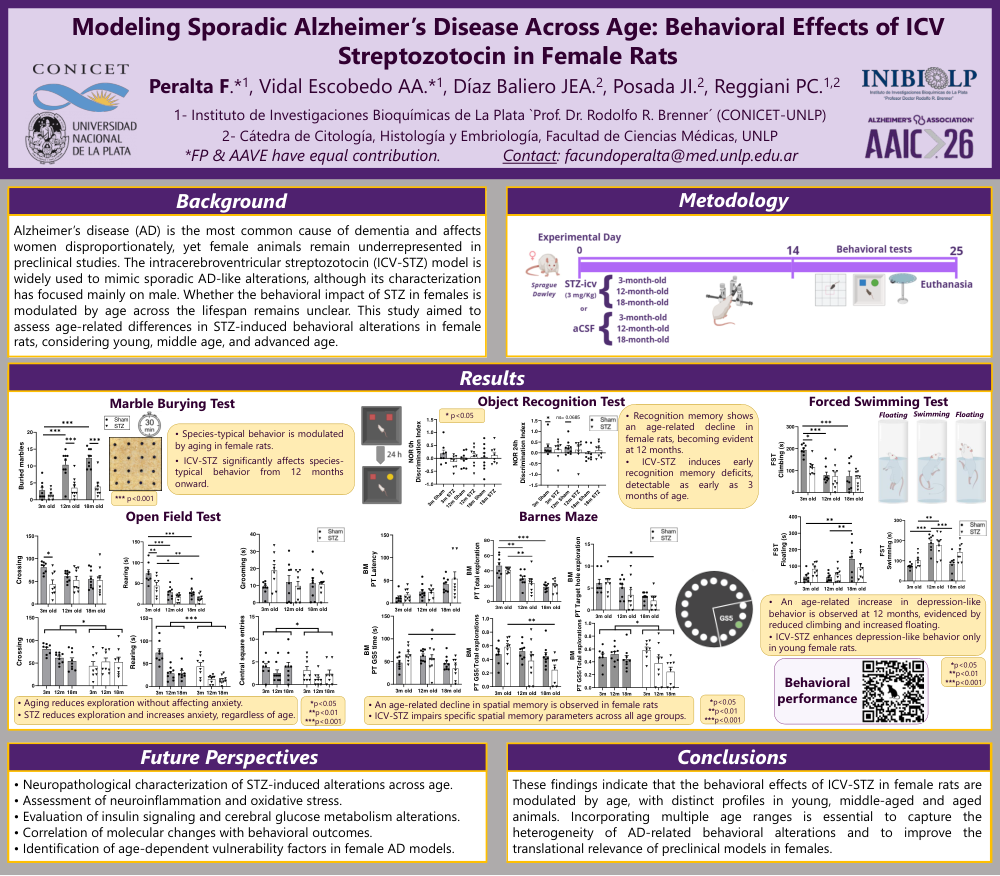
Background: Alzheimer’s disease (AD) is the most common cause of dementia and affects women disproportionately, yet female animals remain underrepresented in preclinical studies. The intracerebroventricular streptozotocin (ICV-STZ) model is widely used to mimic sporadic AD-like alterations, although its characterization has focused mainly on male. Whether the behavioral impact of STZ in females is modulated by age across the lifespan remains unclear. This study aimed to assess age-related differences in STZ-induced behavioral alterations in female rats, considering young, middle age, and advanced age.
Methods: Female Sprague-Dawley rats were assigned to Sham or STZ groups at three ages: 3, 12, and 18 months. On experimental day 0, animals received bilateral intracerebroventricular injections of artificial cerebrospinal fluid (Sham) or streptozotocin (3 mg/kg). Behavioral assessments were conducted between experimental days 14 and 25. Behavioral outcomes included species-typical behavior, exploration and anxiety, recognition memory, and depression-like behavior, assessed using standard behavioral paradigms.
Results: Behavioral analyses revealed that ICV-STZ induces alterations in female rats, with effects influenced by age and behavioral domain. Behavioral outcomes indicated that both age and STZ treatment shaped performance across the different tasks. In the marble burying test, species-typical behavior changed with age, and STZ effects differed depending on the age group analyzed. In the open field, exploratory activity and anxiety-related behaviors were influenced by aging, with specific parameters showing differential sensitivity to STZ. In the novel object recognition task, recognition memory was preserved in 3-month-old animals, whereas STZ exposure was associated with an early decline; from 12 months onward, performance appeared to be mainly affected by age per se. A similar age-dependent pattern was observed in the forced swim test, where younger animals predominantly adopted active coping strategies that markedly decreased from 12 months of age. STZ further modulated these behavioral responses in an age-dependent manner.
Conclusions: These findings indicate that the behavioral effects of ICV-STZ in female rats are modulated by age, with distinct profiles in young, middle-aged and aged animals. Incorporating multiple age ranges is essential to capture the heterogeneity of AD-related behavioral alterations and to improve the translational relevance of preclinical models in females.
Comments
Email is required but is not shown publicly.
Loading comments...