4,068 posters, 219 videos, 101 topics, 69 sessions, 14,365 authors, 6,128 institutions
ePostersLive by SciGen Technologies S.A. All rights reserved.
Alzheimer's Association International Conference 2026
July 12-15, 2026 | London, United Kingdom, and Online

10339
Weekend Warrior Vs Regularly Active: Long-term Fitbit-measured Physical Activity Patterns And Risk Of MCI And Dementia
Part of Topic
Learning Objectives
- Describe the association between long-term physical activity patterns (e.g., “weekend warrior” vs. regularly active) and the risk of mild cognitive impairment (MCI) and dementia in older adults.
- Interpret cumulative incidence curves and hazard ratios to compare how different physical activity patterns impact the development of MCI and dementia.
- Identify the implications of long-term wearable activity tracking for public health recommendations on physical activity and brain health in aging populations.
Background
Physical activity (PA) has been associated with reduced risk of mild cognitive impairment (MCI) and dementia, yet most prior evidence relies on short-term assessments that may not capture stable PA patterns over time. It remains unclear whether different long-term PA patterns – particularly “weekend warrior” vs. “regularly active” – are similarly associated with risk of MCI or dementia in older adults. We leveraged multi-year Fitbit data from the All of Us (AoU) Research Program, to examine associations between sustained PA patterns and incident MCI and dementia among adults aged ≥50 years.
Method
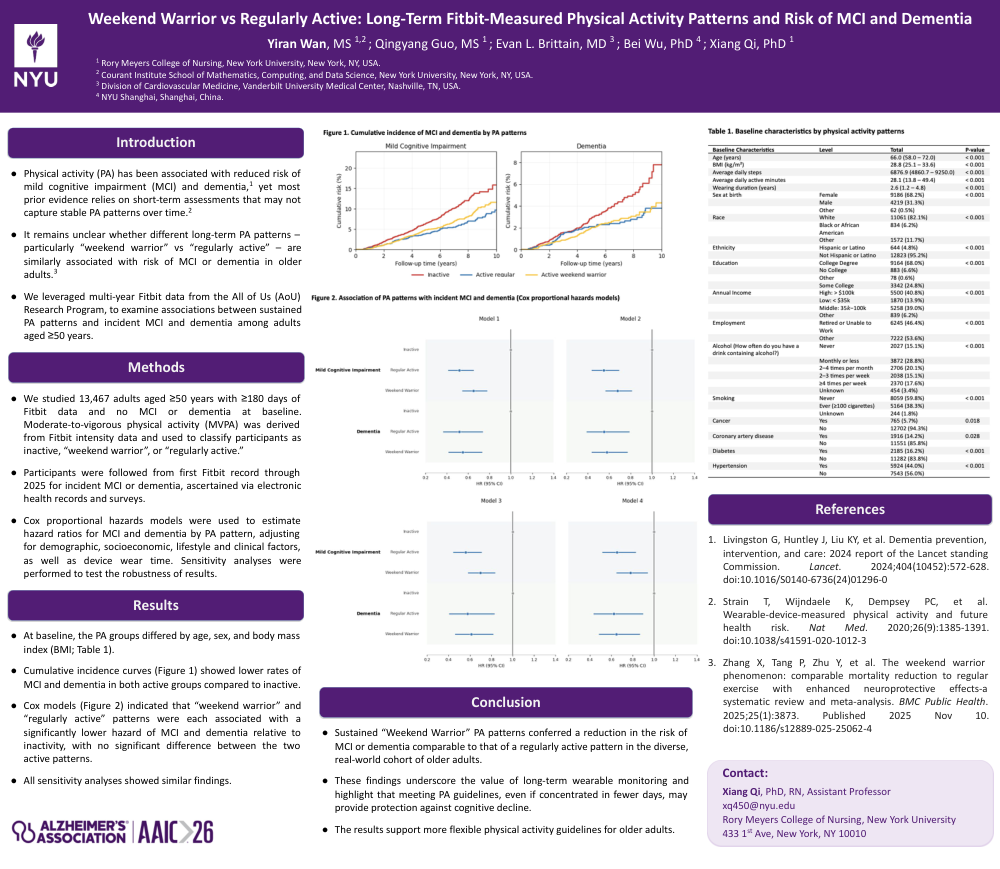
We studied 13,467 adults aged ≥50 years with ≥180 days of Fitbit data and no MCI or dementia at baseline. Moderate-to-vigorous physical activity (MVPA) was derived from Fitbit intensity data and used to classify participants as inactive, “weekend warrior,” or “regularly active.” Participants were followed from first Fitbit record through 2025 for incident MCI or dementia, ascertained via electronic health records and surveys. Cox proportional hazards models were used to estimate hazard ratios for MCI and dementia by PA pattern, adjusting for demographic, socioeconomic, lifestyle and clinical factors, as well as device wear time. Sensitivity analyses were performed to test the robustness of results.
Result
At baseline, the PA groups differed by age, sex, and body mass index (BMI; Table 1). Cumulative incidence curves (Figure 1) showed lower rates of MCI and dementia in both active groups compared to inactive. Cox models (Figure 2) indicated that “weekend warrior” and “regularly active” patterns were each associated with a significantly lower hazard of MCI and dementia relative to inactivity, with no significant difference between the two active patterns. All sensitivity analyses showed similar findings.
Conclusion
Sustained “weekend warrior” PA patterns conferred a reduction in the risk of MCI or dementia comparable to that of a regularly active pattern in this diverse, real-world cohort of older adults. These findings underscore the value of long-term wearable monitoring and highlight that meeting PA guidelines, even if concentrated in fewer days, may provide protection against cognitive decline. The results support more flexible physical activity guidelines for older adults.
Comments
Email is required but is not shown publicly.
Loading comments...