4,068 posters, 219 videos, 101 topics, 69 sessions, 14,365 authors, 6,128 institutions
ePostersLive by SciGen Technologies S.A. All rights reserved.
Alzheimer's Association International Conference 2026
July 12-15, 2026 | London, United Kingdom, and Online

5768
Regional Tau Burden Associated With Nitric Oxide-mediated Neurovascular Dysfunction In Mild Cognitive Impairment
Poster Presenter
Authors
Part of Topic
Regional Tau Burden Associated With Nitric Oxide-mediated
Neurovascular Dysfunction in Mild Cognitive Impairment
Baihua Ren¹, Alexander Cohen¹, Kelly Ristow¹, Yang Wang¹, Lei Fan²
¹Medical College of Wisconsin, Milwaukee, WI, USA ²Michigan State University, East Lansing, MI, USA AAIC 2026 • Virtual
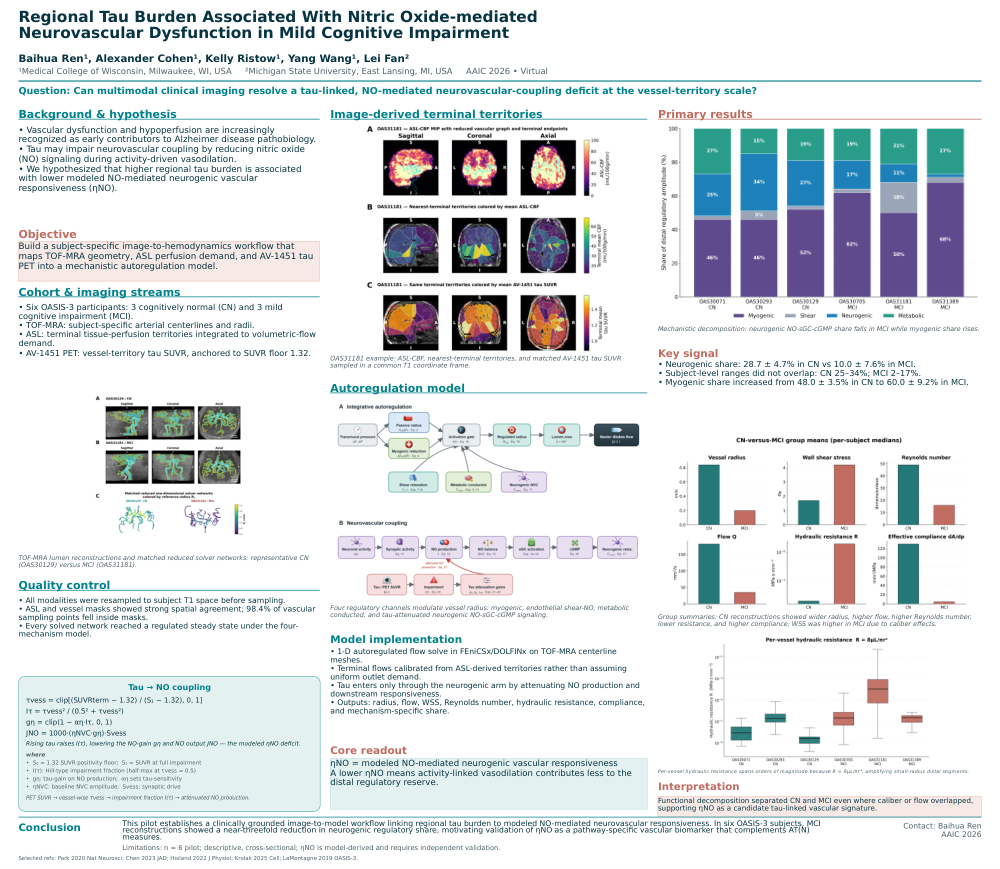
Question: Can multimodal clinical imaging resolve a tau-linked, NO-mediated neurovascular-coupling deficit at the vessel-territory scale?
Background & hypothesis
• Vascular dysfunction and hypoperfusion are increasingly recognized as early contributors to Alzheimer disease pathobiology.
• Tau may impair neurovascular coupling by reducing nitric oxide (NO) signaling during activity-driven vasodilation.
• We hypothesized that higher regional tau burden is associated with lower modeled NO-mediated neurogenic vascular responsiveness (ηNO).
Objective
Build a subject-specific image-to-hemodynamics workflow that maps TOF-MRA geometry, ASL perfusion demand, and AV-1451 tau PET into a mechanistic autoregulation model.
Cohort & imaging streams
• Six OASIS-3 participants: 3 cognitively normal (CN) and 3 mild cognitive impairment (MCI).
• TOF-MRA: subject-specific arterial centerlines and radii.
• ASL: terminal tissue-perfusion territories integrated to volumetric-flow demand.
• AV-1451 PET: vessel-territory tau SUVR, anchored to SUVR floor 1.32.
TOF-MRA lumen reconstructions and matched reduced solver networks: representative CN (OAS30129) versus MCI (OAS31181).
Quality control
• All modalities were resampled to subject T1 space before sampling.
• ASL and vessel masks showed strong spatial agreement; 98.4% of vascular sampling points fell inside masks.
• Every solved network reached a regulated steady state under the four-mechanism model.
Image-derived terminal territories
OAS31181 example: ASL-CBF, nearest-terminal territories, and matched AV-1451 tau SUVR sampled in a common T1 coordinate frame.
Autoregulation model
Four regulatory channels modulate vessel radius: myogenic, endothelial shear-NO, metabolic conducted, and tau-attenuated neurogenic NO-sGC-cGMP signaling.
Model implementation
• 1-D autoregulated flow solve in FEniCSx/DOLFINx on TOF-MRA centerline meshes.
• Terminal flows calibrated from ASL-derived territories rather than assuming uniform outlet demand.
• Tau enters only through the neurogenic arm by attenuating NO production and downstream responsiveness.
• Outputs: radius, flow, WSS, Reynolds number, hydraulic resistance, compliance, and mechanism-specific share.
Core readout
ηNO = modeled NO-mediated neurogenic vascular responsiveness
A lower ηNO means activity-linked vasodilation contributes less to the distal regulatory reserve.
Primary results
Mechanistic decomposition: neurogenic NO-sGC-cGMP share falls in MCI while myogenic share rises.
Key signal
• Neurogenic share: 28.7 ± 4.7% in CN vs 10.0 ± 7.6% in MCI.
• Subject-level ranges did not overlap: CN 25–34%; MCI 2–17%.
• Myogenic share increased from 48.0 ± 3.5% in CN to 60.0 ± 9.2% in MCI.
Group summaries: CN reconstructions showed wider radius, higher flow, higher Reynolds number, lower resistance, and higher compliance; WSS was higher in MCI due to caliber effects.
Per-vessel hydraulic resistance spans orders of magnitude because R = 8μL/πr⁴, amplifying small-radius distal segments.
Interpretation
Functional decomposition separated CN and MCI even where caliber or flow overlapped, supporting ηNO as a candidate tau-linked vascular signature.
Conclusion
This pilot establishes a clinically grounded image-to-model workflow linking regional tau burden to modeled NO-mediated neurovascular responsiveness. In six OASIS-3 subjects, MCI reconstructions showed a near-threefold reduction in neurogenic regulatory share, motivating validation of ηNO as a pathway-specific vascular biomarker that complements AT(N) measures.
Limitations: n = 6 pilot; descriptive, cross-sectional; ηNO is model-derived and requires independent validation.
Contact: Baihua Ren
AAIC 2026
Selected refs: Park 2020 Nat Neurosci; Chen 2023 JAD; Hoiland 2022 J Physiol; Krolak 2025 Cell; LaMontagne 2019 OASIS-3.
Tau → NO coupling
τvess = clip[(SUVRterm − 1.32) / (S₁ − 1.32), 0, 1]
Iτ = τvess² / (0.5² + τvess²)
gη = clip(1 − αη·Iτ, 0, 1)
JNO = 1000·(ηNVC·gη)·Svess
Rising tau raises I(τ), lowering the NO-gain gη and NO output JNO — the modeled ηNO deficit.
where
• S₀ = 1.32 SUVR positivity floor; S₁ = SUVR at full impairment
• I(τ): Hill-type impairment fraction (half-max at τvess = 0.5)
• gη: tau-gain on NO production; αη sets tau-sensitivity
• ηNVC: baseline NVC amplitude; Svess: synaptic drive
PET SUVR → vessel-wise τvess → impairment fraction I(τ) → attenuated NO production.
Comments
Email is required but is not shown publicly.
Loading comments...