4,068 posters, 219 videos, 101 topics, 69 sessions, 14,365 authors, 6,128 institutions
ePostersLive by SciGen Technologies S.A. All rights reserved.
Alzheimer's Association International Conference 2026
July 12-15, 2026 | London, United Kingdom, and Online

9052
Renal Function Influences Blood-based Alzheimer'S Disease Biomarkers In A Disease-stage-dependent Manner: The Pumch Dementia Cohort
Poster Presenter
Authors
Yunfan You, Yuyue Qiu, Tianyi Wang, Yuanheng Li, Wenjun Wang, Yuhan Jiang, Xinying Huang, Dan Lei, Meiqi Wu, Feng Feng, Ling Qiu, Liling Dong, Chenhui Mao, Jing Gao
Affiliations
Neurology, State Key Laboratory of Complex Severe and Rare Disease, Peking Union Medical College Hospital, Chinese Academy of Medical Science and Peking Union Medical College, Beijing, China, Clinical Laboratory, Peking Union Medical College Hospital, Chinese Academy of Medical Science and Peking Union Medical College, Beijing, China, Nuclear Medicine, Peking Union Medical College Hospital, Chinese Academy of Medical Science and Peking Union Medical College, Beijing, China, Radiology, State Key Laboratory of Complex Severe and Rare Disease, Peking Union Medical College Hospital, Chinese Academy of Medical Science and Peking Union Medical College, Beijing, China
Part of Topic
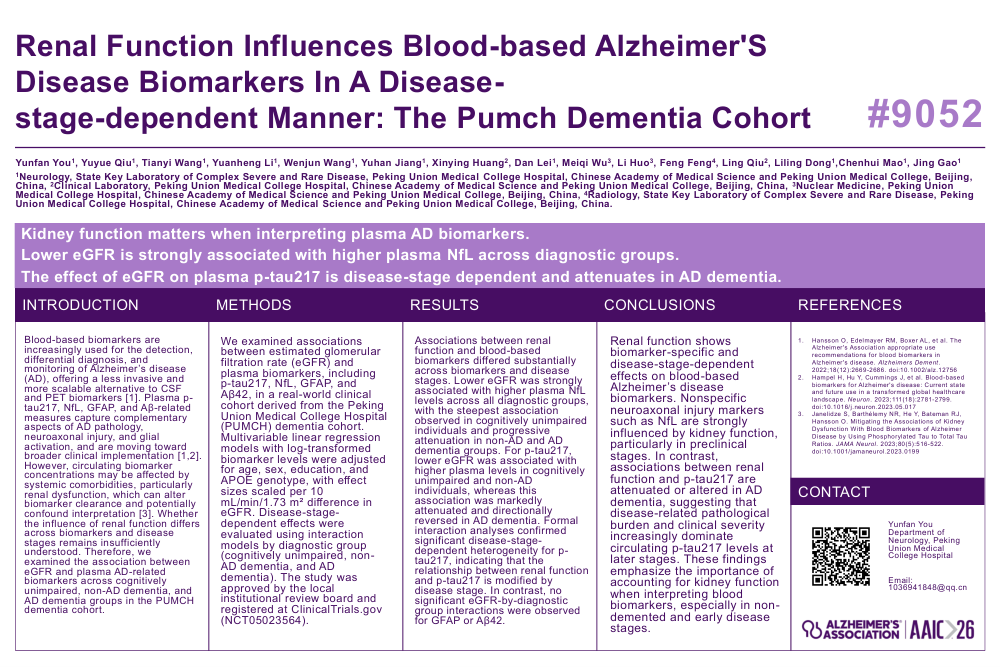
Background: Blood-based biomarkers have shown promise for the detection and monitoring of Alzheimer's disease (AD); however, their circulating levels may be influenced by systemic factors such as renal function. How kidney function differentially affects AD-related blood biomarkers across disease stages remains incompletely understood.
Methods: We examined associations between estimated glomerular filtration rate (eGFR) and plasma biomarkers, including p-tau217, NfL, GFAP, and Aβ42, in a real-world clinical cohort derived from the Peking Union Medical College Hospital (PUMCH) dementia cohort. Multivariable linear regression models with log-transformed biomarker levels were adjusted for age, sex, education, and APOE genotype, with effect sizes scaled per 10 mL/min/1.73 m² difference in eGFR. Disease-stage-dependent effects were evaluated using interaction models by diagnostic group (cognitively unimpaired, non-AD dementia, and AD dementia). The study was approved by the local institutional review board and registered at ClinicalTrials.gov (NCT05023564).
Results: Associations between renal function and blood-based biomarkers differed substantially across biomarkers and disease stages. Lower eGFR was strongly associated with higher plasma NfL levels across all diagnostic groups, with the steepest association observed in cognitively unimpaired individuals and progressive attenuation in non-AD and AD dementia groups. For p-tau217, lower eGFR was associated with higher plasma levels in cognitively unimpaired and non-AD individuals, whereas this association was markedly attenuated and directionally reversed in AD dementia. Formal interaction analyses confirmed significant disease-stage-dependent heterogeneity for p-tau217, indicating that the relationship between renal function and p-tau217 is modified by disease stage. In contrast,no significant eGFR-by-diagnostic group interactions were observed for GFAP or Aβ42.
Conclusion: Renal function shows biomarker-specific and disease-stage-dependent effects on blood-based Alzheimer's disease biomarkers. Nonspecific neuroaxonal injury markers such as NfL are strongly influenced by kidney function, particularly in preclinical stages. In contrast, associations between renal function and p-tau217 are attenuated or altered in AD dementia, suggesting that disease-related pathological burden and clinical severity increasingly dominate circulating p-tau217 levels at later stages. These findings emphasize the importance of accounting for kidney function when interpreting blood biomarkers, especially in non-demented and early disease stages.
Comments
Email is required but is not shown publicly.
Loading comments...