4,068 posters, 219 videos, 101 topics, 69 sessions, 14,365 authors, 6,128 institutions
ePostersLive by SciGen Technologies S.A. All rights reserved.
Alzheimer's Association International Conference 2026
July 12-15, 2026 | London, United Kingdom, and Online

10462
Determining The Impact Of Chronic Comorbidities On The Accuracy Of Blood-based Biomarkers For Diagnosing Amyloid Status.
Poster Presenter
Authors
Bhargavi Ramamurthy, Yunyi Sun, Dominic Roby, Timothy Hohman, Henrik Zetterberg, Angela Jefferson, Corey Bolton
Affiliations
Vanderbilt Memory and Alzheimer’s Center, Vanderbilt University School of Medicine, Nashville, TN, USA, Institute of Neuroscience and Physiology, The Sahlgrenska Academy at University of Gothenburg, Mölndal, Sweden
Part of Topic
Video
Background
•The diagnostic accuracy of blood-based biomarkers (BBMs) of Alzheimer’s disease (AD) is known to be impacted by comorbid conditions such as chronic kidney disease and obesity. The effect of other chronic medical conditions on BBM accuracy is less understood.
•This study examines the moderating effect of various chronic medical conditions on the ability of BBMs to diagnose amyloid positivity.
Methods
•Participants: Vanderbilt Memory and Aging Project participants, free of clinical dementia or stroke (n=154, 72±6 years, 37% mild cognitive impairment (MCI)), completed baseline fasting blood draw, lumbar puncture and self-reported medical history form; see Table 1.
•Biomarkers and Medical Conditions: plasma p-tau231, glial fibrillary acidic protein (GFAP), neurofilament light (NfL), beta-amyloid42, beta-amyloid40, and beta-amyloid42/40 were quantified using the Quanterix Simoa platform. Amyloid positivity was defined as cerebrospinal fluid Aβ42/40 ratio of <0.072. Over 25 medical conditions were assessed as present/absent.
•Statistical Analysis: Logistic regression models related BBMs to amyloid positivity. Models included BBM x chronic medical condition interaction terms. Significant interactions were followed by stratified analyses to compare associations among participants with and without the condition.
•Participants: Vanderbilt Memory and Aging Project participants, free of clinical dementia or stroke (n=154, 72±6 years, 37% mild cognitive impairment (MCI)), completed baseline fasting blood draw, lumbar puncture and self-reported medical history form; see Table 1.
•Biomarkers and Medical Conditions: plasma p-tau231, glial fibrillary acidic protein (GFAP), neurofilament light (NfL), beta-amyloid42, beta-amyloid40, and beta-amyloid42/40 were quantified using the Quanterix Simoa platform. Amyloid positivity was defined as cerebrospinal fluid Aβ42/40 ratio of <0.072. Over 25 medical conditions were assessed as present/absent.
•Statistical Analysis: Logistic regression models related BBMs to amyloid positivity. Models included BBM x chronic medical condition interaction terms. Significant interactions were followed by stratified analyses to compare associations among participants with and without the condition.
Results
Interaction models:
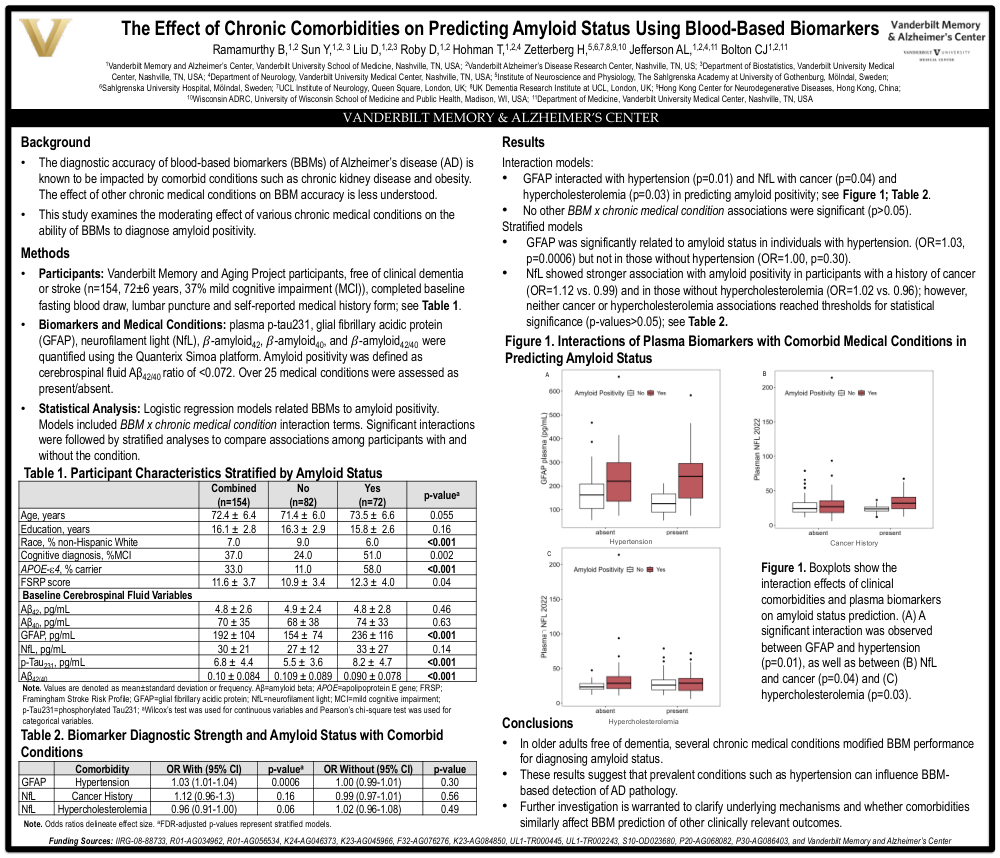
•GFAP interacted with hypertension (p=0.01) and NfL with cancer (p=0.04) and hypercholesterolemia (p=0.03) in predicting amyloid positivity; see Figure 1; Table 2.
•No other BBM x chronic medical condition associations were significant (p>0.05).
Stratified models
•GFAP was significantly related to amyloid status in individuals with hypertension. (OR=1.03, p=0.0006) but not in those without hypertension (OR=1.00, p=0.30).
•NfL showed stronger association with amyloid positivity in participants with a history of cancer (OR=1.12 vs. 0.99) and in those without hypercholesterolemia (OR=1.02 vs. 0.96); however, neither cancer or hypercholesterolemia associations reached thresholds for statistical significance (p-values>0.05); see Table 2.
Conclusions
•In older adults free of dementia, several chronic medical conditions modified BBM performance for diagnosing amyloid status.
•These results suggest that prevalent conditions such as hypertension can influence BBM-based detection of AD pathology.
•Further investigation is warranted to clarify underlying mechanisms and whether comorbidities similarly affect BBM prediction of other clinically relevant outcomes.
Comments
Email is required but is not shown publicly.
Loading comments...