4,068 posters, 219 videos, 101 topics, 69 sessions, 14,365 authors, 6,128 institutions
ePostersLive by SciGen Technologies S.A. All rights reserved.
Alzheimer's Association International Conference 2026
July 12-15, 2026 | London, United Kingdom, and Online

6887
Glial Fibrillary Acidic Protein-based Phenotyping Reveals Early Cognitive And Pathological Profiles In Cognitively Unimpaired Adults
Poster Presenter
Part of Topic
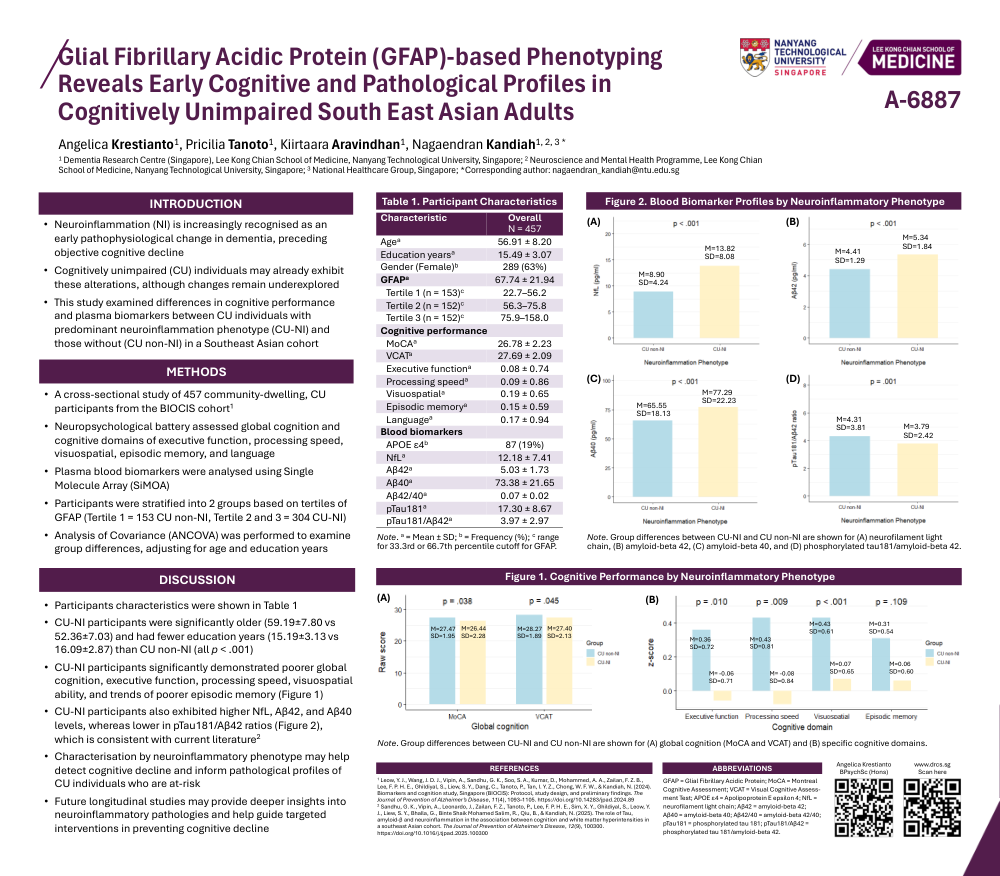
Glial Fibrillary Acidic Protein (GFAP)-based Phenotyping Reveals Early Cognitive and Pathological Profiles in Cognitively Unimpaired South East Asian Adults (A-6887)
Angelica Krestianto1, Pricilia Tanoto1, Kiirtaara Aravindhan1, Nagaendran Kandiah1, 2, 3 *
1 Dementia Research Centre (Singapore), Lee Kong Chian School of Medicine, Nanyang Technological University, Singapore; 2 Neuroscience and Mental Health Programme, Lee Kong Chian School of Medicine, Nanyang Technological University, Singapore; 3 National Healthcare Group, Singapore; * Corresponding author: nagaendran_kandiah@ntu.edu.sg
Introduction
Neuroinflammation (NI) is increasingly recognised as an early pathophysiological change in dementia, preceding objective cognitive decline
Cognitively unimpaired (CU) individuals may already exhibit these alterations, although changes remain underexplored
This study examined differences in cognitive performance and plasma biomarkers between CU individuals with predominant neuroinflammation phenotype (CU-NI) and those without (CU non-NI) in a Southeast Asian cohort
Methods
A cross-sectional study of 457 community-dwelling, CU participants from the BIOCIS cohort1
Neuropsychological battery assessed global cognition and cognitive domains of executive function, processing speed, visuospatial, episodic memory, and language
Plasma blood biomarkers were analysed using Single Molecule Array (SiMOA)
Participants were stratified into 2 groups based on tertiles of GFAP (Tertile 1 = 153 CU non-NI, Tertile 2 and 3 = 304 CU-NI)
Analysis of Covariance (ANCOVA) was performed to examine group differences, adjusting for age and education years
Discussion
Participants characteristics were shown in Table 1
CU-NI participants were significantly older (59.19±7.80 vs 52.36±7.03) and had fewer education years (15.19±3.13 vs 16.09±2.87) than CU non-NI (all p < .001)
CU-NI participants significantly demonstrated poorer global cognition, executive function, processing speed, visuospatial ability, and trends of poorer episodic memory (Figure 1)
CU-NI participants also exhibited higher NfL, Aβ42, and Aβ40 levels, whereas lower in pTau181/Aβ42 ratios (Figure 2), which is consistent with current literature2
Characterisation by neuroinflammatory phenotype may help detect cognitive decline and inform pathological profiles of CU individuals who are at-risk
Future longitudinal studies may provide deeper insights into neuroinflammatory pathologies and help guide targeted interventions in preventing cognitive decline
References
1 Leow, Y. J., Wang, J. D. J., Vipin, A., Sandhu, G. K., Soo, S. A., Kumar, D., Mohammed, A. A., Zailan, F. Z. B., Lee, F. P. H. E., Ghildiyal, S., Liew, S. Y., Dang, C., Tanoto, P., Tan, I. Y. Z., Chong, W. F. W., & Kandiah, N. (2024). Biomarkers and cognition study, Singapore (BIOCIS): Protocol, study design, and preliminary findings. The Journal of Prevention of Alzheimer’s Disease, 11(4), 1093–1105. https://doi.org/10.14283/jpad.2024.89
2 Sandhu, G. K., Vipin, A., Leonardo, J., Zailan, F. Z., Tanoto, P., Lee, F. P. H. E., Sim, X. Y., Ghildiyal, S., Leow, Y. J., Liew, S. Y., Bhalla, G., Binte Shaik Mohamed Salim, R., Qiu, B., & Kandiah, N. (2025). The role of Tau, amyloid-β and neuroinflammation in the association between cognition and white matter hyperintensities in a southeast Asian cohort. The Journal of Prevention of Alzheimer’s Disease, 12(9), 100300. https://doi.org/10.1016/j.tjpad.2025.100300
Abbreviations
GFAP = Glial Fibrillary Acidic Protein; MoCA = Montreal Cognitive Assessment; VCAT = Visual Cognitive Assessment Test; APOE ε4 = Apolipoprotein E epsilon 4; NfL = neurofilament light chain; Aβ42 = amyloid-beta 42; Aβ40 = amyloid-beta 40; Aβ42/40 = amyloid-beta 42/40; pTau181 = phosphorylated tau 181; pTau181/Aβ42 = phosphorylated tau 181/amyloid-beta 42.
Comments
Email is required but is not shown publicly.
Loading comments...