4,068 posters, 219 videos, 101 topics, 69 sessions, 14,365 authors, 6,128 institutions
ePostersLive by SciGen Technologies S.A. All rights reserved.
Alzheimer's Association International Conference 2026
July 12-15, 2026 | London, United Kingdom, and Online

8615
Pathways Linking Modifiable Protective And Risk Factors, Multimodal Alzheimer’s Biomarkers, And Cognition: Preliminary Findings
Poster Presenter
Part of Topic
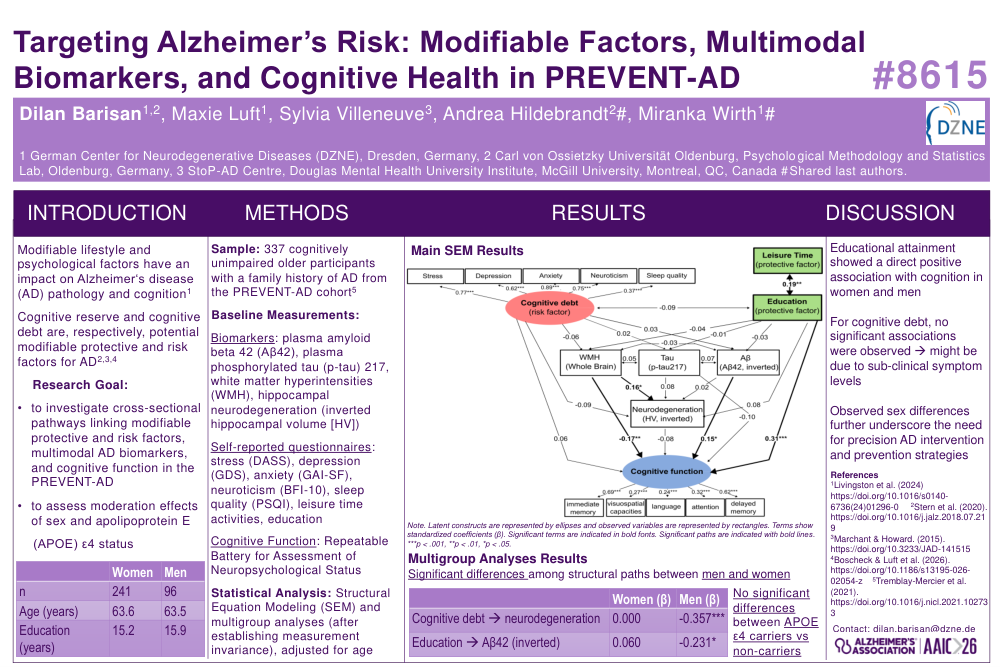
Background: Findings from the DELCODE cohort (Boscheck and Luft et al., 2025, under review) show that higher cognitive reserve, but not lower cognitive debt, is associated with cognitive resilience in older adults in the context of AD-related brain pathology and increased AD risk. We aimed to conceptually replicate these findings in the independent PREVENT-AD cohort. We investigated cross-sectional pathways linking modifiable protective and risk factors, multimodal AD biomarkers, and cognitive function, and assessed whether these relationships were moderated by biological sex and apolipoprotein E (APOE) ε4 status.
Methods: Baseline data from the PREVENT-AD cohort were analyzed. The sample included 337 cognitively unimpaired older adults with family history of AD (mean age = 63.6 years; 72% women). Structural equation modeling (SEM) with multigroup analyses was conducted. Cognitive reserve was indexed by observed measures of education and leisure time activities, since a latent variable of cognitive reserve could not be reliably identified. Cognitive debt was modeled as a latent variable indicated by depression, anxiety, neuroticism, poor sleep quality, and life stress. Cognitive function was modeled as a latent variable indicated by five subtests from a comprehensive neuropsychological battery. Multimodal biomarkers of whole-brain white matter hyperintensities (WMH), plasma amyloid-β42 (Aβ42-inverted), plasma phosphorylated tau-217 (p-tau217), and hippocampal volume (adjusted and inverted) were included as observed measures. Age was included as covariate.
Results: Greater cognitive function was linked to higher education (p<.001), and this positive association was maintained across AD risk groups. No such association was observed for leisure time activities or for cognitive debt. Poorer cognitive function was linked to greater WMH (p = .006); this association was not found for the remaining multimodal biomarkers. Multigroup analyses showed sex-specific differences: In men, lower Aβ42 pathology was linked to higher education (p=.027); no such association was found in women. There were no significant differences between APOE ε4 carriers vs. non-carriers.
Conclusion: We replicate that educational attainment, a cognitive reserve proxy, supports cognitive resilience to brain pathology in cognitively unimpaired older adults, including those at increased AD risk. Newly observed sex-specific pathways highlight the importance of individualized prevention strategies.
Keywords: AD biomarkers, cognitive reserve, resilience, cognitive debt, Structural Equation Modeling (SEM)
Comments
Email is required but is not shown publicly.
Loading comments...