4,068 posters, 219 videos, 101 topics, 69 sessions, 14,365 authors, 6,128 institutions
ePostersLive by SciGen Technologies S.A. All rights reserved.
Alzheimer's Association International Conference 2026
July 12-15, 2026 | London, United Kingdom, and Online

4759
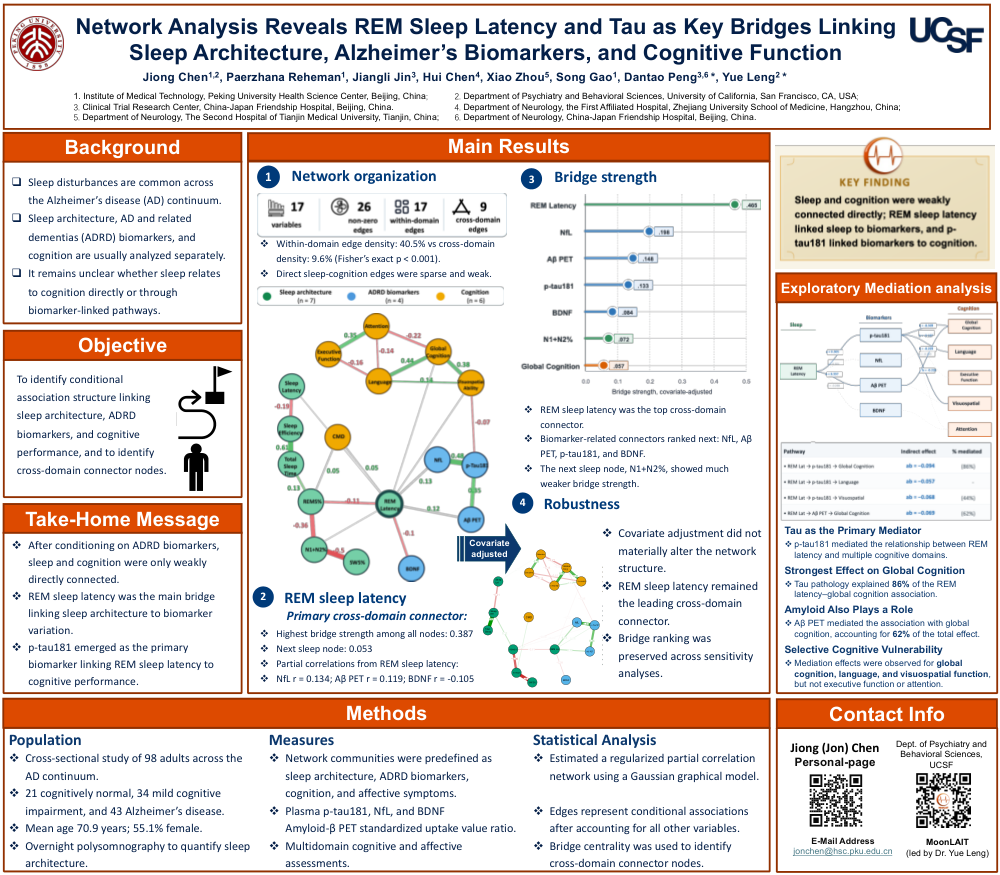
Rem Sleep Latency As A Cross-domain Bridge Linking Adrd Biomarkers And Cognition Across The Alzheimer’S Disease Spectrum
Poster Presenter
Authors
Jiong Chen, Paerzhana Reheman, Jiangli Jin, Hui Chen, Xiao Zhou, Song Gao, Dantao Peng, Yue Leng
Affiliations
Department of Psychiatry and Behavioral Sciences, University of California, San Francisco, CA, USA, Institute of Medical Technology, Peking University Health Science Center, Beijing, China, Department of Psychiatry and Behavioral Sciences, University of California, San Francisco, CA, USA;, Clinical Trial Research Center, China-Japan Friendship Hospital, Beijing, China, Department of Neurology, the First Affiliated Hospital, Zhejiang University School of Medicine, Hangzhou, China, Department of Neurology, The Second Hospital of Tianjin Medical University, Tianjin, China, Department of Neurology, China-Japan Friendship Hospital, Beijing, China
Part of Topic
Background
Sleep macro-architecture has been inconsistently associated with Alzheimer’s disease and related dementias (ADRD), partly due to conventional analyses that focus on isolated, pairwise relationships between sleep features, biomarkers, and cognition. However, sleep disturbances, neurodegeneration, and cognitive impairment form an interdependent system across multiple interacting domains. Network analysis offers a systems-level approach by estimating conditional (partial) associations and quantifying the relative importance of variables, enabling identification of central and bridge features linking sleep architecture to ADRD biology and cognition beyond traditional regression models.
Methods
We included 128 participants (23 cognitively normal, 41 mild cognitive impairment [MCI], 64 Alzheimer’s disease [AD]) with overnight polysomnography, plasma biomarker measurements, Aβ PET imaging, and domain-specific cognitive testing. Sleep macro-architecture measures included total sleep time, sleep efficiency, sleep onset latency, REM sleep latency, and sleep stage proportions. ADRD biomarkers included plasma p-tau181, neurofilament light chain (NfL), brain-derived neurotrophic factor (BDNF), and Aβ PET burden. A partial-correlation network was constructed to estimate conditional associations among sleep, biomarkers, and cognition. Node importance was quantified using centrality metrics (strength, betweenness, expected influence).
Results
Plasma p-tau181 was significantly higher in AD compared with cognitively normal participants and those with MCI (median 3.5 vs 2.8 and 2.0 pg/mL, respectively; p < 0.001), along with higher Aβ PET burden (p<0.05). In the network analysis, REM sleep latency ranked as the most central sleep feature. REM latency showed the strongest associations with ADRD biomarkers, including p-tau181 (r=0.253), NfL (r=0.276), BDNF (r=−0.226), and Aβ PET (r=0.261). Conditional network edges demonstrated partial correlations of +0.23 between REM latency and Aβ PET and −0.23 between REM latency and BDNF (Fig. 1). Network centrality metrics, particularly expected influence, remained stable across case-dropping bootstrap analyses (Fig. 2). Within the biomarker network, plasma p-tau181 exhibited the highest expected influence and showed the strongest associations with cognition, including global cognition (r=−0.31) and language performance (r=−0.27), defining a dominant pathway linking REM sleep latency to cognitive impairment via tau pathology (Fig. 3).
Conclusion
Network-based analysis identifies REM sleep latency and tau pathology as key integrative features linking sleep macro-architecture to ADRD biomarkers and cognitive impairment, supporting REM sleep latency as a clinically accessible marker relevant to ADRD pathophysiology.
Comments
Email is required but is not shown publicly.
Loading comments...