4,068 posters, 219 videos, 101 topics, 69 sessions, 14,365 authors, 6,128 institutions
ePostersLive by SciGen Technologies S.A. All rights reserved.
Alzheimer's Association International Conference 2026
July 12-15, 2026 | London, United Kingdom, and Online

2465
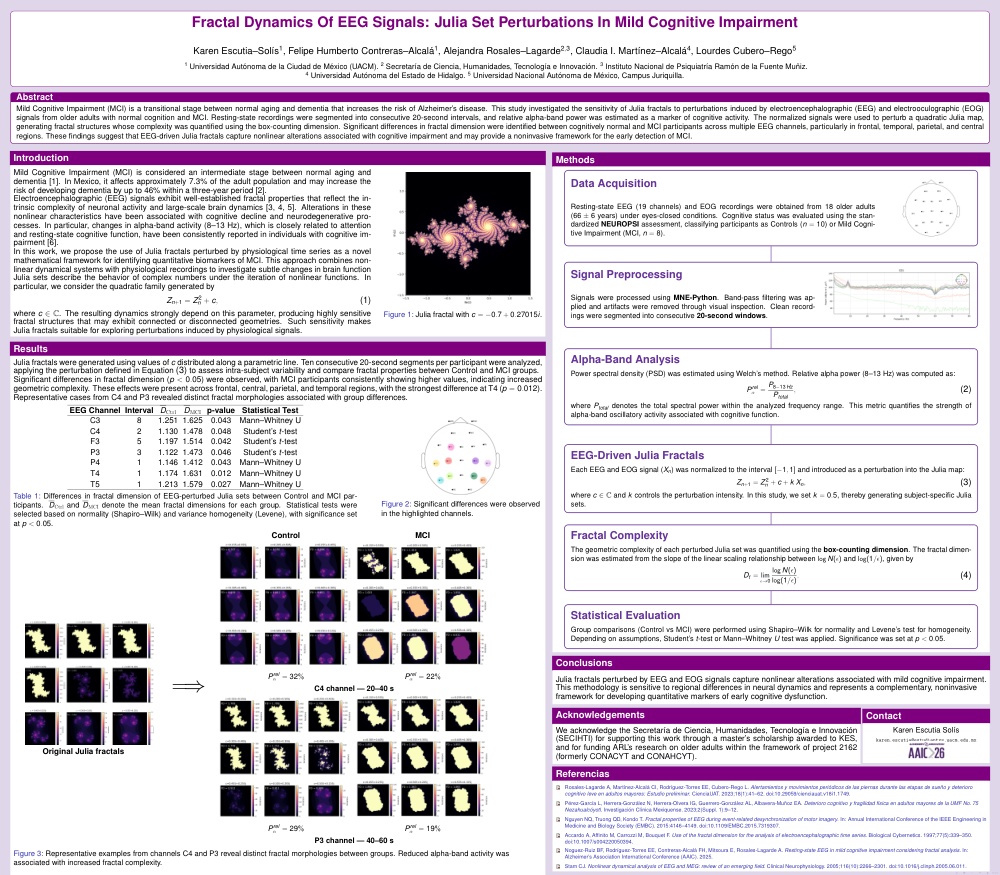
Fractal Dynamics Of Eeg Signals: Julia Set Perturbations In Mild Cognitive Impairment
Poster Presenter
Authors
Karen Escutia-Solis, Felipe Humberto Contreras–Alcalá, Alejandra Rosales–Lagarde, Claudia I. Martínez–Alcalá, Lourdes Cubero–Rego
Affiliations
Universidad Autónoma de la Ciudad de México (UACM)., Secretaría de Ciencia, Humanidades, Tecnología e Innovación. Instituto Nacional de Psiquiatría Ramón de la Fuente Muñiz., Universidad Autónoma del Estado de Hidalgo., Universidad Nacional Autónoma de México, Campus Juriquilla.
Part of Topic
Fractal Dynamics of EEG Signals: Julia Set Perturbations in Mild Cognitive Impairment
Background: Mild Cognitive Impairment (MCI) is considered an intermediate stage between normal aging and dementia and is associated with an elevated risk of progression to Alzheimer's disease and related dementias. Electroencephalographic (EEG) signals reflect the complex dynamics of neuronal activity and exhibit well-established fractal characteristics. Previous studies have reported alterations in neural complexity and oscillatory behavior in cognitive impairment, particularly within the alpha frequency band, which is closely associated with attention, memory, and cognitive processing. Nonlinear dynamical systems, such as Julia fractals, offer a flexible mathematical framework to characterize sensitivity to external perturbations and may provide novel quantitative markers for early cognitive decline.
Methods: EEG and electrooculography (EOG) recordings were obtained from 18 older adults (66 ± 6 years), classified as cognitively normal (n = 10) or diagnosed with MCI (n = 8) based on the standardized NEUROPSI test. Resting-state signals with eyes closed were preprocessed, band-pass filtered, and segmented into consecutive 20-second intervals. Alpha-band power was estimated using Welch's method. Each biological time series was normalized and introduced as an external perturbation into a quadratic Julia map, generating a family of perturbed Julia sets over a range of parameter values. The fractal dimension of each set was computed using the box-counting method. Group comparisons between Control and MCI participants were performed using Student's t-test or the Mann–Whitney U test, according to the results of the Shapiro–Wilk normality test and Levene's test for homogeneity of variances.
Results: Significant differences (p < 0.05) in the fractal dimension of perturbed Julia sets were identified between cognitively normal and MCI groups across multiple EEG channels and specific time intervals. These effects were predominantly observed in temporal, parietal, frontal, and central regions.
Conclusion: Julia fractals perturbed by EEG and EOG signals capture nonlinear alterations associated with mild cognitive impairment. This methodology is sensitive to regional differences in neural dynamics and represents a complementary, noninvasive framework for developing quantitative markers of early cognitive dysfunction.
Comments
Email is required but is not shown publicly.
Loading comments...