4,068 posters, 219 videos, 101 topics, 69 sessions, 14,365 authors, 6,128 institutions
ePostersLive by SciGen Technologies S.A. All rights reserved.
Alzheimer's Association International Conference 2026
July 12-15, 2026 | London, United Kingdom, and Online

9286
Blood Volume Influences Blood Biomarker Associations With MRI Atrophy, FDG Hypometabolism, And Cognitive Decline In Alzheimer’S Disease
Poster Presenter
Part of Topic
Title: Blood Volume Influences Blood Biomarker Associations With MRI Atrophy, FDG Hypometabolism, and Cognitive Decline in Alzheimer’s Disease
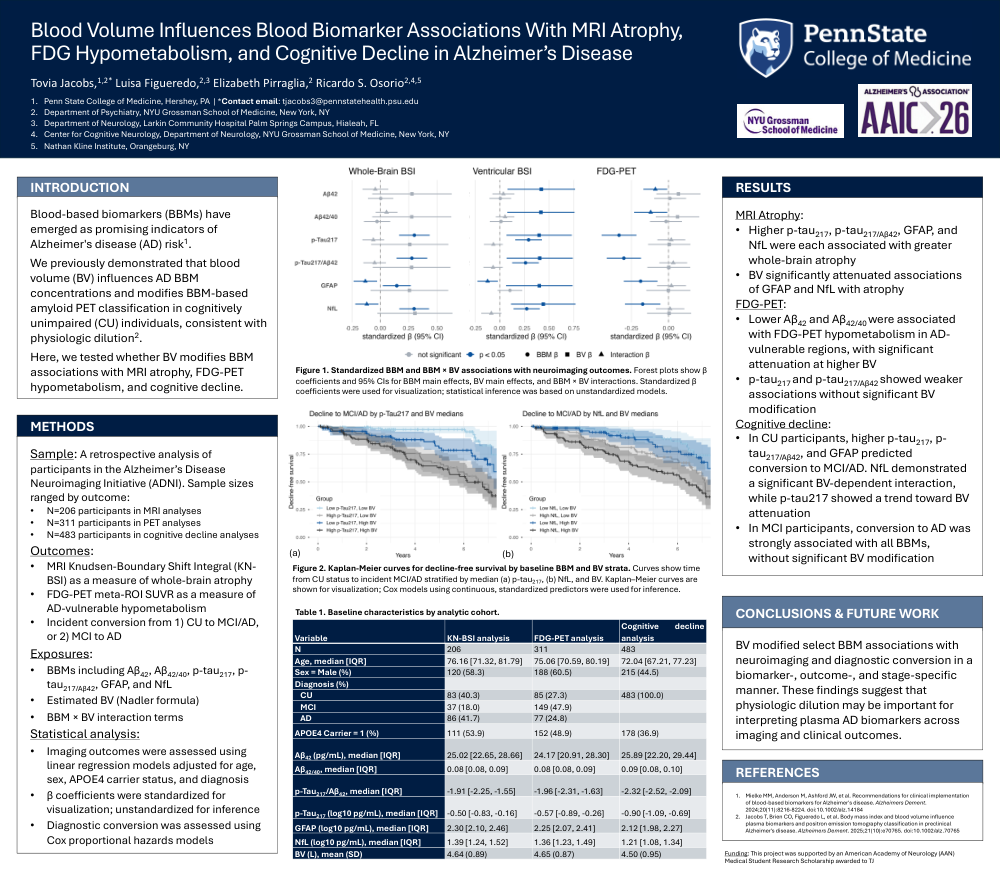
Introduction: Blood-based biomarkers (BBMs) have emerged as promising indicators of Alzheimer's disease (AD) risk1. We previously demonstrated that blood volume (BV) influences AD BBM concentrations and modifies BBM-based amyloid PET classification in cognitively unimpaired (CU) individuals, consistent with physiologic dilution2. Here, we tested whether BV modifies BBM associations with MRI atrophy, FDG-PET hypometabolism, and cognitive decline.
Methods: A retrospective analysis of participants in the Alzheimer’s Disease Neuroimaging Initiative (ADNI). Sample sizes ranged by outcome:N=206 participants in MRI analyses; N=311 participants in PET analyses; N=483 participants in cognitive decline analyses. Outcomes included 1) MRI Knudsen-Boundary Shift Integral (KN-BSI) as a measure of whole-brain atrophy; 2) FDG-PET meta-ROI SUVR as a measure of AD-vulnerable hypometabolism; 3) incident conversion from CU to MCI/AD, or from MCI to AD. Exposures included 1) BBMs (Aβ42, Aβ42/40, p-tau217, p-tau217/Aβ42, GFAP, and NfL); 2) estimated BV (using the Nadler formula); 3) BBM × BV interaction terms. For statistical analysis, imaging outcomes were assessed using linear regression models adjusted for age, sex, APOE4 carrier status, and diagnosis. β coefficients were standardized for visualization; unstandardized for inference. Diagnostic conversion was assessed using Cox proportional hazards models.
Results: Higher p-tau217, p-tau217/Aβ42, GFAP, and NfL were each associated with greater whole-brain atrophy. BV significantly attenuated associations of GFAP and NfL with MRI atrophy. Lower Aβ42 and Aβ42/40 were associated with FDG-PET hypometabolism in AD-vulnerable regions, with significant attenuation at higher BV. p-tau217 and p-tau217/Aβ42 showed weaker associations with FDG-PET without significant BV modification. In CU participants, higher p-tau217, p-tau217/Aβ42, and GFAP predicted conversion to MCI or AD. NfL demonstrated a significant BV-dependent interaction, while p-tau217 showed a trend toward BV attenuation. In MCI participants, conversion to AD was strongly associated with all BBMs, without significant BV modification.
Conclusions and future work: BV modified select BBM associations with neuroimaging and diagnostic conversion in a biomarker-, outcome-, and stage-specific manner. These findings suggest that physiologic dilution may be important for interpreting plasma AD biomarkers across imaging and clinical outcomes.
References:
Comments
Email is required but is not shown publicly.
Loading comments...