4,068 posters, 219 videos, 101 topics, 69 sessions, 14,365 authors, 6,128 institutions
ePostersLive by SciGen Technologies S.A. All rights reserved.
Alzheimer's Association International Conference 2026
July 12-15, 2026 | London, United Kingdom, and Online

3364
Testosterone Deprivation Shapes Behavioral Responses To Intracerebroventricular Streptozotocin In Male Rats
Poster Presenter
Authors
Ana Abril Vidal Escobedo, facundo peralta, julia diaz baliero, dylan canale, camila juan, juan ignacio posada, Paula Reggiani
Affiliations
Part of Topic
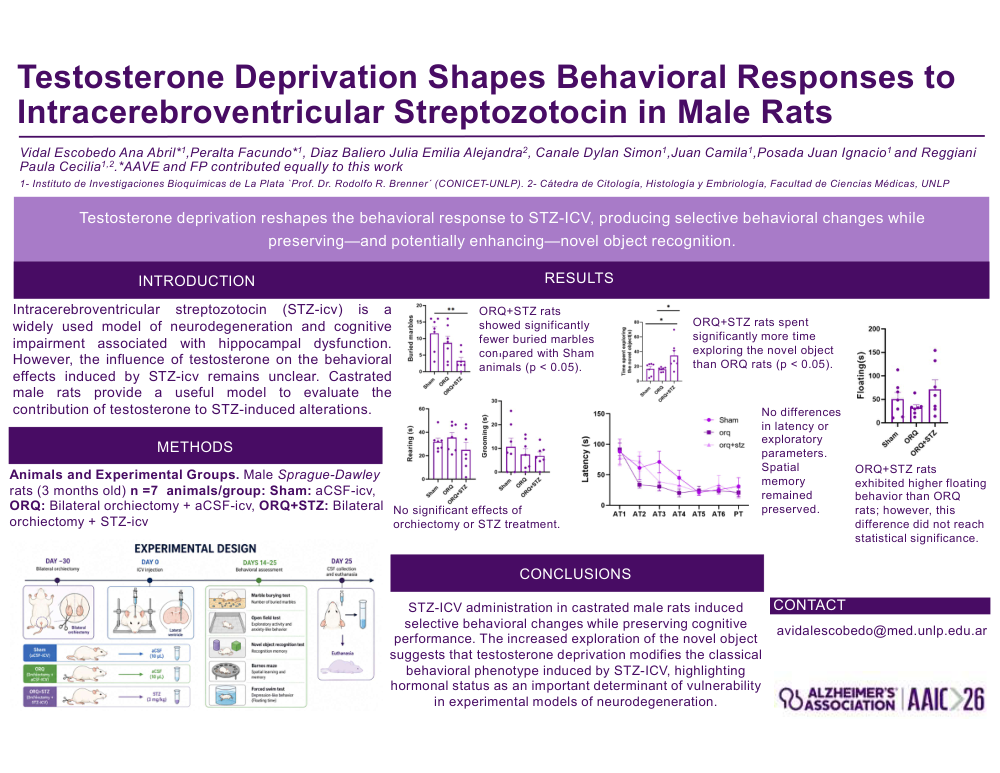
Testosterone deprivation reshapes the behavioral response to STZ-ICV, producing selective behavioral changes while
preserving—and potentially enhancing—novel object recognition.
Intracerebroventricular streptozotocin (STZ-icv) is a widely used model of neurodegeneration and cognitive impairment associated with hippocampal dysfunction. However, the influence of testosterone on the behavioral effects induced by STZ-icv remains unclear. Castrated male rats provide a useful model to evaluate the contribution of testosterone to STZ-induced alterations.
Animals and Experimental Groups. Male Sprague-Dawley rats (3 months old) n =7 animals/group: Sham: aCSF-icv, ORQ: Bilateral orchiectomy + aCSF-icv, ORQ+STZ: Bilateral orchiectomy + STZ-icv
ORQ+STZ rats showed significantly fewer buried marbles compared with Sham animals (p < 0.05).
ORQ+STZ rats spent significantly more time exploring the novel object than ORQ rats (p < 0.05).
No differences in latency or exploratory parameters. Spatial memory remained preserved.
ORQ+STZ rats exhibited higher floating behavior than ORQ rats; however, this difference did not reach statistical significance.
STZ-ICV administration in castrated male rats induced selective behavioral changes while preserving cognitive performance. The increased exploration of the novel object suggests that testosterone deprivation modifies the classical behavioral phenotype induced by STZ-ICV, highlighting hormonal status as an important determinant of vulnerability in experimental models of neurodegeneration.
Comments
Email is required but is not shown publicly.
Loading comments...