4,068 posters, 219 videos, 101 topics, 69 sessions, 14,365 authors, 6,128 institutions
ePostersLive by SciGen Technologies S.A. All rights reserved.
Alzheimer's Association International Conference 2026
July 12-15, 2026 | London, United Kingdom, and Online

7408
Perimenopause Status And Progesterone Levels Affect Episodic Memory At Midlife
Poster Presenter
Part of Topic
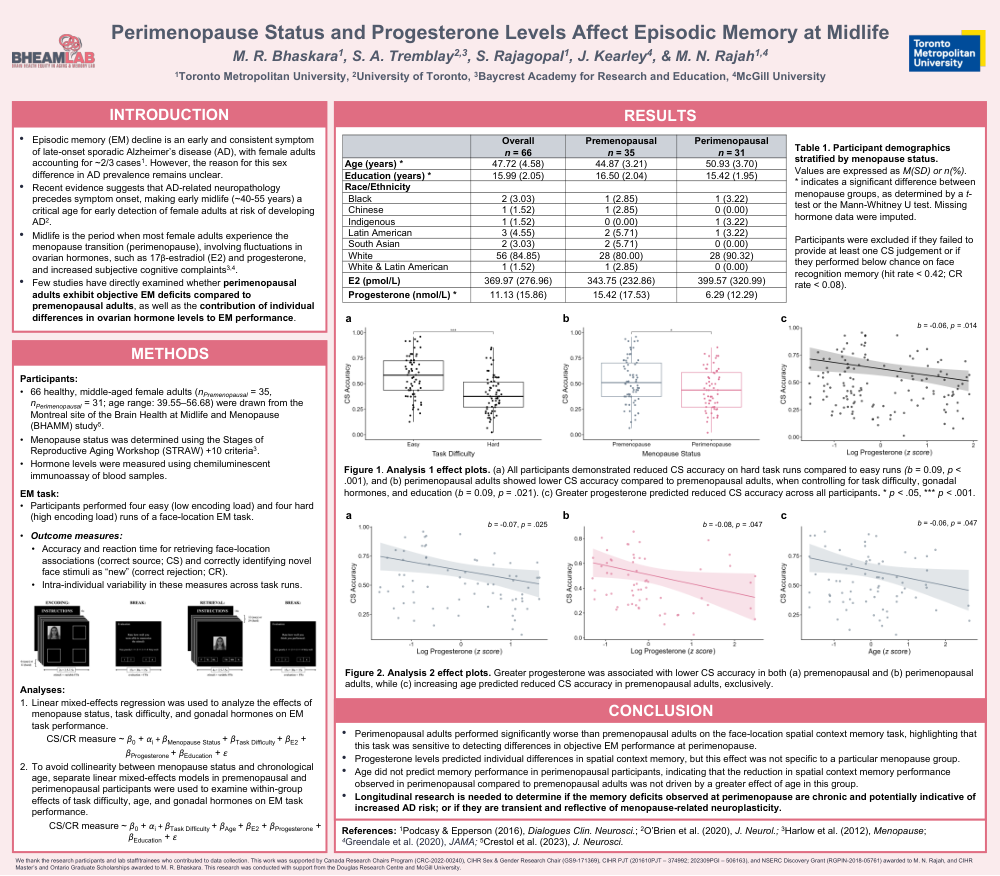
Background: Episodic memory (EM) decline is an early and consistent symptom of late-onset Alzheimer’s disease (AD), with females accounting for approximately two-thirds of cases. Current models suggest that AD-related neuropathology arises at midlife (age range: 40-65). During this time, most females experience the menopause transition (perimenopause), involving changes in gonadal hormones, primarily 17b-estradiol (E2) and progesterone, that can impact EM. This suggests that perimenopausal hormonal changes may impact female brain health and EM, potentially influencing later AD risk. Here, we explore whether menopause status and gonadal hormone levels predict EM at midlife.
Methods: Middle-aged females (nPremenopause = 35 , nPerimenopause = 31; Table 1) completed an EM task, where they were instructed to encode and retrieve the spatial locations of presented faces (correct source [CS]), and correctly reject novel face stimuli as not previously seen (correct rejection [CR]). Menopause status was determined using the Stages of Reproductive Aging Workshop +10 criteria and gonadal hormone levels were measured from participant blood. Mean accuracy and reaction time for CS and CR, and intra-individual variability in these measures across task runs were calculated for each participant. Imputation was used to account for missing hormone data. Linear mixed-effects regression (LMER) models were used to determine whether menopause status and hormone levels predicted EM performance, controlling for education. Subsequent within-group analyses were conducted to examine effects of gonadal hormones and age on EM task performance.
Results: Only the model predicting CS accuracy demonstrated a menopause status effect, in addition to task difficulty and progesterone level effects. Perimenopausal participants showed lower CS accuracy than premenopausal participants (Figure 1) and higher progesterone levels predicted poorer CS accuracy. Separate premenopause and perimenopause LMER models demonstrated significant effects of progesterone, such that higher levels predicted lower CS accuracy. Age predicted CS accuracy in premenopausal females only, with older age predicting lower accuracy.
Conclusion: The findings demonstrate that EM decline may arise during perimenopause and that higher progesterone levels predict poorer EM at midlife, regardless of menopause status. Future studies should investigate how AD-specific risk factors influence these effects to advance knowledge of how endocrinological aging may interact with AD risk.
Comments
Email is required but is not shown publicly.
Loading comments...