4,068 posters, 219 videos, 101 topics, 69 sessions, 14,365 authors, 6,128 institutions
ePostersLive by SciGen Technologies S.A. All rights reserved.
Alzheimer's Association International Conference 2026
July 12-15, 2026 | London, United Kingdom, and Online

10627
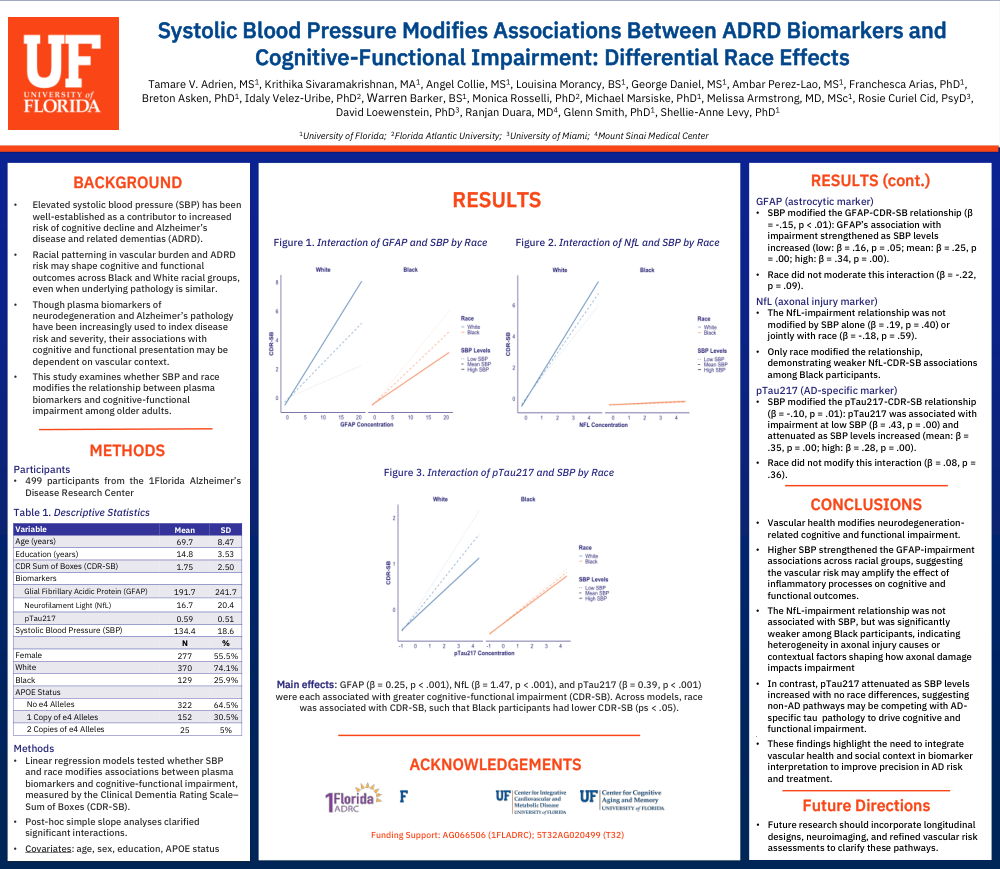
Systolic Blood Pressure Modifies Associations Between ADRD Biomarkers And Cognitive/Functional Impairment: Differential Race Effects
Poster Presenter
Authors
Tamare Adrien, Krithika Sivaramakrishnan, Angel Collie, Louisina Morancy, George Daniel, Ambar Perez-Lao, Franchesca Arias, Breton Asken, Idaly Velez-Uribe, Monica Rosselli, Warren Barker, Michael Marsiske, Melissa Armstrong, Rosie Curiel Cid, David Loewenstein, Ranjan Duara, Glenn Smith, Shellie-Anne Levy
Affiliations
Florida Atlantic University, University of Florida, Mount Sinai Medical Center, University of Miami School of Medicine
Part of Topic
Background: Elevated systolic blood pressure (SBP) is a well-established contributor toAlzheimer’s disease (AD) dementia, yet how SBP influences associations between AD-relatedplasma biomarkers and clinical impairment remains unclear. Social patterning of risk capturedby race may influence how biomarkers relate to clinical presentation. This study examinedwhether SBP and race, conceptualized as a social construct reflecting differential exposure tostructural and vascular risk, modify associations between plasma biomarkers and cognitive-functional impairment in older adults.
Methods: Baseline data from 499 participants in the 1Florida Alzheimer’s Disease ResearchCenter were analyzed. Linear regression models tested whether SBP and race moderatedassociations between plasma biomarkers (GFAP, NFL, and pTau217) and cognitive-functionalimpairment measured by the Clinical Dementia Rating Scale-Sum of Boxes (CDR-SB). Modelsadjusted for age, sex, education, and APOE ε4 status. SBP was modeled continuously, with post-hoc simple slopes estimated at low, mean, and high SBP levels.
Results: A significant SBP×GFAP interaction was observed (b = 0.15, p < .001), with strongerGFAP-impairment associations at higher SBP (low b = 0.16; mean b = 0.25; high b = 0.34; all p≤ .05). SBP did not moderate NFL associations (p = .40); however, a significant NFL×raceinteraction emerged (b = −1.43, p < .001), indicating weaker NFL-impairment associationsamong Black participants across SBP levels. For pTau217, a significant negative interaction withSBP was observed (b = −0.10, p = .01), with associations attenuating as SBP increased. Race didnot significantly moderate GFAP and pTau217 associations.
Conclusion: Vascular risk and social context, as proxied by race, shape which biologicalprocesses are most tightly linked to clinical impairment. Vascular risk strengthened associationsbetween astrocytic reactivity (GFAP) and impairment, consistent with vascular-inflammatoryprocesses. In contrast, associations between AD-specific tau pathology (pTau217) andimpairment weakened as vascular risk increased, likely reflecting competing non-AD pathwaysto functional decline. Race-based differences in NFL-impairment associations despitecomparable biomarker burden likely reflect group differences in impairment severity,heterogeneity in sources of axonal injury, or contextual factors influencing how axonal damagetranslates into functional impairment. Biomarker levels are insufficient to interpret clinical riskwithout considering vascular and social context.
Comments
Email is required but is not shown publicly.
Loading comments...