4,068 posters, 219 videos, 101 topics, 69 sessions, 14,365 authors, 6,128 institutions
ePostersLive by SciGen Technologies S.A. All rights reserved.
Alzheimer's Association International Conference 2026
July 12-15, 2026 | London, United Kingdom, and Online

4889
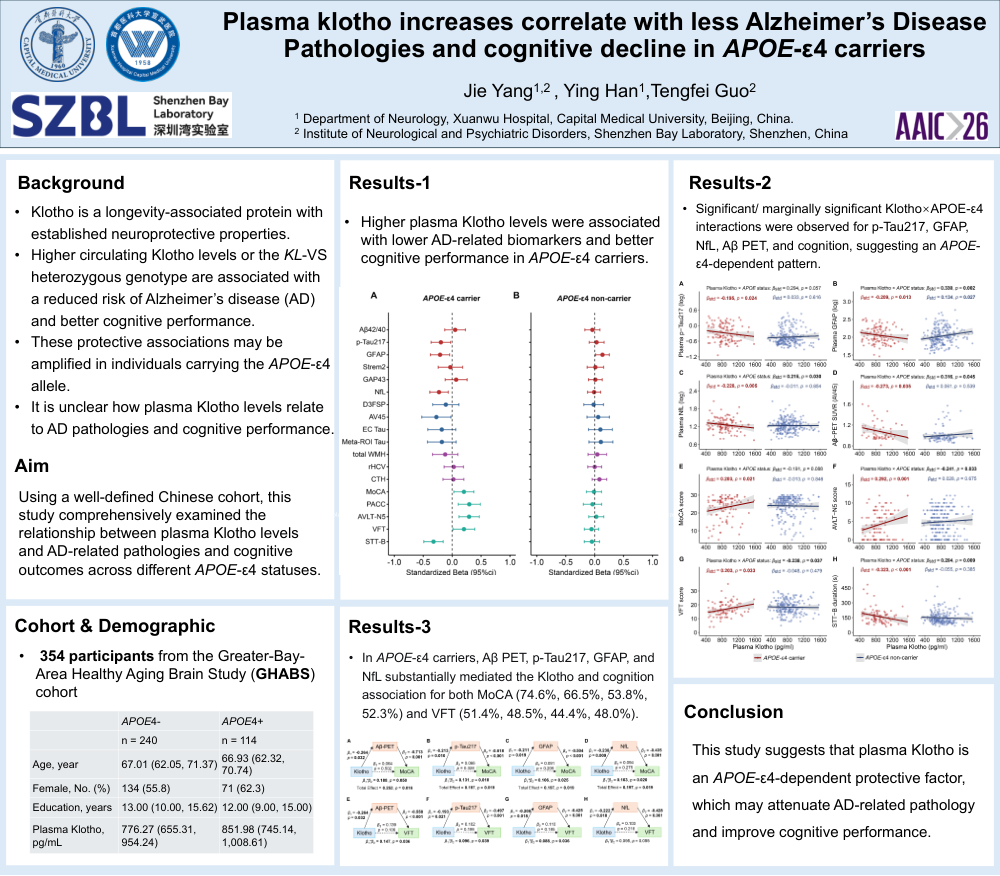
Increased Plasma Klotho Levels Correlate With Reduced Alzheimer's Disease Pathology And Cognitive Decline In APOE-ε4 Carriers
Part of Topic
Background: Klotho is a longevity-associated protein with established neuroprotective properties. Several studies have shown that higher circulating Klotho levels or the KL-VS heterozygous genotype are associated with a reduced risk of Alzheimer’s disease (AD) and better cognitive performance. These protective associations may be amplified in individuals carrying the APOE-ε4 allele. However, it is unclear how plasma Klotho levels relate to AD pathologies and cognitive performance. Using a well-defined Chinese cohort, this study comprehensively examined the relationship between plasma Klotho levels and AD-related pathologies and cognitive outcomes across different APOE-ε4 statuses.
Methods: We recruited 354 participants from the Greater-Bay-Area Healthy Aging Brain Study (GHABS) cohort to investigate the associations between plasma Klotho levels and AD-related biomarkers, including plasma p-Tau217, GFAP, NfL, Aβ PET, tau PET, as well as cognitive performance across multiple domains. Stratified analyses were performed according to APOE-ε4 carrier status. Interaction models were used to evaluate whether APOE-ε4 modified the associations between plasma Klotho and AD-related biomarkers or cognition. Mediation analyses were further conducted within APOE-ε4 carriers to investigate whether AD pathologies and neurodegeneration markers mediated the associations between plasma Klotho and cognitive outcomes.
Results: Higher plasma Klotho levels were associated with lower AD-related biomarkers and better cognitive performance in APOE-ε4 carriers (Figures 1-2). Significant or marginally significant interactions between plasma Klotho and APOE-ε4 status were observed for plasma p-Tau217, GFAP, NfL, Aβ PET burden, and multiple cognitive measures (Figures 1-2), indicating an APOE-ε4-dependent pattern of association. In APOE-ε4 carriers, mediation analyses further revealed that Aβ-PET (Composite AV45) SUVR, plasma p-Tau217, GFAP, and NfL mediated 74.6%, 66.5%, 53.8%, and 52.3% of the association between plasma Klotho levels and MoCA scores, respectively (Figure 3). Similarly, Aβ-PET, plasma p-Tau217, GFAP, and NfL mediated 51.4%, 48.5%, 44.4%, and 48.0% of the association between plasma Klotho and verbal fluency performance as assessed by VFT (Figure 3).
Conclusion: This study suggests that plasma Klotho is an APOE-ε4-dependent protective factor, which may attenuate AD-related pathology and improve cognitive performance.
Keywords: Alzheimer’s disease; Plasma Klotho; APOE-ε4 carrier; cognitive decline
Learning Objectives:
① Demonstrate that plasma Klotho is linked to AD-related biomarkers and cognitive performance in APOE-ε4 carriers.
② Recognize that APOE-ε4 status modified the associations between plasma Klotho, biomarkers, and cognition.
③ Identify that AD-related biomarkers partially mediate the associations between plasma Klotho and cognition.
Comments
Email is required but is not shown publicly.
Loading comments...