4,068 posters, 219 videos, 101 topics, 69 sessions, 14,365 authors, 6,128 institutions
ePostersLive by SciGen Technologies S.A. All rights reserved.
Alzheimer's Association International Conference 2026
July 12-15, 2026 | London, United Kingdom, and Online

390
Why I Study Black Family Caregivers: A Reflection From A Nurse And Daughter
Poster Presenter
Authors
Affiliations
Part of Topic
Video
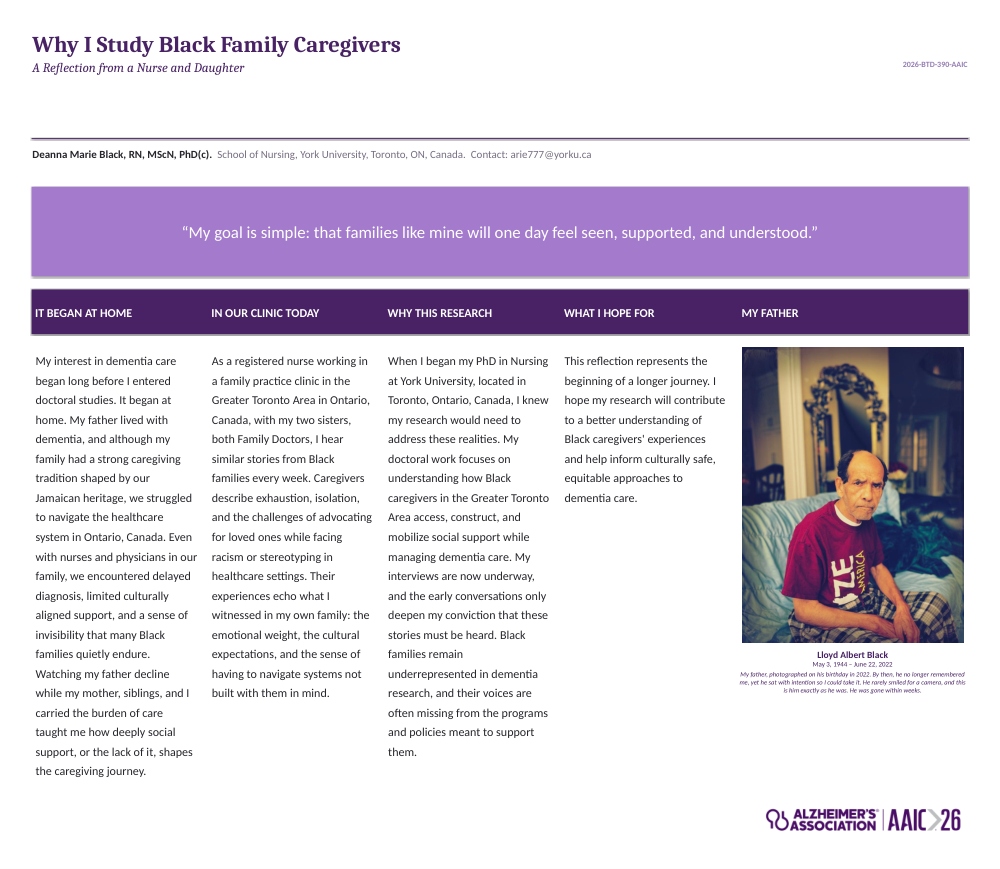
This reflection accompanies a photograph of my father, Lloyd Albert Black (1944–2022), taken on his birthday in the final weeks of his life. My interest in dementia care began long before I entered doctoral studies. It began at home. My father lived with dementia, and although my family had a strong caregiving tradition shaped by our Jamaican heritage, we struggled to navigate the healthcare system in Ontario, Canada. Even with nurses and physicians in our family, we encountered delayed diagnosis, limited culturally aligned support, and a sense of invisibility that many Black families quietly endure. Watching my father decline while my mother, siblings, and I carried the burden of care taught me how deeply social support, or the lack of it, shapes the caregiving journey.
As a registered nurse working in a family practice clinic in the Greater Toronto Area in Ontario, Canada, with my two sisters, both Family Doctors, I hear similar stories from Black families every week. Caregivers describe exhaustion, isolation, and the challenges of advocating for loved ones while facing racism or stereotyping in healthcare settings. Their experiences echo what I witnessed in my own family: the emotional weight, the cultural expectations, and the sense of having to navigate systems not built with them in mind. When I began my PhD in Nursing at York University, located in Toronto, Ontario, Canada, I knew my research would need to address these realities. My doctoral work focuses on understanding how Black caregivers in the Greater Toronto Area access, construct, and mobilize social support while managing dementia care. My interviews are now underway, and the early conversations only deepen my conviction that these stories must be heard. Black families remain underrepresented in dementia research, and their voices are often missing from the programs and policies meant to support them. This reflection represents the beginning of a longer journey. I hope my research will contribute to a better understanding of Black caregivers' experiences and help inform culturally safe, equitable approaches to dementia care. My goal is simple: that families like mine will one day feel seen, supported, and understood.
Keywords: Black family caregivers, dementia, Alzheimer's disease, social support, health equity, culturally safe care, caregiver experience, nursing, Greater Toronto Area, Canada, intersectionality.
Comments
Email is required but is not shown publicly.
Loading comments...