4,068 posters, 219 videos, 101 topics, 69 sessions, 14,365 authors, 6,128 institutions
ePostersLive by SciGen Technologies S.A. All rights reserved.
Alzheimer's Association International Conference 2026
July 12-15, 2026 | London, United Kingdom, and Online

8724
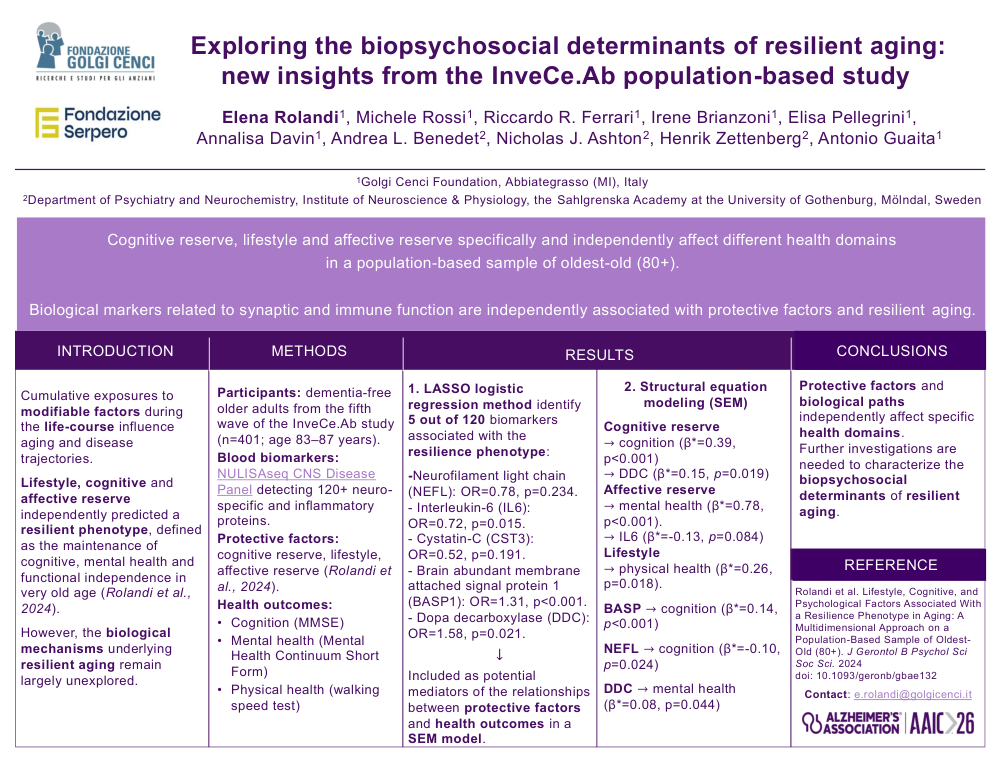
Exploring The Biopsychosocial Determinants Of Resilient Aging: New Insights From The Invece.Ab Population-based Study
Poster Presenter
Authors
Elena Rolandi, Michele Rossi, Riccardo R. Ferrari, Irene Brianzoni, Elisa Pellegrini, Annalisa Davin, Andrea L. Benedet, Nicholas J. Ashton, Henrik Zettenberg, Antonio Guaita
Affiliations
Golgi Cenci Foundation, Abbiategrasso (MI), Italy, Department of Psychiatry and Neurochemistry, Institute of Neuroscience & Physiology, the Sahlgrenska Academy at the University of Gothenburg, Mölndal, Sweden
Part of Topic
Exploring the biopsychosocial determinants of resilient aging: new insights from the InveCe.Ab population-based study
Background: Cumulative exposures to modifiable factors during the life-course influence aging and disease trajectories. Lifestyle, cognitive and affective reserve independently predicted positive adaptation to the aging process (Rolandi et al., 2024). However, the biological mechanisms by which these protective factors affect brain health remain largely unknown. Here, we aimed to explore both the independent and biologically-mediated pathways linking these key protective factors with positive health outcomes.
Methods: Dementia-free older adults from the fifth wave of the InveCe.Ab population-based study were included (age 83–87 years, n=401). The NULISA CNS panel detected 120 blood biomarkers. The LASSO logistic regression method was used to identify those biomarkers significantly associated with the resilience phenotype defined by Rolandi et al., 2024. Then, structural equation modeling (SEM) was used to estimate paths in a theoretical model linking the three protective factors (cognitive reserve, affective reserve, lifestyle habits during aging), to positive health outcomes (global cognition, mental health, walking speed) with LASSO-selected biomarkers entered as potential mediators.
Results: Five out of 120 blood biomarkers were selected: Neurofilament light chain (NEFL, OR=0.78, p=0.234), Interleukin-6 (IL6, OR=0.72, p=0.015), Cystatin-C (CST3, OR=0.52, p=0.191), Brain abundant membrane attached signal protein 1 (BASP1, OR=1.31, p<0.001), Dopa decarboxylase (DDC, OR=1.58, p=0.021). Figure 1 shows the SEM model with significant paths displayed with bold arrows. Direct pathway emerged between: cognitive reserve and global cognition (β*=0.39, p<0.001), affective reserve and mental health (β*=0.78, p<0.001), lifestyle and walking speed (β*=0.26, p=0.018). Affective reserve was inversely related to IL6 levels (β*=-0.13, p=0.084), while BASP and NEFL were directly (β*=0.14, p<0.001) and inversely (β*=-0.10, p=0.024) related with global cognition respectively. An indirect pathway was observed: cognitive reserve predicted DDC levels (β*=0.15, p=0.019), which predicted mental health (β*=0.08, p=0.044), although the combined indirect effect was small (β*=0.01, p=0.128).
Conclusions: A complex picture emerged in which protective factors and biological paths independently affect specific health domains, except for the cross-domain mediation of DDC between cognitive reserve and mental health. These original findings pave the way for further investigations on the biopsychosocial determinants of resilient aging.
Keywords: resilience, aging, cognitive reserve, affective reserve, lifestyles, biomarkers
Comments
Email is required but is not shown publicly.
Loading comments...