4,068 posters, 219 videos, 101 topics, 69 sessions, 14,365 authors, 6,128 institutions
ePostersLive by SciGen Technologies S.A. All rights reserved.
Alzheimer's Association International Conference 2026
July 12-15, 2026 | London, United Kingdom, and Online

11041
Dysregulated Crosstalk Between Ampk And Pi3k-akt Signaling In Alzheimer’S Disease Drives Metabolic Neurodegeneration
Poster Presenter
Authors
Part of Topic
Dysregulated Crosstalk Between Ampk And Pi3k-akt Signaling In Alzheimer’S Disease Drives Metabolic Neurodegeneration
Abstract:
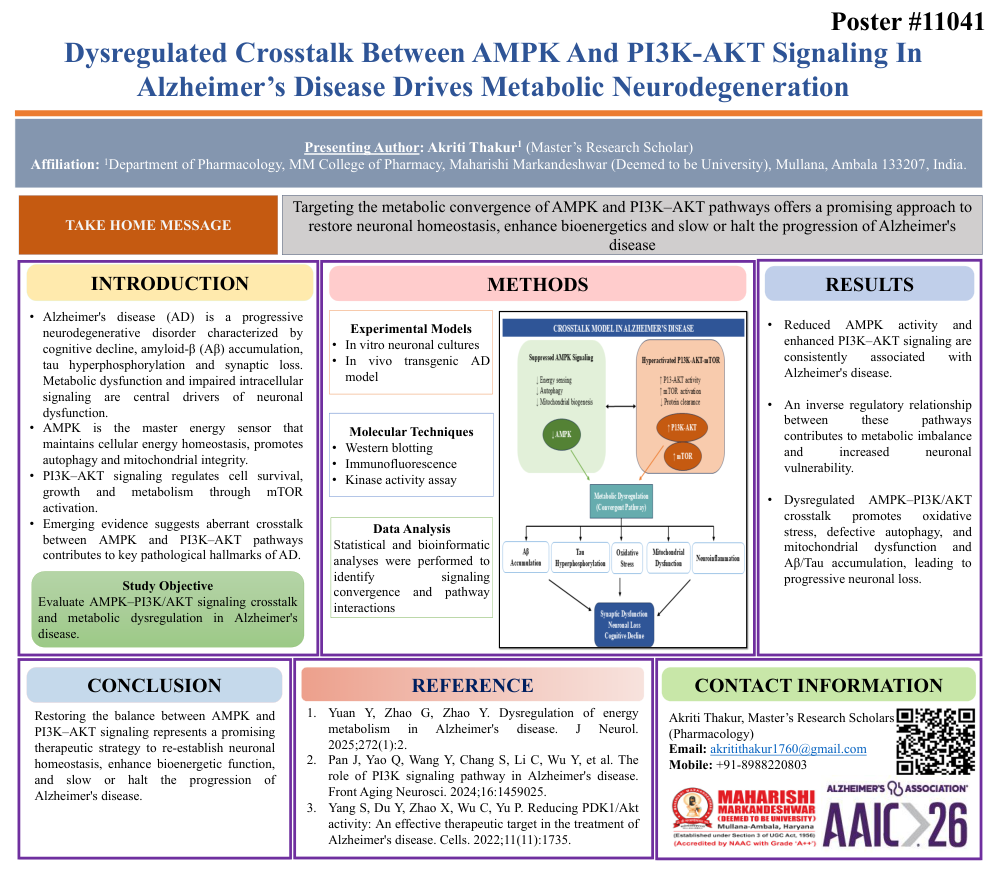
Background: Alzheimer’s disease (AD) represents a profound neurodegenerative disorder marked by progressive cognitive impairment and complex metabolic dysregulation. Mounting evidence implicates energy imbalance and defective intracellular signaling as pivotal drivers of neuronal dysfunction. Among the central regulators of metabolic homeostasis, AMP-activated protein kinase (AMPK) and phosphoinositide 3-kinase-Akt (PI3K-AKT) pathways exert critical control over neuronal energy sensing, mitochondrial dynamics, and survival. Aberrations within these cascades are increasingly associated with key pathological hallmarks of AD, including amyloid-beta (Aβ) accumulation and tau hyperphosphorylation.
Methods: A comprehensive experimental framework combining in vitro neuronal culture systems and in vivo transgenic AD models is employed to delineate the mechanistic interplay between AMPK and PI3K-AKT signaling. Quantitative molecular and biochemical assays such as Western blotting, immunofluorescence, and kinase activity profiling are utilized to evaluate activation dynamics and cross-regulatory interactions. Statistical and bioinformatic analyses are integrated to ensure data robustness and to identify critical convergence points influencing metabolic equilibrium.
Results: Preliminary evidence indicates significant suppression of AMPK activity accompanied by hyperactivation of the PI3K-AKT cascade in AD, suggesting an inverse regulatory relationship that exacerbates neuronal vulnerability. The bidirectional crosstalk between these pathways may potentiate oxidative stress, impair autophagic clearance, and intensify mitochondrial fragmentation, thereby amplifying the neurodegenerative cascade.
Conclusion: Elucidation of the molecular interdependence between AMPK and PI3K-AKT signaling underscores a convergent metabolic axis orchestrating neuronal decline in Alzheimer’s disease. The findings provide a mechanistic framework linking metabolic dysfunction with neuropathological progression. Therapeutic modulation of these pathways holds potential for restoring bioenergetic balance, promoting neuronal resilience, and mitigating the molecular drivers of AD pathology.
Comments
Email is required but is not shown publicly.
Loading comments...