4,068 posters, 219 videos, 101 topics, 69 sessions, 14,365 authors, 6,128 institutions
ePostersLive by SciGen Technologies S.A. All rights reserved.
Alzheimer's Association International Conference 2026
July 12-15, 2026 | London, United Kingdom, and Online

3849
Naringenin Mitigates α-synuclein Pathology And Stress Signaling In SH (SNCA) Cells Via Redox Modulation.
Poster Presenter
Part of Topic
Video
Theme: Basic Science and Pathogenesis
Topic: Molecular and Cell Biology
Subtopics: α-synuclein, Neurodegeneration and neuroprotection, Oxidative stress
Title:
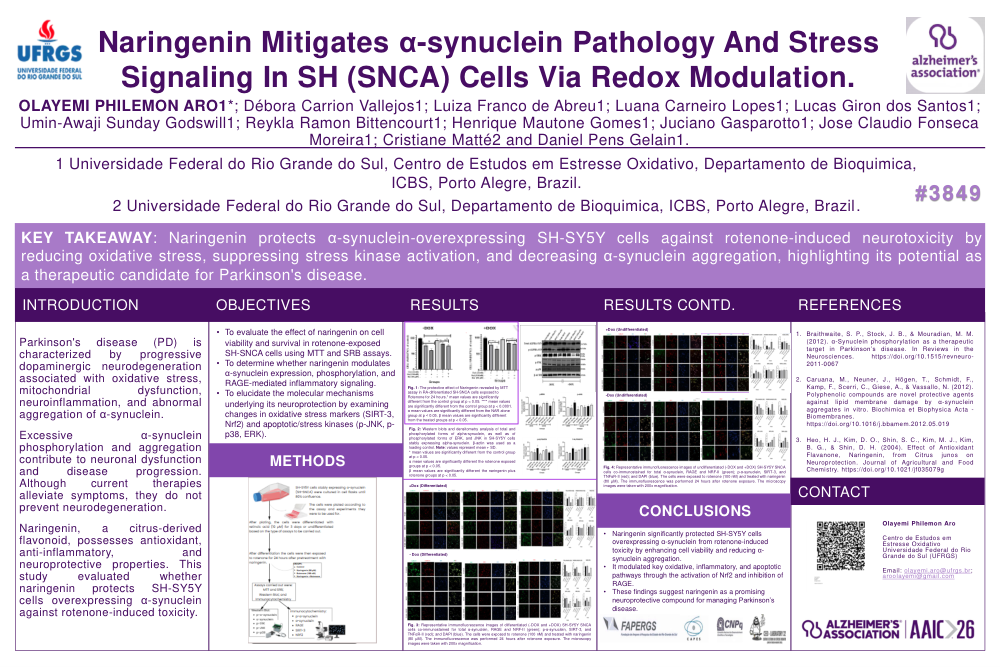
Naringenin Mitigates α-Synuclein Pathology and Stress Signaling in SH-SNCA Cells via Redox Modulation
Authors:
Olayemi Philemon Aro¹*, Débora Carrion Vallejos¹, Luiza Franco de Abreu¹, Luana Carneiro Lopes¹, Lucas Giron dos Santos¹, Umin-Awaji Sunday Godswill¹, Reykla Ramon Bittencourt¹, Henrique Mautone Gomes¹, Juciano Gasparotto¹, Jose Claudio Fonseca Moreira¹, Cristiane Matté², and Daniel Pens Gelain.¹
¹Universidade Federal do Rio Grande do Sul, Centro de Estudos em Estresse Oxidativo, Departamento de Bioquímica, ICBS, Porto Alegre, Brazil
²Universidade Federal do Rio Grande do Sul, Departamento de Bioquímica, ICBS, Porto Alegre, Brazil
Abstract:
Parkinson's disease (PD) is a progressive neurodegenerative disorder characterised by dopaminergic neuronal loss, mitochondrial dysfunction, oxidative stress, neuroinflammation, and pathological α-synuclein accumulation. These interconnected processes contribute to neuronal dysfunction and disease progression, highlighting the need for therapeutic strategies that target multiple pathogenic pathways. Naringenin, a naturally occurring citrus flavanone, possesses potent antioxidant and anti-inflammatory properties; however, its molecular mechanisms in α-synuclein-associated cellular stress remain incompletely understood. This study investigated the neuroprotective effects of naringenin using a doxycycline-inducible SH-SY5Y cell model stably expressing human α-synuclein (SH-SNCA), in which withdrawal of doxycycline (-DOX) induces α-synuclein expression, whereas doxycycline treatment (+DOX) suppresses transgene expression. Cells were exposed to rotenone-induced mitochondrial stress in the presence or absence of naringenin (80 μM). Cell viability was assessed using MTT and sulforhodamine B assays, while immunocytochemistry and Western blotting were performed to evaluate α-synuclein pathology, oxidative stress, inflammatory mediators, antioxidant signalling, and mitogen-activated protein kinase (MAPK) pathways. Rotenone significantly reduced cell viability, with α-synuclein-expressing (-DOX) cells exhibiting greater susceptibility than doxycycline-suppressed (+DOX) cells, demonstrating that α-synuclein expression enhances neuronal vulnerability to mitochondrial stress. Naringenin significantly attenuated rotenone-induced cytotoxicity and reduced total and Ser129-phosphorylated α-synuclein immunoreactivity. Furthermore, rotenone-induced upregulation of the receptor for advanced glycation end products (RAGE) and tumour necrosis factor receptor II (TNFRII) was suppressed by naringenin, whereas expression of the antioxidant regulators SIRT3 and Nrf2 was enhanced. Western blot analyses further demonstrated modulation of MAPK signalling, including attenuation of stress-associated JNK and p38 activation and partial restoration of ERK signalling. Collectively, these findings demonstrate that naringenin protects against rotenone-induced mitochondrial dysfunction and α-synuclein-associated cellular stress through coordinated regulation of MAPK signalling, oxidative stress, inflammatory responses, and antioxidant defence pathways. The use of an inducible α-synuclein expression model provides new mechanistic insight into α-synuclein-dependent neuronal vulnerability and supports naringenin as a promising multi-target therapeutic candidate for Parkinson's disease.
Keywords: Naringenin; α-synuclein; mitochondrial dysfunction; oxidative stress; stress signalling; Parkinson’s disease.
Comments
Email is required but is not shown publicly.
Loading comments...