4,068 posters, 219 videos, 101 topics, 69 sessions, 14,365 authors, 6,128 institutions
ePostersLive by SciGen Technologies S.A. All rights reserved.
Alzheimer's Association International Conference 2026
July 12-15, 2026 | London, United Kingdom, and Online

9314
Impaired Mitochondrial Translation Or Transcription Models Alzheimer’s Disease-like Molecular Phenotypes
Poster Presenter
Part of Topic
Video
Title: Impaired Mitochondrial Translation or Transcription Models Alzheimer’s Disease-Like Molecular Phenotypes
Authors and Affiliations: Anysja Roberts, MS 1,2, Lesya Novikova, PhD 1,2, Ian Weidling, PhD 1,2, Xiaowan Wang, PhD 1,2, Emily Schueddig, MS 1, Heather Wilkins, PhD 1,2, Dong Pei, PhD 1,2, and Russell Swerdlow, MD 1,2. 1 - University of Kansas Medical Center, 2 - KU Alzheimer’s Disease Research Center
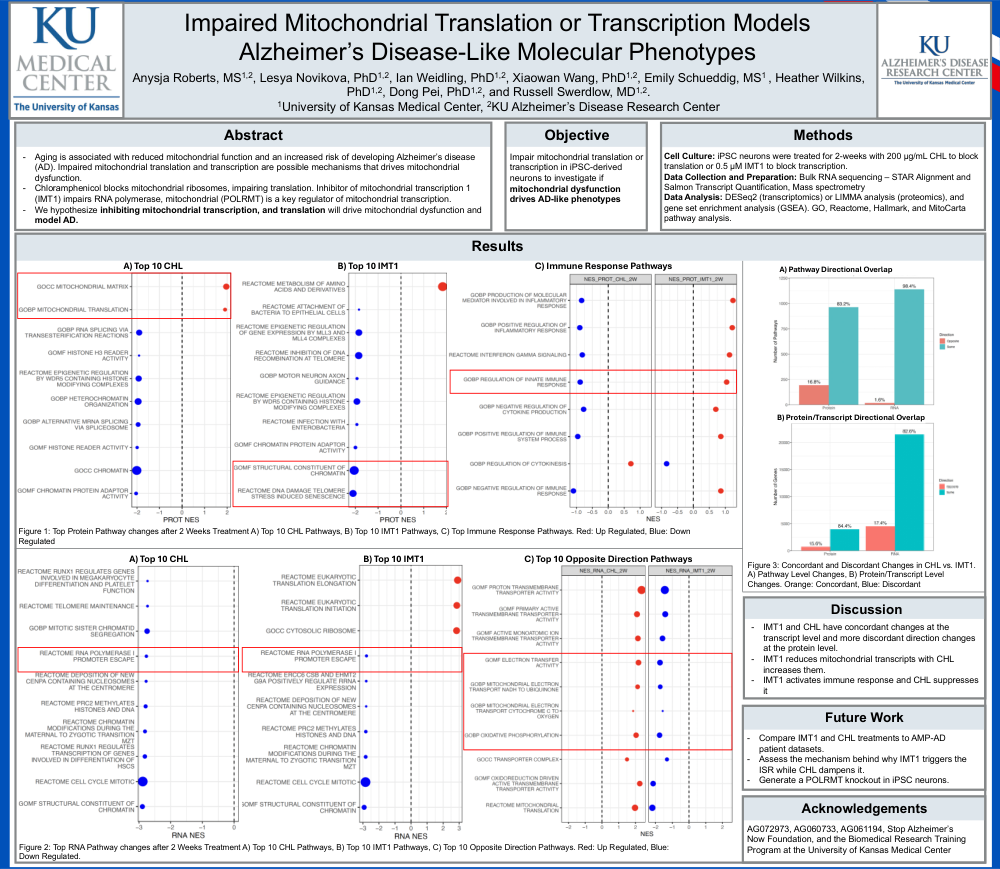
Abstract: Aging is associated with reduced mitochondrial function and an increased risk of developing Alzheimer’s disease (AD). Impaired mitochondrial translation and transcription are possible mechanisms that drives mitochondrial dysfunction. Chloramphenicol blocks mitochondrial ribosomes, impairing translation. Inhibitor of mitochondrial transcription 1 (IMT1) impairs RNA polymerase, mitochondrial (POLRMT) is a key regulator of mitochondrial transcription. We hypothesize inhibiting mitochondrial transcription, and translation will drive mitochondrial dysfunction and model AD.
Objective: Impair mitochondrial translation or transcription in iPSC-derived neurons to investigate if mitochondrial dysfunction drives AD-like phenotypes
Methods: Cell Culture: iPSC neurons were treated for 2-weeks with 200 μg/mL CHL to block translation or 0.5 μM IMT1 to block transcription. Data Collection and Preparation: Bulk RNA sequencing – STAR Alignment and Salmon Transcript Quantification, Mass spectrometry Data Analysis: DESeq2 (transcriptomics) or LIMMA analysis (proteomics), and gene set enrichment analysis (GSEA). GO, Reactome, Hallmark, and MitoCarta pathway analysis.
Discussion: IMT1 and CHL have concordant changes at the transcript level and more discordant direction changes at the protein level. IMT1 reduces mitochondrial transcripts with CHL increases them. IMT1 activates immune response and CHL suppresses it
Future Work: Compare IMT1 and CHL treatments to AMP-AD patient datasets. Assess the mechanism behind why IMT1 triggers the ISR while CHL dampens it. Generate a POLRMT knockout in iPSC neurons.
Acknowledgements: AG072973, AG060733, AG061194, Stop Alzheimer’s Now Foundation, and the Biomedical Research Training Program at the University of Kansas Medical Center
Comments
Email is required but is not shown publicly.
Loading comments...