4,068 posters, 219 videos, 101 topics, 69 sessions, 14,365 authors, 6,128 institutions
ePostersLive by SciGen Technologies S.A. All rights reserved.
Alzheimer's Association International Conference 2026
July 12-15, 2026 | London, United Kingdom, and Online

10781
Cognitive Function Improves In Female 5xfad Mice Following Plasma Bcaa Reduction
Poster Presenter
Authors
Affiliations
Part of Topic
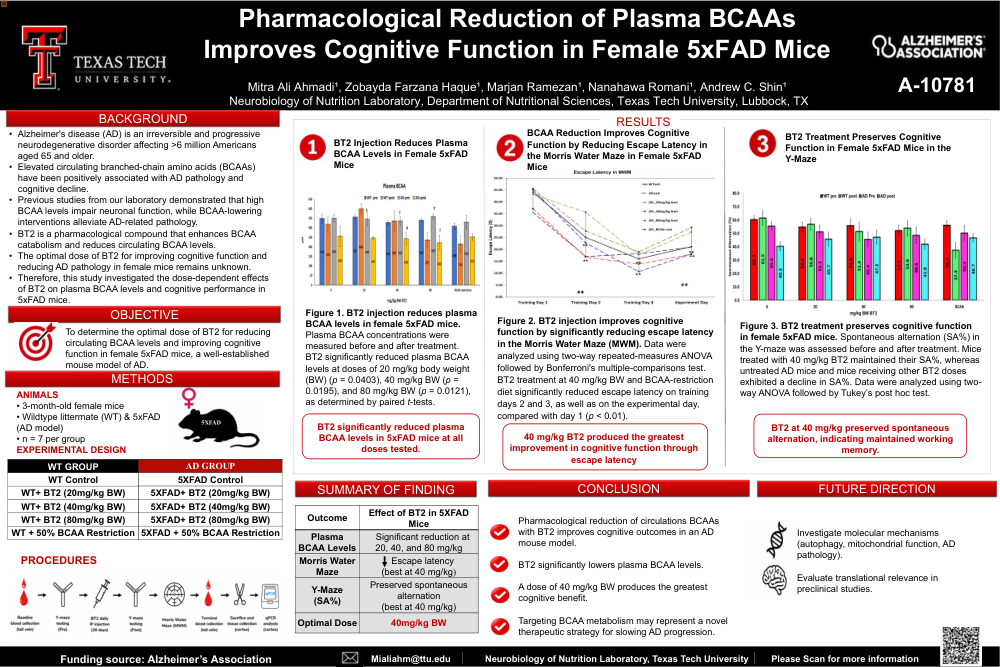
Pharmacological Reduction of Plasma BCAAs Improves Cognitive Function in Female 5xFAD Mice
Mitra Ali Ahmadi1, Zobayda Farzana Haque1, Marjan Ramazan1, Nanahawa Romani1, Andrew C Shin1
1Texas Tech University, Nutritional Sciences, Lubbock, TX
Background: Alzheimer's disease (AD) is an irreversible and progressive neurodegenerative disorder affecting millions globally, with over 6 million Americans aged 65 and older currently diagnosed. Despite available medications, there is currently no effective cure. Our lab has identified a positive correlation between elevated circulating branched-chain amino acids (BCAAs) and AD. Previously, we demonstrated that BCAAs impair neuronal function, while BCAA-lowering intervention or restriction alleviates AD-related pathology. However, the optimal dosage of the BCAA-lowering compound BT2 remines unknown. Methods: To determine the most effective dose of BT2 in AD pathology and cognitive function, we conducted a follow-up study using 3-month-old wildtype (WT) and 5xFAD female mice (n= 7 per group). Animal were divided into ten groups: WT, WT + BT2 (20, 40, and 80 mg/kg BW), WT + WT + BCAA restriction diet (50%), 5xFAD, 5xFAD + BT2 (20, 40, and 80 mg/kg BW), 5XFAD + BCAA restriction diet (50%). Baseline blood samples were collected from the tail. BT2 was administered via daily intraperitoneal injection for 30 consecutive days. At the end of the treatment, mice were euthanized, and plasma was collected for BCAA quantification using BCAA assay. Cognitive function was assessed using Y-maze before and after treatment and Morris Water Maze (MWM) after treatment. Results: BT2 treatment reduced Plasma BCAA level in all AD groups after one month (Fig 1). Notably, 5xFAD mice treated with BT2 at 40 mg/kg or a BCAA restriction diet showed significant improvement in the scape latency (MWM) (Fig 2). Consistent with these findings, 5xFAD mice treated with (40 mg/kg) showed a maintained spontaneous alternation in Y-maze, whereas other AD groups exhibited a decline (Fig 3). Conclusion: Our findings demonstrate that the BCAA-lowering compound BT2 has the potential to mitigate cognitive decline in AD. The observed improvement in cognitive performance, accompanied by reduced BCAA plasma levels, might underscores BT2’s therapeutic promise. Future studies will investigate whether genes related to AD pathology, mitochondrial electron transport chain, and mitochondrial biogenesis mediate the memory-enhancing effect of BT2. While further investigation is needed, these results suggest that targeting BCAAs metabolism may represent a novel strategy for slowing AD progression.
Comments
Email is required but is not shown publicly.
Loading comments...