4,068 posters, 219 videos, 101 topics, 69 sessions, 14,365 authors, 6,128 institutions
ePostersLive by SciGen Technologies S.A. All rights reserved.
Alzheimer's Association International Conference 2026
July 12-15, 2026 | London, United Kingdom, and Online

10770
A Systematic Review Of Multi-omics Integration In Neurodegenerative, Neurodevelopmental, And Psychiatric Disorders
Poster Presenter
Part of Topic
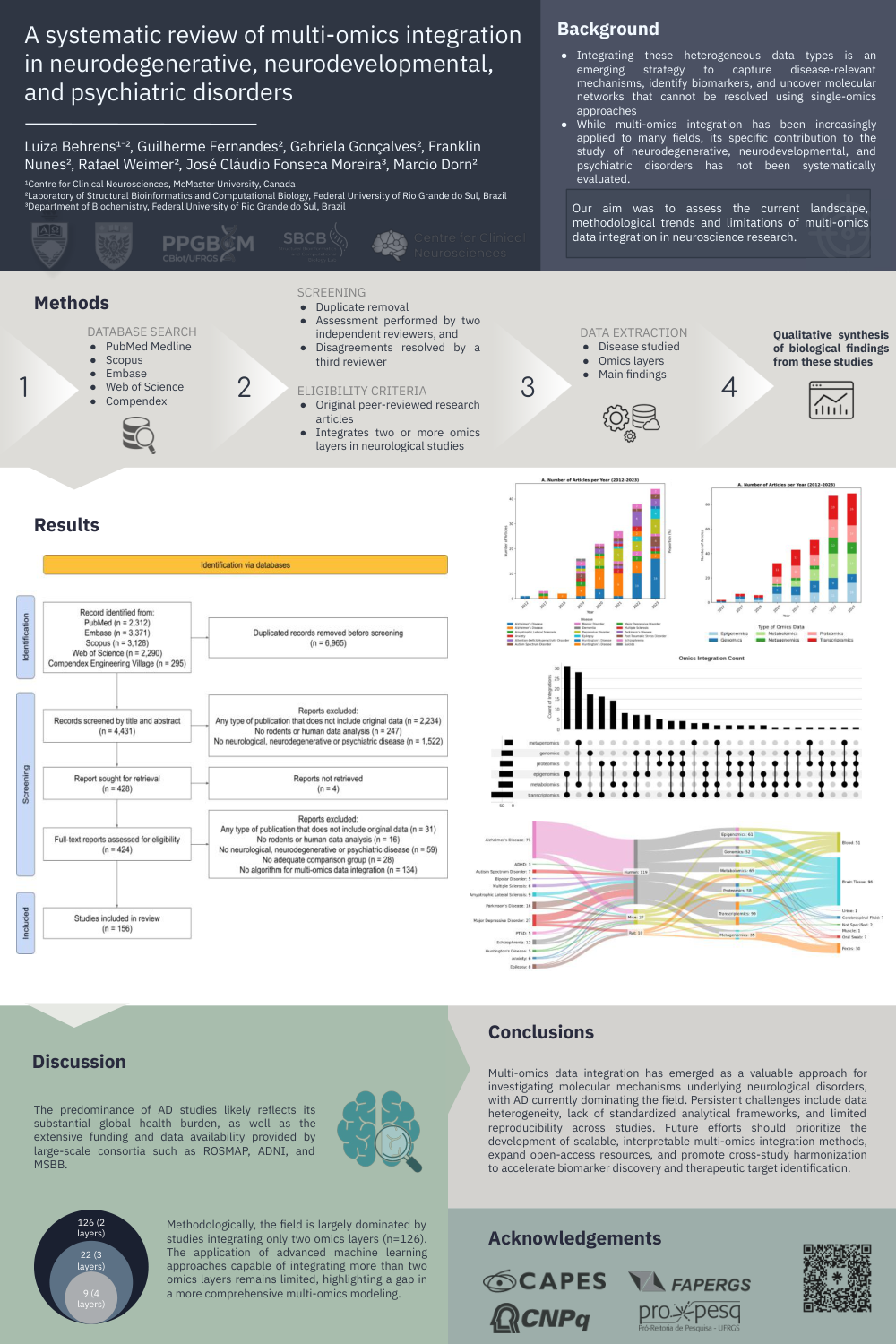
Background: Advances in high-throughput technologies have enabled the large-scale generation of biological data, including genomics, transcriptomics, proteomics, epigenomics, and metabolomics. Integrating these heterogeneous data types is an emerging strategy to capture disease-relevant mechanisms, identify biomarkers, and uncover molecular networks that cannot be resolved using single-omics approaches. While multi-omics integration has been increasingly applied to many fields, its specific contribution to the study of neurodegenerative, neurodevelopmental, and psychiatric disorders has not been systematically evaluated. This systematic review aims to assess the current landscape, methodological trends and limitations of multi-omics data integration in neuroscience research.
Methods: A systematic literature search was conducted across five databases, with no restrictions on publication date or language. The search strategy included broad terms related to multi-omics integration and the field of neuroscience. Studies were included if they applied integrative analyses of two or more omics layers. All records were screened by two independent investigators, and disagreements were resolved by a third investigator.
Results: A total of 156 studies met the inclusion criteria. Neurodegenerative disorders constituted the majority (n=115), with Alzheimer’s Disease (AD) emerging as the most frequently studied condition overall (n=71). Depressive disorders represented the largest non-neurodegenerative studied condition (n=27), while Parkinson’s Disease was the second most studied neurodegenerative disorder and ranked third overall (n=16). The predominance of AD studies likely reflects its substantial global health burden, as well as the extensive funding and data availability provided by large-scale consortia such as ROSMAP, ADNI, and MSBB. Methodologically, the field is largely dominated by studies integrating only two omics layers (n=126). The application of advanced machine learning approaches capable of integrating more than two omics layers remains limited, highlighting a gap in a more comprehensive multi-omics modeling.
Conclusions: Multi-omics data integration has emerged as a valuable approach for investigating molecular mechanisms underlying neurological disorders, with AD currently dominating the field. Persistent challenges include data heterogeneity, lack of standardized analytical frameworks, and limited reproducibility across studies. Future efforts should prioritize the development of scalable, interpretable multi-omics integration methods, expand open-access resources, and promote cross-study harmonization to accelerate biomarker discovery and therapeutic target identification.
Comments
Email is required but is not shown publicly.
Loading comments...