4,068 posters, 219 videos, 101 topics, 69 sessions, 14,365 authors, 6,128 institutions
ePostersLive by SciGen Technologies S.A. All rights reserved.
Alzheimer's Association International Conference 2026
July 12-15, 2026 | London, United Kingdom, and Online

3351
How Heteroamyloids Between Tau And RNA Binding Proteins Can Influence Toxicity And Disease Progression In Alzheimer’s Disease
Poster Presenter
Authors
Abbigael Aday, Nemil Bhatt, Nikita Shchankin, Mauro Montalbano, Rakez Kayed
Affiliations
null,
Part of Topic
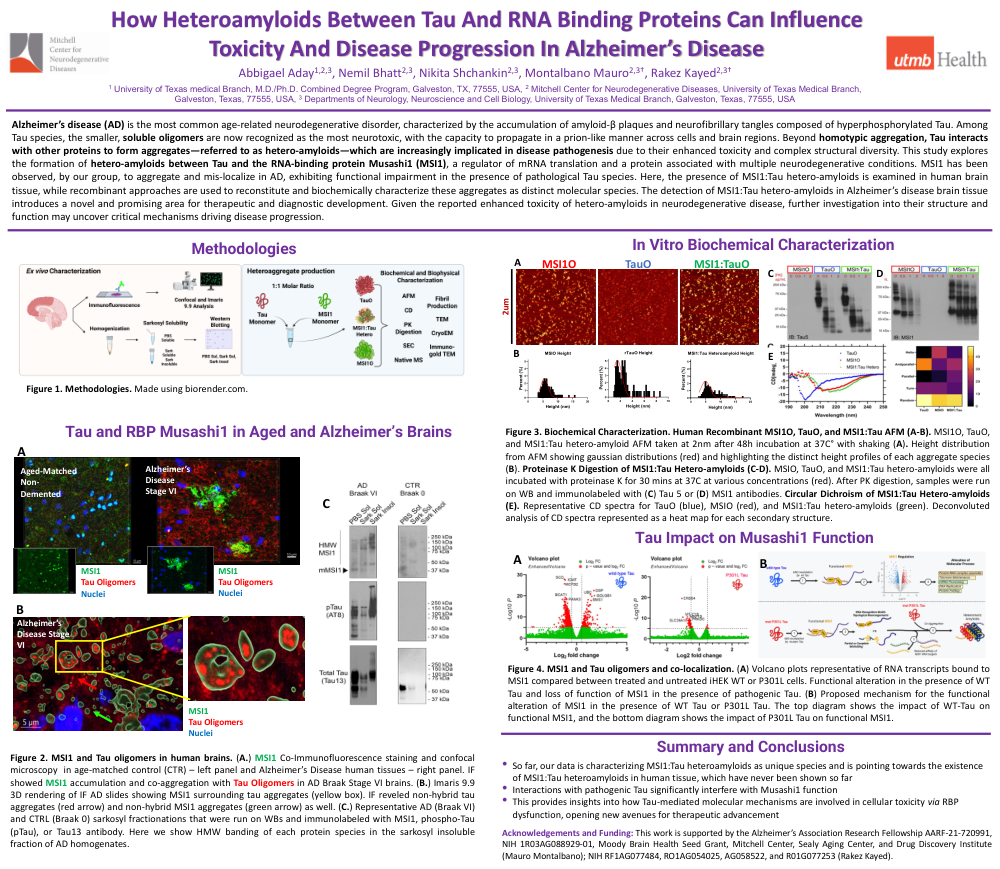
Alzheimer’s disease (AD) is the most common age-related neurodegenerative disorder, characterized by the accumulation of amyloid-β plaques and neurofibrillary tangles composed of hyperphosphorylated Tau. Among Tau species, the smaller, soluble oligomers are now recognized as the most neurotoxic, with the capacity to propagate in a prion-like manner across cells and brain regions. Beyond homotypic aggregation, Tau interacts with other proteins to form aggregates—referred to as hetero-amyloids—which are increasingly implicated in disease pathogenesis due to their enhanced toxicity and complex structural diversity. This study explores the formation of hetero-amyloids between Tau and the RNA-binding protein Musashi1 (MSI1),a regulator of mRNA translation and a protein associated with multiple neurodegenerative conditions. MSI1 has been observed, by our group, to aggregate and mis-localize in AD, exhibiting functional impairment in the presence of pathological Tau species. Here, the presence of MSI1:Tau hetero-amyloids is examined in human brain tissue, while recombinant approaches are used to reconstitute and biochemically characterize these aggregates as distinct molecular species. The detection of MSI1:Tau hetero-amyloids in Alzheimer’s disease brain tissue introduces a novel and promising area for therapeutic and diagnostic development. Given the reported enhanced toxicity of hetero-amyloids in neurodegenerative disease, further investigation into their structure and function may uncover critical mechanisms driving disease progression.
Comments
Email is required but is not shown publicly.
Loading comments...