4,068 posters, 219 videos, 101 topics, 69 sessions, 14,365 authors, 6,128 institutions
ePostersLive by SciGen Technologies S.A. All rights reserved.
Alzheimer's Association International Conference 2026
July 12-15, 2026 | London, United Kingdom, and Online

4436
A Comparison Of Alzheimer’S Disease Neuropathology And Vascular Pathology Between Hispanic And Non-hispanic White Populations
Poster Presenter
Authors
Jose Mojardin Moreno, Kassu Beyene, PhD, Alexandra Paget-Blanc, PhD, Marwan Sabbagh, MD
Affiliations
Barrow Neurological Institute, Phoenix, AZ, USA, Creighton University School of Medicine - Phoenix, AZ, USA, Creighton University School of Medicine - Phoenix, AZ, USA; Barrow Neurological Institute, Phoenix, AZ, USA
Part of Topic
Abstract:
Background: There is some research exploring the differences in mortality, neuropathological,
and vascular pathology data at autopsy between Hispanic and non-Hispanic White (NHWs)
populations in the United States. Yet, it's still relatively unknown how these two populations'
pathological disease burdens vary at a larger scale.
Methods: We used the National Alzheimer's Coordinating Center (NACC) neuropathology
database and compared the prevalence of several different neuropathological signs of
Alzheimer's disease from autopsy between the two groups. The groups were assigned based on
whether the donors self-identified as Hispanic or NHWs. Categories looked at include Thal phase
amyloid, Braak stage for neurofibrillary tangles, neuritic plaques and several vascular
pathologies (infarcts/lacunes, microinfarcts, arteriosclerosis, cerebral amyloid angiopathy,
laminar necrosis, and hemorrhages/microbleeds). There are 33,530 participants who identified
as NHWs and 1,276 participants that identified as Hispanic, for a total of 34,806 participants
whose neuropathological data is available.
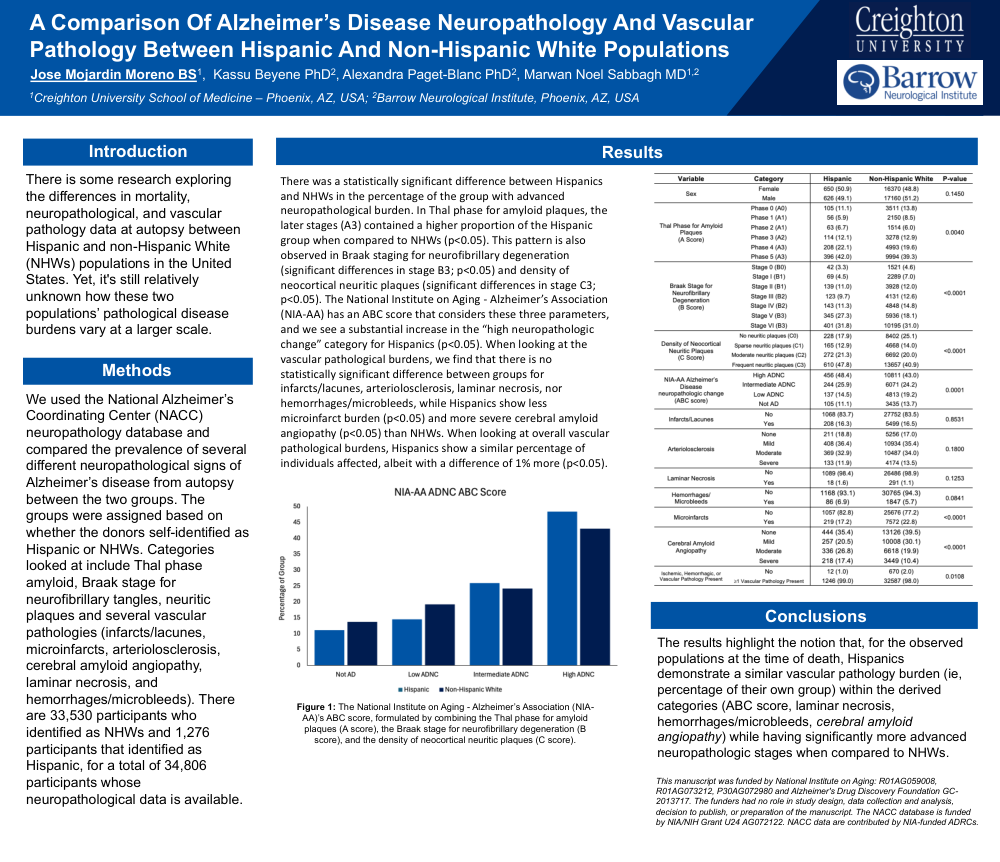
Results: There was a statistically significant difference between Hispanics and NHWs in the
percentage of the group with advanced neuropathological burden. In Thal phase for amyloid
plaques, the later stages (A3) contained a higher proportion of the Hispanic group when
compared to NHWs (p<0.05). This pattern is also observed in Braak staging for neurofibrillary
degeneration (significant differences in stage B3; p<0.05) and density of neocortical neuritic
plaques (significant differences in stage C3; p<0.05). The National Institute on Aging -
Alzheimer's Association (NIA-AA) has an ABC score that considers these three parameters, and
we see a substantial increase in the "high neuropathologic change" category for Hispanics
(p<0.05). When looking at the vascular pathological burdens, we find that there is no statistically
significant difference between groups for infarcts/lacunes, arteriosclerosis, laminar necrosis, nor
hemorrhages/microbleeds, while Hispanics show less microinfarct burden (p<0.05) and more
severe cerebral amyloid angiopathy (p<0.05) than NHWs. When looking at overall vascular
pathological burdens, Hispanics show a similar percentage of individuals affected, albeit with a
difference of 1% more (p<0.05).
Conclusion: The results highlight the notion that, for the observed populations at the time of
death, Hispanics demonstrate a similar vascular pathology burden within the derived categories
while having significantly more advanced neuropathologic stages when compared to NHWs.
Comments
Email is required but is not shown publicly.
Loading comments...