4,068 posters, 219 videos, 101 topics, 69 sessions, 14,365 authors, 6,128 institutions
ePostersLive by SciGen Technologies S.A. All rights reserved.
Alzheimer's Association International Conference 2026
July 12-15, 2026 | London, United Kingdom, and Online

723
Recovery Sleep Enhances Cognitive Abilities and Mitigates Histopathological Alterations in the CA1 Region of Sleep-Deprived Adult Rats by Regulating Inflammatory Pathways
Poster Presenter
Authors
Affiliations
Part of Topic
Recovery Sleep Enhances Cognitive Abilities and Mitigates Histopathological Alterations in the CA1 Region of Sleep-Deprived Adult Rats by Regulating Inflammatory Pathways
Ubong Udeme Ekpo, MSc1, Uduak Emmanuel Umana, PhD1, Abubakar Adamu Sadeeq, PhD1, Sonhap James Sambo, PhD2
1Department of Human Anatomy, Faculty of Basic Medical Sciences, College of Medical Sciences, Ahmadu Bello University, Zaria, Kaduna, Nigeria
2Department of Veterinary Pathology and Microbiology, Faculty of Veterinary Medicine, Ahmadu Bello University, Zaria, Kaduna, Nigeria
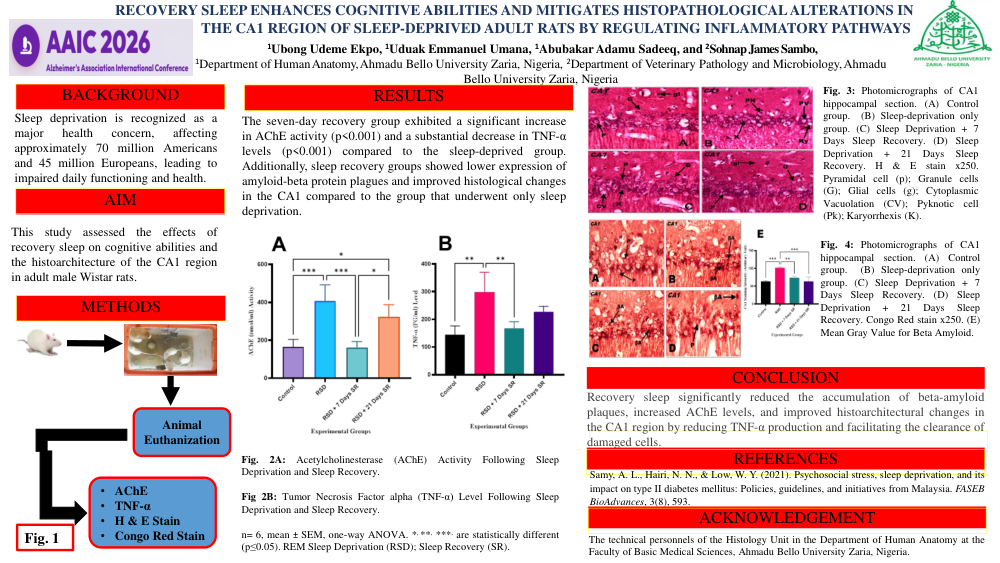
Background: Sleep deprivation is recognized as a major health concern, affecting approximately 70 million Americans and 45 million Europeans, leading to impaired daily functioning and health. This study assessed the effects of recovery sleep on cognitive abilities and the histoarchitecture of the CA1 region in adult male Wistar rats.
Methods: Twenty-four adult male Wistar rats were divided into four groups of six. Group I served as the control and remained in their home cages, while Groups II, III, and IV underwent 24 hours of sleep deprivation daily for five days. After this, Groups III and IV had recovery periods of seven and twenty-one days, respectively, in their home cages. Rats from each group were humanely sacrificed at the end of the experiment. Their brains were harvested and divided into two halves. One half was homogenized to evaluate acetylcholinesterase (AChE) levels related to memory function and Tumor Necrosis Factor alpha (TNF-α) for inflammation, while the other half was reserved for histological analysis.
Results: The seven-day recovery group exhibited a significant increase in AChE activity (p<0.001) and a substantial decrease in TNF-α levels (p<0.001) compared to the sleep-deprived group. Additionally, sleep recovery groups showed lower expression of amyloid-beta protein plagues and improved histological changes in the CA1 compared to the group that underwent only sleep deprivation.
Conclusion: Recovery sleep significantly reduced the accumulation of beta-amyloid plaques, increased AChE levels, and improved histoarchitectural changes in the CA1 region by reducing TNF-α production and facilitating the clearance of damaged cells.
Keywords: Sleep deprivation, recovery sleep, memory abilities, histopathology, amyloid-beta plagues
Comments
Email is required but is not shown publicly.
Loading comments...